Old School. Biblically Independent.
By Chris Revelle | TV | February 6, 2026
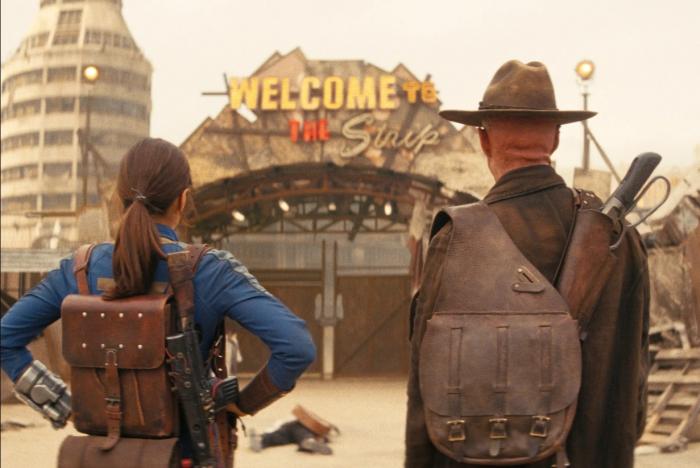
Fallout’s second season finale, “The Strip,” was my favorite episode of the whole series so far. It distilled the Amazon series’ best traits into a lean, mean, wasteland spree that paid off some major emotional arcs while setting up fresh conflict for the third season. The finale did what Fallout does best: threading the needle between fan service for the lovers of the video game series and compelling original plotlines that fit right into the Mad Max-on-laughing-gas world. While the season was a little slow to get going, “The Strip” takes off like a rocket ship and ends with a cliffhanger so good that I will riot if Fallout is not back on my screen ASAP.
The finale saw our favorite Brotherhood Knight, Maximus (Aaron Moten), step up into the hero he’s wanted to be for two seasons. Watching him battle through deathclaws to save Freeside and the rest of New Vegas wasn’t just a satisfying action set-piece; it represented a big development for the character. Max is stronger, more confident, and a proven warrior, without succumbing to the techno-fascism of the Brotherhood. The games have taken different approaches to the Brotherhood of Steel; some portray them as bloodthirsty Templar types, while others portray them as badass action heroes. Fallout wisely splits the difference by allowing Max to become a hero in his own way.
Lucy (Ella Purnell) completed her own transformation in the finale. From the start of season one, she’s been the Pollyanna whose impossibly chipper naïveté clashes hilariously with the ruthless denizens of the Wasteland. As she confronts her father, Hank (Kyle McLachlan), about his grand plans, she realizes that there are limits to seeing the best in everyone when the world is a radioactive pit. She maintains her sense of right and wrong but doesn’t blindly throw her trust around. Hank sheds a little light on the mind-control devices that have been going around this season: he refers to a “real experiment” being done in which surface-dwellers are fit with the devices and sent out into the world to follow mysterious orders that were programmed centuries ago. Hank activates his own device before he can say more, essentially killing himself as his identity is wiped, and all that’s left is a pleasantly smiling husk-person.
Cooper, aka The Ghoul (Walton Goggins), unearths some answers of his own. His search for his family is also an exploration of Fallout’s past and how Vault-Tec doomed the world so they could remake it in their vision. That Vault-Tec is responsible for the apocalypse is a series-only development, but it entirely fits in the service-with-a-smile dystopia Vault-Tec represents in the games. When he reaches the fateful vault where his wife and child are stored, Cooper finds their pods open and empty. Mr. House (Justin Theroux) taunts him, assuming the Ghoul is broken by the discovery, but he’s quite wrong. Cooper is happy for maybe the first time in 200 years because to him, the empty pods represent hope. If they’re empty, it means his family is somewhere out there. The Ghoul sets out for Colorado to search for them with the best pooch in the wastes, Dogmeat, as his only companion.
The only snoozer of the finale is Norm (Moisés Arias), and the intrigue in the Vaults. It’s not nothing; learning that Stephanie (Annabel O’Hagan) is an Enclave agent is a nice bit of spice that opens some intriguing plot possibilities going forward. In the games, the Enclave is a faction of pseudo-science lunatics who seek to purge humanity in some Darwinism-inspired culling so that only “true humans” are left. Norm and friends uncover the Forced Evolutionary Virus, which turns people into Super Mutants like the one played by Ron Perlman earlier in the season, before getting wiped out by giant roaches.
The finale ends with Lucy and Max meeting as Caesar’s Legion and the forces of the New California Republic draw near to battle for control of New Vegas. The game Fallout: New Vegas revolved around the conflict between these two factions and presented them in a mostly agnostic way. The series portrays both groups as flawed, but leans more toward the NCR being the “better” side when compared to the re-enactment power fantasy of the Legion. The self-serious Legion marching to New Vegas to make “Caesar’s Palace” is the perfect Fallout joke; a little dark, a little silly, and absolutely hilarious. I can’t wait to see where this conflict goes in season 3.


