Old School. Biblically Independent.
By Tori Preston | TV | June 2, 2026
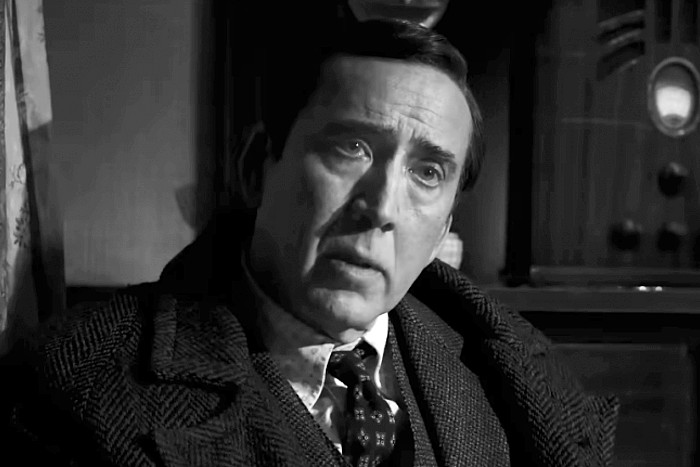
Usually, when a comic book adaptation comes out, websites rush to do some sort of homework explainer, filling in all the references from the source material that casual viewers might have missed. I suppose one could do that for MGM+/Prime Video’s Spider-Noir as well, but it wouldn’t amount to much. This isn’t so much a comic book show as it is a pulpy film noir pastiche in a Marvel skin - or, more accurately, a Nic Cage performance poured into a noir glass with a Marvel floater.
Sure, there are characters in the show that are parallels to figures from the comics, but only loosely. Is lounge-singer/femme fatale Cat Hardy (Li Jun Li, Sinners) based on longtime Spidey-adjacent figure Felicia “Black Cat” Hardy? I mean, barely. At least Flint Marko (Jack Huston) has Sandman powers, but I needed a wiki to tell me Lonnie Lincoln (Abraham Popoola) was supposed to be Tombstone. Brendan Gleeson’s character, Silvermane, could have been any gangster from the comics or none of them, it wouldn’t have made any difference, and ditto Lamorne Morris as journalist Robbie Robertson. It’s like the writers just picked random comic character names out of a hat and applied them to the show to appease the nerds. And that includes Spider-Noir himself.
There is an alternate-universe noir Spider-Man in the comics. He’s a Peter Parker, and he was subsequently included in Spider-Man: Into the Spider-Verse, where he was voiced by Nicolas Cage. But that Spidey ain’t quite this show’s Spidey - or, as showrunner Oren Uziel explained, “Same character, different universe.” Spider-Noir’s Spidey isn’t even called Peter Parker. He’s Ben Reilly (a reference to a Spidey clone from the comics), and other than his webslinging powers, his story bears almost no resemblance to the comics. That’s not a complaint! If anything, it’s a compliment. You don’t need to know a thing about Marvel to pick up what Spider-Noir is putting down. All you need is unwavering faith that Nic Cage really would play the absolute hell out of a middle-aged private eye in the 1930s who occasionally fights crime as a masked vigilante called “The Spider.” Like duh, of course he would.
So if we can set aside the comic book references, how does Spider-Noir fare as an actual noir? Pretty well, actually. The black & white/ saturated True-Hue color gimmick offers stunning results, though I recommend viewing in monochrome. The plot holds up well as a tale of crime and betrayal and muddied agendas, as Reilly juggles multiple cases that all lead him to the same slice of New York City’s underbelly. Someone hires him to track a dame, who ends up meeting with the Mayor, who is at odds with a crime boss, who is looking to hire superpowered goons, and the goons are looking for a cure. The superpowered folks don’t detract from the setting the way I’d feared; “The Spider’ has more in common with radio serial vigilantes like The Shadow than the Peter Parkers we’re familiar with. In fact, the central mystery unravels the source of the superpowers in a way that connects The Spider to the other goons he’s been fighting, while still putting a unique spin on the “bitten by a radioactive spider” origin we’ve seen rehashed so often. Trust me when I say, you’ve never seen a Spidey go Spidey quite like this… with a human/spider hybrid science experiment gone wrong doing the biting.
So Spider-Noir isn’t really for the Marvel fans, and while it’s far more successful as a noir than I’d expected, it’s still just a well-executed homage to the pictures of the era. Where the show really succeeds is simply as a vehicle for Cage himself - and I say this as someone who will defend his Ghost Rider movie to the death while acknowledging he was completely wrong for the part. Maybe Nic Cage is wrong for every part, but it doesn’t matter. He doesn’t transform himself to become the role so much as he transforms each role to be right for him, by finding the dark corners of the part other actors would overlook. He has said his performance as Ben Reilly is “70 percent Humphrey Bogart, and 30 percent Bugs Bunny,” and that tracks. His every choice, every tic, every rage is so unexpected but also so intentional, goofy yet committed and sincere, and Spider-Noir offers a brilliant showcase for his brand of heightened authenticity - one where we are invited to laugh with him, not at him.
That’s the thing, Spider-Noir is genuinely funny. So what if Cage’s stunt double clearly doesn’t match his softer physique? You can’t tell me that wasn’t a choice, to lay the artifice out for all to see! Or how about whenever Ben gets hurt, he lays on his back with his arms and legs in the air, twitching… just like a curled-up spider? Why hasn’t any other Spider-Man media ever taken the conceit that literally before?! The show is fun because Cage is so clearly having a ball with it all, and his joy is infectious. It could have been nothing more than some half-baked vanity project for him, and it still would have been worth watching. The fact that the production and story are worth your time as well is just the cherry on top. Spider-Noir is for the Cage fans, but mostly it’s just for Nic Cage. And I love that for him.


