
Old School. Biblically Independent.
By Nate Parker | TV | June 18, 2024
Minor spoilers follow.
Eric Kripke’s The Boys has always been about the expression and abuses of power. Not just the physical strength and near-invulnerability of Vought’s heroes, but how the corporation controlled these demigods via financial strings, political ties, and psychological manipulation. They held the Supes’ reins for decades before their overconfidence and greed spawned Homelander, whose physical power is offset by his megalomania and brittle psyche. Madelyn Stillwell used a creepy combination of sex and maternal affection to restrain Homelander’s worst impulses. His thirst for public adoration meant Stan Edgar could keep him on a leash as long as the status quo remained. Enter Billy Butcher and the Boys. They throw a spanner in the works of Edgar’s carefully maintained machine, and suddenly, the power dynamics change. Stillwell is dead, Edgar is in prison, and Ashley Barrett is like a substitute teacher with all the responsibility and no authority. Homelander is not only free; he’s in charge.
So why isn’t he happy? He has his Tower, even if it’s still in disrepair. He has his company, though Vought is floundering under Ashley Barrett. He’s hugely popular among the right-wing, conservative, proto-fascist citizens even if the other half of the country hates him and he’s on trial for a public murder. Victoria Neuman is getting closer to the Vice-Presidency and eventually the Oval Office. The Boys, now under MM’s leadership, are struggling to come up with an effective countermeasure to her political ascendancy and floundering in their personal lives. And Billy Butcher, the biggest thorn in Homelander’s side and the one enemy he respects, is months away from death. Despite all that, Homelander is left looking at his graying pubes and wondering what it’s all for.
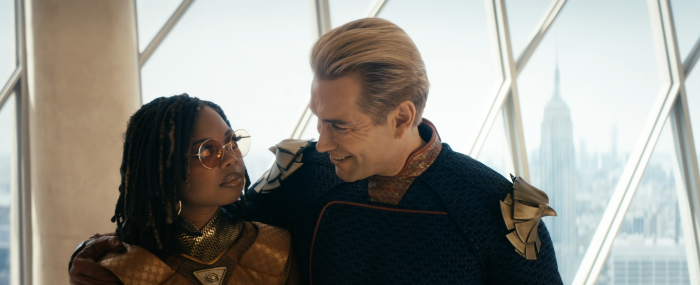
It’s a question he brings to Sister Sage (Susan Heyward), the smartest woman person on the planet. The ennui of being the intellectual peak in any gathering has her steeping in a room of Taco Bell farts and reality television until Homelander offers her the opportunity to put her ideas to the test on a national scale. Homelander has a vision of a world run by Supes, where normal humans are the servants and source of endless amusement. Sage is all in, as is fellow new Seven member Firecracker (Valorie Curry). Starlight’s one-time beauty pageant rival is a conspiracist, political firebrand, and sexy enough to cause many a “hear me out” moment. She gets off on inciting her many (male) followers to violence in the name of higher ratings and social upheaval. The men of the Seven are having a more difficult time of it despite - or perhaps because of - a brutal test of loyalty and gay chicken. The Deep’s having relationship problems. A-Train is struggling with a burgeoning sense of morality. And Black Noir just can’t find his motivation.
Meanwhile, Frenchie’s having relationship troubles that go beyond the will they/won’t they dynamics he has with Kimiko, and it’s threatening his sobriety. Kimiko is refusing to deal with her past trauma at the hands of the Shining Light terrorist group, and it’s turning her into a hot mess. MM, who needs to eat a sandwich, has mostly reconciled with his ex, and it’s her request that he find out what happened to Todd that clues them into Sage’s strategy. Annie wants to leave Starlight behind, but that’s difficult when you’re an inspiration to millions. Hughie, finally, has his sh** together. He’s being supportive to the team and his girlfriend and, apart from some parental drama, seems to finally be moving past his whole… thing.

Butcher, unfortunately, isn’t looking so hot. His brains keep leaking out his ears. There’s something… wriggly… in there. And he’s talking to hallucinations of his dead wife and a CIA agent named Kessler who may or may not be real. The jury’s still out. But with only months to live, he’s desperate to reconnect with Ryan, who, not being a complete monster, has deep misgivings about Homelander’s view of normal humans like his mother. There are several budding redemption arcs happening at once, and that’s good, because things aren’t looking too good for society as a whole. The country is polarized right down political lines, and violence looms at every protest. Thank god it’s all fiction, right?
Eric Kripke was never subtle about who Homelander is. Through all the violence, gore, social commentary, and humor — and this season’s already had multiple gut-buster moments — Homelander remains the same petulant man-child he’s always been. Riddled with insecurity and self-loathing, Homelander hates both himself and the terrified yes-men with whom he’s surrounded himself. He despises the culture of fear he’s created but can’t get out of it on his own. The closest he comes to true self-awareness is when he brings on Sister Sage, but even knowing she’s exponentially more intelligent than himself, he can’t help but sabotage her efforts on his behalf. He’s as self-destructive as ever and becoming a threat to the son he thinks he wants because their worldviews are diametrically opposed. He’s not much different than James Gunn’s Brandon Breyer or Rod Serling’s Anthony Fremont, oddities whose emotional stunting was caused by their omnipotence. Homelander is so powerful he can’t understand the ramifications of his own power, and doesn’t care to.
It’s why Homelander is so popular among Trumper men. Eric Kripke has spent four seasons holding a mirror up to MAGA culture and said, “This is who you are. This is the unthinking carnage created when you lie about migrants, trans people, and pizza parlors. This is the violence committed when you’re obsessed with feeling tough instead of being tough. It’s what happens when you wave guns and kill randomly at the slightest provocation.” And he’s very good at it. It’s not subtle, but neither is the reality Kripke skewers. The problem is that part of the audience already knows who they are. It’s not that they’re ignorant of the consequences. It’s that their real fantasy, the real draw, is that the consequences of exercising power don’t apply to them. There is no validation without conflict. Without society trying to punish them for being an outspoken bigot or shooting unarmed teenagers there’s no point, because there won’t be anyone leaping to their defense. They can’t be shamed because there are millions of men who are just like them. It’s #MeToo for belligerent morons.
But just because they’re incapable of embarrassment doesn’t mean we can’t enjoy Kripke et al skewering the Right at every opportunity. The Boys remains as funny and squick-inducing as ever. The Supernatural reunion continues with Rob “Chuck” Benedict, who makes multiple appearances in a single episode, and Jim Beaver is back on our screens. Now all we need is Jared Padalecki and Misha Collins to show up and get brutally slaughtered. The first three episodes are on Prime now and well worth your time.


