Old School. Biblically Independent.
By Kaleena Rivera | TV | October 14, 2026
East of Eden was released nearly two weeks ago, and it’s hard to imagine any other show sliding in over the few remaining months as a possible nominee for “Best Show of the Year.’ I’d welcome anyone to try, but the odds of any streamer releasing a show with the richness and depth of writer Zoe Kazan’s sweeping adaptation (along with co-showrunner Jeb Stuart) of John Steinbeck’s magnum opus before year’s end is exceedingly unlikely. It’s a big story that asks some big questions, least of which is how much free will impacts our lives. Even for those who aren’t as utterly bowled away as I am, East of Eden will certainly make it on all the year’s major top ten lists. It’ll be richly deserved.
Grand in its historic and human scope, the story follows the fictional Trask family as they live through the unsteady years following the Civil War through the dark period of World War I. Led by patriarch and veteran Cyrus (Tracy Letts), whose near obsession with the war is only matched by his effort to relentlessly model his young sons, Charles and Adam (teenaged versions played by Tom Sweet and Costa D’Angelo, respectively), into soldiers. Fatherly approval is strategically rationed, which ensures that both boys, despite their mutual affection, are also in opposition to one another. The biblical story of Cain and Abel is writ large throughout East of Eden, echoing even decades later when the focus shifts to another pair of brothers; what better way for Steinbeck to demonstrate the power of free will than to use two people with the same upbringing as fictional case studies?
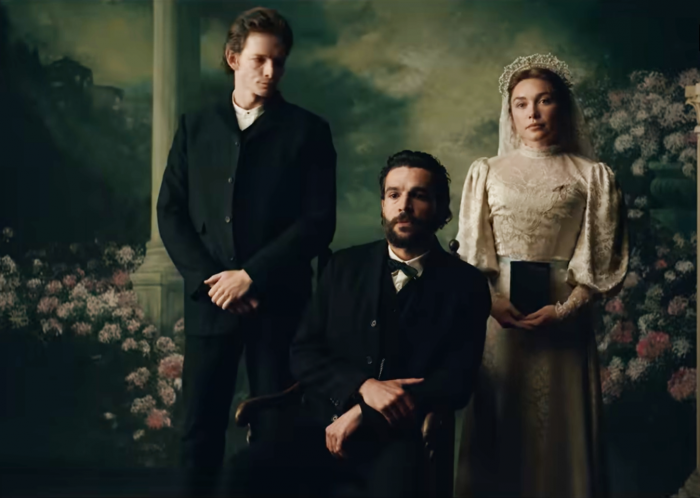
The adolescent brothers part ways bitterly before reuniting a decade later. The now-adult versions of Adam (Christopher Abbott) and Charles (Mike Faist) work to improve the family farm and debate over what to do with the large (and ill-gotten) fortune their now-deceased father has left behind. That’s until an even bigger problem winds up on their literal doorstep.
This is where trouble starts. Because that “problem” happens to be a young woman named Cathy (Florence Pugh) who appears one night, bloodied and vulnerable. We soon learn that she’s not nearly as vulnerable as she appears. All too predictably, Adam becomes the besotted savior, but Charles is far less trusting, a hunch owed in part to his own malicious inclinations, or, as he informs her, “kind recognizes kind.”
You don’t know the half of it, sir. While I’m all-too aware of just how inclined society is to paint trapped, desperate women with an unflattering brush, Cathy is a viper through and through. There’s no mystery to tease here, either; the second episode is a flashback dedicated to Cathy’s origin as a teenage girl who leaves broken hearts (and eventually bodies) in her wake before taking up the world’s oldest profession. Seeing as how that was one of the only viable options for a woman to earn money on her own (Cathy: “The only true freedom in this world is economic freedom”), it’s a living that defies modern day judgment, but the means with which she ascends to a property-owning madam is a horrific gothic tale that would cause anyone from any time period to shudder. Pugh dazzles here as a woman whose early tragedy laid the foundation for her dark outlook on life, but her choice to see the world as only being horrible, to the point of justifying her own abhorrent actions, is a belief of her own making.
Every character, however, is subjected to the question of free will versus what is deemed as innate qualities. Though the series essentially orbits around Cathy, that central body is held up by the fractured family she left behind. After the recently wedded Adam and Cathy make it to California, she extricates herself from their marital arrangement in the most decisive way possible (Chekov’s gun bears out yet again). Adam spends the next decade nursing a broken heart, paying minimal attention to the twin boys their marriage produced. Abbott uses his puppy dog eyes to great effect here, as a man helplessly in love and incapable of moving on from the betrayal despite the explicit warning. His willingness to delude himself is directly addressed later—as is his inability to listen, which is brought up on numerous occasions—during a long-awaited confrontation with Cathy, breaking the spell of self-pity that held Adam in control for so long.
If Adam has any sort of counter, it’s Lee (Hoon Lee, whose performance has made him an instant lock for next award season), the Chinese American domestic worker who becomes the heart of the series. Lee is a man in possession of a scholarly mind in an intolerant country that limits him in every conceivable way due to his race, from his personal and professional life prospects to the speaking voice and limited English vocabulary he feigns for visitors. As the source for much of the show’s philosophical bent (along with Ciarán Hinds, to a lesser extent) and opposition for the fatalistic tendencies that the Trasks are so often drawn towards, it’s Lee who gives voice to the concept of “timshel,” the ability for a person to choose a life of good over evil in spite of their past. It’s also the key to understanding that generational curses are almost entirely self-inflicted, and the means in which the remaining Trask descendants can find peace at last.
East of Eden is rich in its profundity and storytelling prowess. It does sag in its final episodes, especially when the focus is on the twins, Cal (Joseph Zada) and Aron (Joe Anders), one of the few times the show’s afflicted with an energetic inertia despite its narrative utility. Nevertheless, it’s a gorgeous show that honors the themes found throughout Steinbeck’s novel. As both an adaptation and series, it’s very nearly perfect, which, funny enough, is a sentiment that the novel’s themes would themselves refute. To paraphrase Lee, “now that you don’t have to be perfect, you can be good.”
All seven episodes of East of Eden is streaming on Netflix.
Kaleena Rivera is the TV Editor for Pajiba.


