
Old School. Biblically Independent.
By Chris Revelle | TV | August 25, 2025
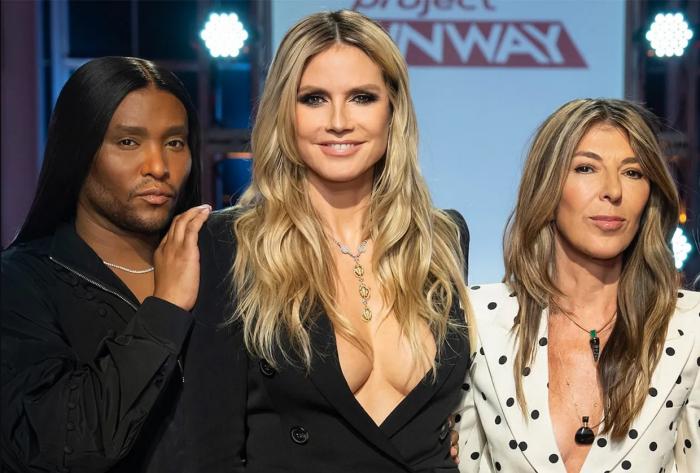
Project Runway first premiered in 2004, not just another time, but a different reality. The Bravo it aired on was not the Housewives-driven circus it is today. Like its younger sibling, Top Chef, Project Runway based its competition around actual skills and tapped experts in the fashion field to judge the designer hopefuls. Over its 21 seasons, its move to Lifetime and then back to Bravo, the spin-offs, the revivals, and reimaginings, the series has tinkered with its formula. Some seasons cast big personalities in the hopes that they would generate more drama for the camera. Some seasons leaned into team challenges, others swapped out hosts and mentors. This new season, on the Disney-owned Freeform and Hulu, mixes up its own take on the Project Runway cocktail, restoring some old favorites while introducing some new ingredients. So, how does this new incarnation of the reality competition standby fare?
Let’s start with something positive: Heidi Klum is back! The grinning German über-model and her unbridled love of the loudest clothes available has returned! In Project Runway’s juggernaut heyday, Heidi’s “auf wiedersehen” was the chirping axe-blade that sent many a designer-hopeful home. She’s a major part of what makes Project Runway feel like itself.
In a more just world, her dream teammate, Tim Gunn, would be standing with her, but alas, we live in the most cursed timeline. For some reason, Disney didn’t see fit to invite Gunn back, despite him being the near-magical mentor par excellence of the workroom. Whichever executive decided they didn’t need Gunn is a Zazlav-level fool. Christian Siriano is a great mentor, both as an accomplished designer in his own right and as a former contestant on the show. He’s performed the ‘Tim role’ for the past several Project Runway seasons with his own unsparing, forthright style, but Gunn is sorely missed. Bringing back Heidi feels like a call back to the series’ roots, but it’s a half-measure without Tim Gunn’s gentle, teacherly presence.
There is also the issue of run-time. Past Project Runway episodes would run anywhere from an hour and change to a full 90 minutes, which meant that viewers got in-depth looks at the designing process, the styling, the hair and make-up choices, and all the rounds of feedback and revision the designers would go through to produce their looks. There’d be extended sequences of judges discussing the clothes in detail and of the designers during downtime, when they’d share about themselves. In its newest form, Project Runway episodes run for 1 hour with commercials, which puts the amount of actual content in the neighborhood of 40-42 minutes. So much of the tasty, interesting detail gets lost. There’s simply no time for many mentor check-ins or judge comments longer than a few moments. Viewers barely get to see any of the styling decisions or the designers’ thought process. I really miss this level of detail because it gave greater understanding, stakes, and depth to the viewing experience.
The Project Runway revival has also taken an unfortunate turn for the senselessly mean. Nina Garcia and her gloriously sharp tongue have returned to hold the designers to account, and mega-famous stylist Law Roach has joined the judging panel as well. This is a smart move; Garcia is another classic presence of the series, and Roach is a huge get as a stylist with a famously adventurous eye. They clash in entertaining ways. Sadly, Project Runway seems overexcited by Roach, so much so that one episode’s judging was done by him alone. He obliged with delicious dragging, but it felt like a particularly sweaty attempt to generate meme-able drama. Shutting out the rest of the judging panel makes the series feel confused and lopsided.
A similar instinct seemed to motivate the decision to leave the fourth episode’s elimination up to the designers. In that episode, the judges designated their top and bottom three. When it came time to eliminate someone, the designers were made to vote on who would go. The resulting speeches and tears, with some designers playing along and others refusing, were not particularly entertaining. It felt perfunctory, like Project Runway was trying too hard to mimic current-day reality competition smashes like Traitors. Stoking designer-on-designer melodrama out of nowhere feels off-brand and ill-fitting for the series. Shows like Traitors are built around these kinds of interactions, but Project Runway is centered on the designers competing against one another in tests of skill. It feels like a reach to suddenly make the contestants vote each other off the show when the rest of the series doesn’t have anything to do with that.
Project Runway is a reality show, and that means it will not always be about the designs and the clothes. Even at its most fashion-focused, the series regularly slapped unrealistically short time frames on its challenges to amp up the drama. That’s entirely understandable, but it’s still frustrating to see so much of the series’ energy go towards creating cheap, unengaging conflict for the cameras, especially at the cost of the nitty-gritty details that set the series apart from the crowd. In the balance, Project Runway is still a lot of fun to watch, but with Tim missing in action and the focus on drama, the calories feel emptier than ever.


