Old School. Biblically Independent.
By Kayleigh Donaldson | Film | September 15, 2026
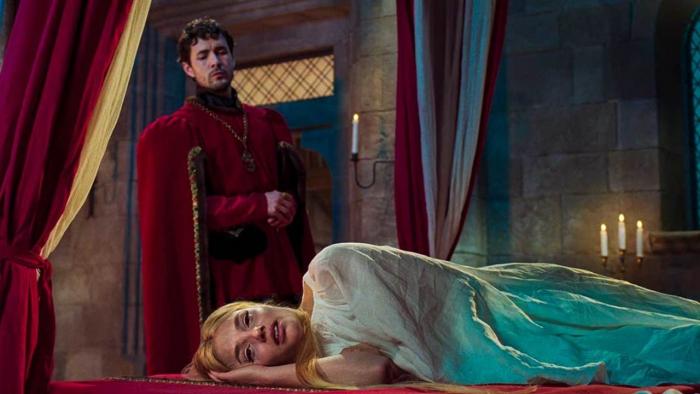
Eleanor (Kristine Froseth) is a naive beauty who thinks she has found her one true love in the form of Edward (Jonah Hauer-King), a gallant knight with a loyal squire. Sure, he all but blackmailed her into marrying him, but that’s just the way things are for women in this age. And yes, he murdered her father and robbed his corpse, but she doesn’t know that. Love is complicated, and with Edward losing interest and Eleanor worried she’s losing her looks, the path to happy-ever-after is rougher than ever. Just don’t worry about the other woman on the scene. Tis a tale of dashing knights, courtly love, hypocritical beauty standards, the vicious cycle of toxic masculinity, and lute solos. You know, the classics, albeit through the lens of Anna Biller.
A decade on from her indie hit The Love Witch, Biller returns with an adaptation of the Kabuki play Yotsuya Kaiden, transported to the Medieval England of Roger Corman’s Poe movies. It’s only her third feature, but Biller has quickly established her own approach that feels deliciously unique in the crowded market of pop culture. Her recreations of old-school cinema, from Hammer horror to Russ Meyer, Hollywood melodrama, and the aforementioned Corman, are uncannily precise in tone and aesthetic. Yet she retains a do-it-yourself nerdy quality that is earnest even when she dabbles in genre pastiche. It is high-low art of the best kind, made all the more intriguing by her inclusion of feminist critique into the tropes and types that often reduced women to props. With The Face of Horror, she has a lot of questions to ask, even when her tongue is planted firmly between her cheeks.
The devil really is in the details, and it’s clear that Biller, who is credited as director, writer, producer, costume designer, and songwriter, that she has done her homework. The mannered acting, heightened but avoiding pantomime, feels like it could have come straight from a ’60s B-movie. The costumes, particularly the ladies’ gowns, are elegant but transparently polyester, reminiscent of one of the shoddier Hammer Dracula movies. Even the wigs have the sheen of artificial hair that could go up in flames with one unexpected spark. The fakeness is the point. Realism has no place in Biller’s worlds, at least not aesthetically. For Eleanor, and the other ladies of The Face of Horror, looking the part is an issue of survival.
“My face and my figure are my fortune,” Eleanor says, and it’s unfortunately true. Her chauvinist loser of a husband starts to lose interest in her once she’s had a child, and a persistent cough leaves her looking well, pretty much as gorgeous as ever but with dark bags under her eyes. It’s a parody of the sick heroine of cinema, one who is close to death but still looks as though she’s lit by the glow of angels. Speaking of glow, the vibrancy of The Face of Horror is invigorating. Inspired by Technicolour and the fevered shades of Powell and Pressburger, the film is borderline lurid in its cinematography. It’s equally matched by costume and production design that seem allergic to the mere notion of beige. Altogether, it presents the key theme of gender as a ridiculous performance: women must make themselves pretty (but not too much lest they be accused of fraud), while men are forever drenched in the blood spilled by their macho fury.
The essentialism of it all has fuelled decades of stories, including the ones that inspired Biller. It doesn’t take much to reveal the psychosexual furore beneath the painted surface, and boy is there a lot to reveal: the politics of beauty, the misery of marriage, the brutality of toxic masculinity, the hypocrisy of the church and state, and the inescapability of death, to name but a few. Biller remains as ambitious as ever, and all while stridently committed to her pinpoint-precise recreation of a bygone era of storytelling. You cannot dismiss her commitment to the bit, although at two hours long, it comes close to outstaying its welcome. What prevents it from becoming repetitive is the propulsion of the story, one that has been adapted countless times in Japan, and the pure energy of these very game actors. Many filmmakers dabble in bursts of nostalgia as a kind of storytelling cheat code, a way to pander to audiences without doing much work. Biller expects you to do the work she’s done, and for those who do, the rewards are immense.
The Face of Horror had its world premiere at the 2026 Toronto International Film Festival. It currently does not have a release date.


