Old School. Biblically Independent.
By Kayleigh Donaldson | Film | August 7, 2025
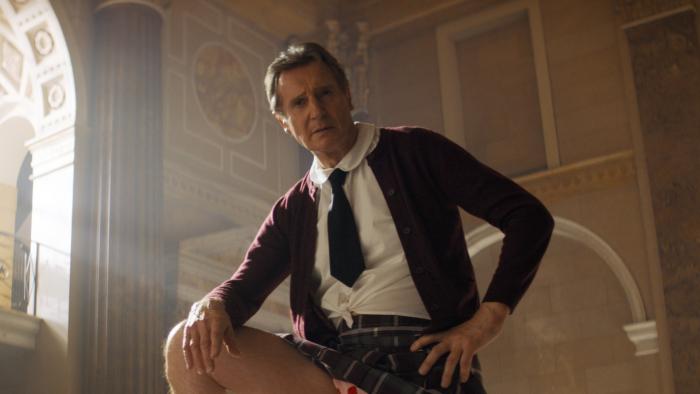
To the surprise of many, the 2025 legacy sequel-slash-reboot of The Naked Gun is pretty damn good. Audiences and critics alike were sceptical about yet another comedy reboot, especially for a legendary comedy that felt so of its time. Yet Akiva Schaffer’s smartly stupid revival of the antics of Police Squad is genuinely hilarious, as I discussed in my review here. It’s a laugh-a-second romp where everything is thrown at the wall and no joke is too dumb (I will forever think of the snowman moment with the nostalgic fondness that some people reserve for their offspring.) The movie has inspired a lot of talk over whether or not it will revive the big studio comedy at the box office, but there’s also the question of whether or not it can bring back an oft-derided subgenre of comedy: the spoof movie. With the latter, my answer is ‘no’ for one simple reason: The Naked Gun (2025) is not a spoof movie.
That feels like a weird thing to say about a movie that is a sequel to one of the most iconic and influential spoof movies ever made, but it’s true. Schaffer and his writers understood that the only way this film would work would be if it weren’t hyper-focused on parodying a genre. Spoofs aren’t dead, but the expectations and rules are very different from what they once were.
The Naked Gun was a spin-off of the one-season ABC comedy Police Squad!, the brainchild of the comedy trio Zucker, Abrahams, and Zucker. They met in high school and collaborated for the first time in the 1970s on the frenetic sketch comedy film The Kentucky Fried Movie. That was a hit, but it was small fry compared to the mega-success of Airplane! The 1980 spoof of the disaster genre made so much money, landed them Golden Globe and BAFTA nominations, and almost immediately became known as one of the greatest comedies ever made.
Parody films have been around for almost as long as cinema, with the Marx brothers, Abbott and Costello, and Mel Brooks all making spoofs that helped to define the movie comedy. But the ZAZ trio became defined by the spoof thanks to their ability to get as many jokes as possible into every scene. If one joke doesn’t work, then don’t sweat it because another will be here in 2.4 seconds. Their work was also specific in its parodying of various genres. Airplane! is still hilarious if you don’t know all the stuff it’s mocking, but the layers added to your experience when you do are potent. The same goes for the entire Police Squad!/Naked Gun world and their underrated spy parody that’s also, weirdly, a piss take of Elvis movies, Top Secret.
The ’80s saw a huge increase in parody movies getting major releases, which spilled over into the ’90s with titles like Don’t Be a Menace to South Central While Drinking Your Juice in the Hood and the Austin Powers series. Trey Parker and Matt Stone got their start with Cannibal! The Musical and Mel Brooks was still at it with Robin Hood: Men in Tights.
A major change came in 2000 with Scary Movie, the Wayans brothers’ brash and proudly vulgar parody of the previous decade’s rise of teen-oriented horror movies. Scary Movie was spot on in so many jokes, finding sharp and weird new angles to the already self-aware works of Wes Craven. Other jokes, like references to Budweiser ads and bullet time, flop but it felt in line with the ZAZ ethos: anything for a joke. That does mean that many of the jokes are sexist, homophobic, and just kind of gross. Good taste was not for sale. A few sequels followed, including one by Abrahams and one by Zucker.
The 2000s and 2010s were not bereft of great spoofs — see Shaun of the Dead, Kung Fu Hustle, and the paradigm-shifting Walk Hard. But admit it, when you think of spoof movies from this era, you think of the hellscape of Friedberg and Seltzer. Films (can they even legally be classified as such?) like Date Movie, Epic Movie, and Disaster Movie were the epitome of lowest common denominator slop. They also, crucially, weren’t really parodies. Showing a recognisable thing, then making a statement about it before crushing said thing with a larger thing is not spoofing it. These films were just scene after scene of references and self-descriptors, and maybe a fart joke or 16. You could walk out of any of these movies and not know a dang thing about the narratives they were allegedly riffing on.
The Friedberg and Seltzer massacre of the spoof film led to some of the worst movies ever made, as well as a redefining of the very subgenre they claimed to inhabit. Mel Brooks once famously said that the best parodies were made by people who loved the thing they were mocking, and you certainly didn’t get the sense that this era of spoof was anything other than an act of contempt.
I wonder if Akiva Schaffer was thinking of that Brooks ethos when he made The Naked Gun. It’s not that Schaffer was incapable of doing a spoof. He’s one of the brains behind Popstar: Never Stop Never Stopping, a devastatingly hilarious parody of modern pop music and fame that stands tall as one of the great parody comedies of the millennium so far. But that film had relatively low stakes with its targets. Making a spoof of cops and their associated pop culture depictions in 2025? That’s a stickier issue. When The Naked Gun does showy parody moments, it’s of Liam Neeson’s action shtick and not modern cop stories. The handful of police officer gags we get feel like they’d be at home in the original movies.
You could do a spoof of modern cop movies and TV shows, but it would have to be way darker than what The Naked Gun and its ilk represent. There are a couple of very bleak laughs in the movie about the prevalence of police brutality and how it mostly impacts non-white people, but there’s no way you could make a silly and carefree parody of this stuff in 2025. Danny McBride could make this, and so could Boots Riley, but it’d be pitch-black and unmarketable to anyone except their devotees. The tonal dissonance that would be created from back-to-back scenes of Frank Drebin doing a pratfall and then murdering a civilian in cold blood with no repercussions would leave behind a crater the size of Police Squad HQ.
This is why The Naked Gun works. It’s shaken off the weight of the subgenre and its predecessors’ own falters, and gone for machine gun-speediness and maximum efficiency of pure gag delivery. It’s uncomplicated in its desire to elicit as many laughs as possible from its audience. That’s a hell of a lot easier to do when you’re not forced to confront the realities of copaganda.


