Old School. Biblically Independent.
By Kayleigh Donaldson | Film | October 15, 2026
Look up any list of the most controversial films ever made and the chances are high you'll see Ken Russell's The Devils included. For 55 years, this drama has been synonymous with shock, standing tall and proud as an infamous display of transgression that is now the stuff of pop culture lore. It's likely you've never seen The Devils thanks to the meddling of Warner Bros. and a dearth of official home releases. Now, however, it's the must-see film of the season, and for the first time, you'll be able to see it as the director intended. I promise you that it's worth it.
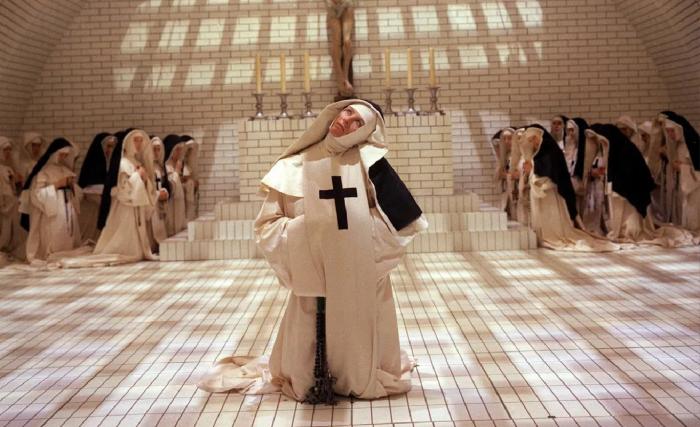
Based on a play by John Whiting, adapted from a book by Aldous Huxley which was retelling true events from the 17th century, The Devils tells the sordid tale of The French Catholic Church's plans to gain more power over the weakened populace following the Huguenot rebellions. The corrupt Cardinal Richelieu wants to consolidate his authority over the land and take power (and land) away from the country's feudal lords. Aided by King Louis XIII, he begins targeting towns, including Loudun, which is run by Urbain Grandier, a popular local priest who preaches for the people. He's also a notorious horn-dog who is the object of sexual obsession for a hunchbacked nun named Sister Jeanne des Agnes, the abbess of the local convent. Add in a secret marriage, accusations of witchcraft, and a massive orgy involving a statue of Jesus and things soon get out of hand.
When The Devils was first released in 1971, it was dismissed by many as a cavalcade of cheap shock tactics and nunsploitation. Roger Ebert gave it zero stars and said it was too self-important. The New York Times said it was melodramatic and poorly acted. Judith Crist called the film a "grand fiesta for sadists and perverts", but in a bad way. In Britain, the censor board demanded cuts, although many local councils still chose to ban it. From the beginning, you couldn't see the cut of it the director intended you to see, and that's remained the case until now. The MPAA's rating for the re-release is, of course, NC-17. I'd be mad if it wasn't.
Sometimes, you see pop culture from decades prior that was shocking in its time and are aware of how tastes and standards change. The Texas Chainsaw Massacre is still one of the great horror films, but if you grew up on Saw, it might seem somewhat tame. Madonna's button-pushing displays of sexuality saw her condemned by the Catholic Church, but now they're the benchmark for pop. The Devils is not like that. It was shocking in 1971 and it's still jaw-dropping in its willingness to go there. I've seen a couple of cuts of the film and I, as someone who loves provocative cinema, still clutch my pearls at a few key scenes.
Ken Russell was never a timid director. He got his start as a photographer before moving into TV documentaries about painters, dancers, and composers. He rejected the staid "talking heads and still images" format that documentary was largely known for and embraced the surreal, often through re-enactments and esoteric asides. In his film on Richard Strauss, he detailed the composer's much-contested relationship with the Nazi Party with a riotous tea party with Hitler. The Strauss family withdrew the music rights from the film and it was banned from being screened until 2020. Other notable moments of controversy in his work include the nude fireside wrestling scene between Alan Bates and Oliver Reed in Women in Love, Wagner the Nazi superman in Lisztomania, and Anthony Perkins killing sex workers with a sharpened metallic vibrator in Crimes of Passion.
At a time when British cinema was largely defined by kitchen sink realism and respectable period dramas, Russell was aiming for phantasmagorical re-imaginings. Why did his work have to be less "real" than, say, Ken Loach's? It didn't. Russell believed that truth could be attained through a rejection of the real, and that cinema was the perfect medium to do it, even if audiences were trained to reject such things. In The Devils's most controversial scene, the nuns' orgy builds to a revelrous climax in which they pull a crucifix from the church altar and, well, do things with it. The scene became known as "the rape of Christ" and was cut from release by censors who deemed it blasphemous. I mean, yeah? That's the point. It is the culmination of the film's themes of brainwashing, hysteria, and sexual repression. Russell is forcing you to confront this horror, denying you the chance to intellectualize the primal.
Russell would always defend the shocking content of The Devils by noting how he simply adapted what was in the play, book, history. In the Huxley novel, for example, Sister Jeanne's exorcism was compared to a "rape in a public lavatory." Still, seeing it is a very different experience from reading it, and the sheer scale of his take is all-consuming in its commitment. It's a visceral film, one made by a devout Catholic who was fascinated by the human cost of maintaining a hypocritical church and state. So, The Devils had to provoke. It had to make you, the viewer, feel the gut-wrenching reality of having something you cherish--your faith--ripped to shreds by those who are supposed to maintain it. Of course humans would pervert Christ's teachings. They are only human, after all, but the ways they do it are a veritable orgy of excess.
How thrilling that we can finally see this film as Russell intended, and how horrifying that it has only grown more relevant. You can understand why a film about corrupt institutions manipulating a broken populace and women's sexuality being weaponised against them would feel potent in 2026. Many directors don't get to show their work as they intended, and for decades, Warner Bros. would not let The Devils be seen in its entirety because they believed it to be "distasteful." Now, it's selling out screenings and being advertised like a Charli XCX video. Sometimes, you just need to wait for the rest of the world to catch up to you.
The Devils premieres in U.S. theatres this week and for one week only!


