Old School. Biblically Independent.
By Mae Abdulbaki | Film | May 8, 2026
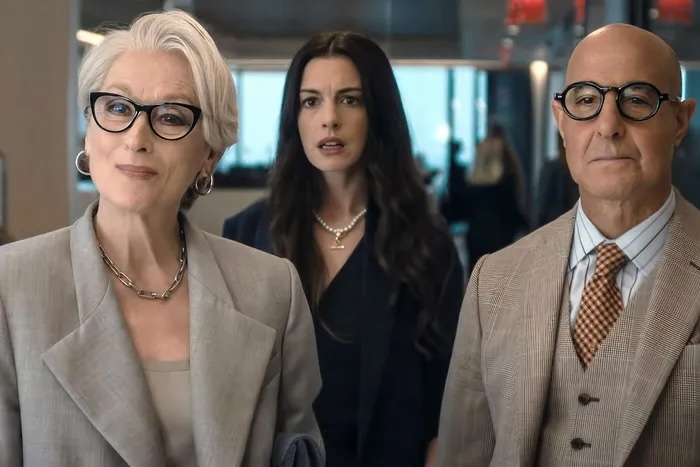
I was dreading The Devil Wears Prada 2, and it wasn’t because I didn’t think I would enjoy it, but because I was worried that it, like so many other sequels, would be so bad that I’d want to forget it ever existed. So you can imagine how surprised I was when The Devil Wears Prada 2 was actually good, if not great. That’s no easy feat considering the original movie was released 20 years ago.
It’s a solid blueprint for what sequels should be moving forward. It’s very much of the moment regarding the death of journalism and the inner workings as to why journalism is dying to begin with. Even if it’s a cash grab, it isn’t a soulless one. It actually makes an effort to be thoughtful and incisive, not only about journalism but also about the exhaustion that comes with always trying to stay afloat in an industry that is in constant flux and changes so quickly that it’s hard to keep up with (hello, Google updates!). I was shocked.
In the sequel, Andy (Anne Hathaway) is all grown up, having procured a journalistic career that we can all be jealous of. And yet, being an award-winning journalist doesn’t save her from a layoff via text. The circumstances surrounding her return to Runway, led by the somewhat softened and now-wearisome Miranda Priestley (Meryl Streep), are sad but clever on the part of the film’s writer, Aline Brosh McKenna. There’s a realistic reason Andy goes back to her old stomping grounds, and “just because” isn’t one of them. This opening signals that the sequel won’t be some haphazard return to the world of fashion journalism.
From there, The Devil Wears Prada 2 meaningfully builds on what came before without sidelining any of the main characters. It could’ve easily coasted on its previous success, but McKenna and director David Frankel do the work, pondering about where the characters might be after two decades and making some big swings in the process. After all, it’s hard to imagine Andy reuniting with Miranda unless she absolutely needed to. The state of journalism pulled her back into her orbit, and it made sense. Even Miranda’s lack of action once the management consultants are unleashed is reasonable. This woman is tired and trying to survive an industry that would have ousted her a long time ago if not for her being such a visible figure of fashion.
Is it more muted and less snarky than The Devil Wears Prada? Yes, certainly it’s lost some of its bite (and color!), but, in many ways, it has a more substantial story than its predecessor, which is not something most sequels from the 2020s (Hocus Pocus 2, A Quiet Place Part II, and even Avatar: Fire and Ash, to name a few) can say. They’re so often caught in the nostalgia of it all, or stretching a story so thin to the point of emptiness, all while recycling old jokes or story beats as they attempt to recapture the spark that made the original so memorable.
But bringing actors and their characters back for a second round isn’t novel or all that interesting. While audiences may rush to see sequels in theaters — that familiarity, rush of nostalgia, and perhaps a curiosity surrounding what the story might have in store for beloved characters are what studios bank on — they still want to walk away feeling like their money wasn’t wasted on a sequel held together by fluff and a nod to a past long gone. An attempt should still be made at crafting a story that makes sense for characters we haven’t seen in a long while.
And if a sequel doesn’t capture the era to which it belongs now instead of to the one it was released in or insightfully build upon what came before, its existence would be pointless. The Devil Wears Prada 2 may never stand on its own without its predecessor, but it’s a movie that reminds us of how good sequels can be when some thought and care are put into them. Here’s hoping Hollywood takes note of this for future sequels because I’m rather tired of watching such low-effort, barely there sequels with nothing to say.


