
Old School. Biblically Independent.
By Lisa Laman | Film | February 11, 2025
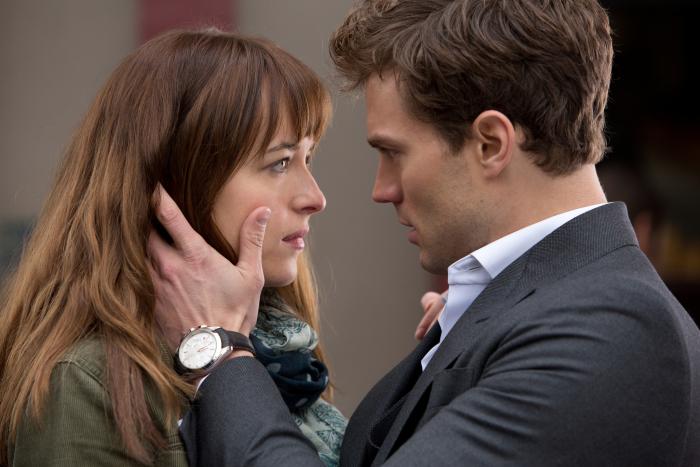
Normally, Hollywood can’t wait to mimic a big box office hit. If another studio takes a “risk” on something a little challenging and it succeeds, everybody else lines up to make the next Deadpool, Saw, Bridget Jones’s Diary, or other sleeper hits. One would’ve thought that, once Fifty Shades of Grey took off at the box office ten years ago, then the theatrical landscape would’ve been dominated by knock-offs.
After all, Twilight birthed Beastly, Beautiful Creatures, and The Host, The Hunger Games gave us Divergent, The Maze Runner, and The 5th Wave. We’d be here all day listing all the fantasy family movies Harry Potter’s film adaptations inspired. Surely Fifty Shades of Grey had the same impact. But a funny thing about after Anastasia Steele and Christian Grey topped the box office. It didn’t really spawn imitators. Why was this the rare sleeper box office hit Hollywood suddenly proved sheepish about imitating?
Fifty Shades of Grey, don’t forget, was not just a mild hit. Its $166.2 million domestic gross alone did four times its $40 million budget. Sex sells, as they say, and it apparently sells to international moviegoers, who showed up to Fifty Shades of Grey in such droves that the feature grossed $569.7 million worldwide. Other steamy erotic novels wouldn’t require excessive amounts of cash to bring to the big screen given the lack of CG co-stars or elaborate action sequences. If a Grey knock-off even made 20% of Grey’s worldwide total on, say, a $20 million budget, a studio would be rolling in dough.
Movie theaters and audiences didn’t get a wave of other sensual features filling up auditoriums from 2016 to 2022. Two more Grey sequels (each of which narrowly cracked $100+ million domestically) came out and did terrific business. However, this smash hit didn’t inspire nearly as many imitators as Hunger Games or Twilight. Instead, Hollywood had its eyes set on mimicking the $1.5+ billion worldwide success of The Avengers. “You know what’s cooler than a million dollars? A billion dollars,” so goes those iconic Social Network lines.
In this case, American movie studios gazed upon all that Fifty Shades of Grey cash and determined it wasn’t nearly as cool as getting that Avengers moolah. Never mind that these exploits resulted in massive money-losers from costly boondoggles like King Arthur: Legend of the Sword, The Mummy, and Transformers: The Last Knight. Surely trying to find other steamy erotic novels to adapt into movies could’ve been a more long-term profitable exercise for major studios. However, the priorities of these entities in the late 2010s meant that Fifty Shades of Grey didn’t get nearly as many mainstream carbon copies as Twilight or Hunger Games.
It also didn’t help that Hollywood in the second half of the 2010s began abandoning sex in movies. While sex is beginning to return to the silver screen, any sense of eroticism began vanishing in the late 2010s. Part of the goal of hitting $2+ billion worldwide box office hauls every time a studio went up to bat was in making features sanitized enough to hit every demographic and country possible. Double standards surrounding violence and sex meant that raunchy films full of bloody deaths like Deadpool could be seen as globally appealing blockbusters. Sex-driven movies like Fifty Shades of Grey, not so much.
Thus, major studios put all their chips in trying to revive the Men in Black franchise or wringing any last dollars out of the Universal Monsters. The major studio disinterest in sexually charged movies in the late 2010s was exemplified by what happened with After. This 2019 feature was based on an Anna Todd novel that started out as Wattpad fanfiction focused on One Direction members with a special focus on Harry Style. The saga (which, in its published former as a novel, focused on original characters) may sound like it has dubious origins, but never forget, Fifty Shades of Grey started out with as E.L. James doing Twilight fanfiction. This could totally have been a solid box office performer.
After did end up making bank, just not in the U.S. Though Paramount Pictures was once set to make the feature, After was eventually realized as an independent movie that had to resort to short-lived scandal-ridden indie distributor Aviron Pictures to get to theaters. After was one of the few obvious Fifty Shades of Grey pastiches to hit theaters in the late 2010s and it barely made it to the big screen! Not even smaller studios Lionsgate or STX Entertainment were willing to take on After. They were all too busy trying to resurrect Hellboy as a Deadpool clone or make the umpteenth bullet-ridden Mark Wahlberg movie. Sex-driven cinema just wasn’t what studios wanted even after three lucrative Fifty Shades of Grey movies.
In some ways, even the Fifty Shades of Grey films helped limit how many movies could imitate it or keep expanding on its sexual imagery. Endless (understandable) controversy from folks in the BDSM community has been directed right at Fifty Shades of Grey. Specifically, there was frustration that a mainstream Hollywood film was presented a skewed vision of BDSM that ignored consent and tried to intertwine toxic Christian Grey traits as just part and parcel of the BDSM lifestyle. While the Fifty Shades of Grey marketing promised audiences some scandalous and new, these criticisms reflected how the feature was, in many ways, simply serving up old-hat stereotypes about kinky sex.
A major Universal Pictures film in 2015 that focused on BDSM grossing $500+ million worldwide should’ve been a cause for celebration. This could’ve signed to countless Hollywood creatives of all stripes that a barrier had been broken for what mainstream displays of sexuality could look like in American cinema. Instead, the regressive tendencies of this BDSM depiction was a case of “the more things change, the more they stay the same.” If screenwriters and directors wanted to explore sex in major studio confines, Fifty Shades of Grey indicated that such exploration would retread familiar ground. Even Hunger Games pastiches like The Maze Runner explored new genres and visual aesthetics. Would Fifty Shades of Grey, on the other, really inspire studios to let artists make films about other kinks? Combined with general major studio disinterest in sex-oriented cinema, it’s likely many didn’t see a point in even pitching Grey knock-offs.
Above all else, though, there was one other problem likely plaguing the creation of more movies in the vein of this E.L. James adaptation: Fifty Shades of Grey didn’t get bigger at the box office as the series went on. The first three Harry Potter films had decreasing overall domestic hauls, but Prisoner of Askaban had by far the biggest domestic bow of the series (up to that point) in June 2004. The Hunger Games: Catching Fire made much more than the first Hunger Games. The Twilight Saga: New Moon, meanwhile, made significantly more than Twilight. Heck the second Bella Swan adventure doubled Twilight’s domestic opening! The second and third Fifty Shades installments, meanwhile, made way less than that first entry.
To many executives, this likely made Fifty Shades of Grey another Chronicles of Narnia: The Lion, The Witch, and The Wardrobe phenomenon. One very popular book got adapted into a hit movie … but that didn’t mean sequels like Prince Caspian or Fifty Shades Darker were equally beloved. People just liked that one book/film adaptation, they didn’t want endless follow-ups. If more Anastasia Steele had a steep drop-off from the first Fifty Shades of Grey, what hope would knock-offs have for box office success?
Without a plethora of theatrical cinema pastiches, Fifty Shades of Grey, in hindsight, was a bit of a “climax” to the sex-driven age of Hollywood cinema. Here was the last gasp for horny and erotic major studio filmmaking for the rest of the 2010s. The remainder of this decade would involve selling adults on titles like Rampage or Detective Pikachu as must-see properties. But for a few weekends in the earliest months of 2015, Fifty Shades of Grey brought back movie theaters and their patrons to the days of Basic Instinct. Unlike those erotic thrillers of yore, though, Grey didn’t inspire a slew of movies to try and recapture that Christian Grey magic.


