
Old School. Biblically Independent.
By Kayleigh Donaldson | Film | July 22, 2026
It shouldn’t have been a surprise that The Odyssey made as much money as it did in its opening weekend. Christopher Nolan’s epic, based on one of humanity’s foundational narratives, made back its $250 million budget in its first week of release and has already stormed past the $300 million mark. The reviews were also stellar, which wouldn’t have been much of a shock given Nolan’s consistency behind the camera. Alas, many people cannot see past their algorithms and seemed to truly believe that The Odyssey was a woke flop waiting to stumble. Bless.
I doubt Nolan himself noticed such chatter. He’s a rarity in the entertainment industry: a creator who can command a blank cheque and total creative control, then turn that into critical and commercial glory. Spielberg can’t do it anymore. Scorsese can command the budget and reviews but not the grosses. Seeing Nolan evolve into this kind of filmmaker, even if you’re not necessarily a fan of his output, has been fascinating. His 13 features have made him, arguably, one of the most important directors of his generation. I’ve seen many declare that The Odyssey is his best. I disagree. That title forever belongs to Dunkirk.
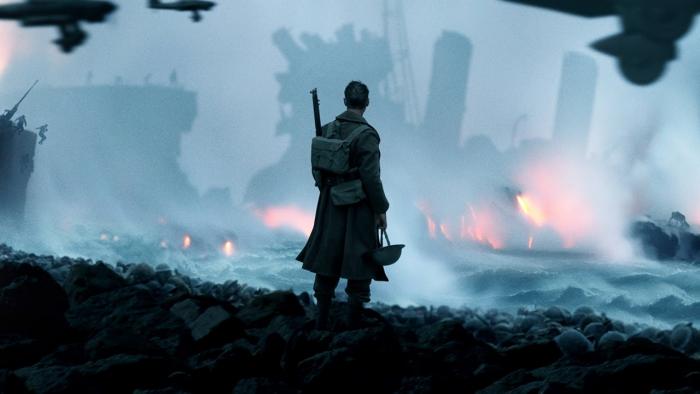
Released in 2017, Dunkirk was Nolan’s first foray into the war drama, and boy did he set himself one hell of a challenge for it. The film depicts the 1940 evacuation of Dunkirk during the Second World War, taking in various perspectives from land, sea, and air. Civilian boats are arriving from England to help bring fighters home. A group of young soldiers scramble to find a way off the beach. A Spitfire pilot, aware that he’s running low on fuel and probably doomed for death, decides to do all he can to ensure the safe evacuation of the thousands of men below him.
Dunkirk was based on a tight 76-page script, about half the length of a typical Nolan screenplay. Dialogue is minimal. Character development is scant. The effects are largely practical, with CGI kept to a minimum. And it’s under two hours in length. This is a film of ruthless efficiency, Nolan keeping himself on the tightest of reins. But it is no minimalist piece. This is a work of noise, fury, and pure emotional and sensory overload. The blend of sound design and Hans Zimmer’s score creates a borderline impressionistic aural nightmare, one where the tension never relents. Zimmer’s music includes the sound of a pocket watch — Nolan’s own — adding to the unavoidable fear that these men are running out of time. The whole thing is one big third act. No need for build-up when you’re thrown into the centre of the fire.
Nolan is not interested in grand heroic gestures or traditional movie heroes. I doubt anyone in Dunkirk would ever give themselves such a label. These are deeply normal people, doing what they can, whether they want to or not. The soldiers are an almost interchangeable bunch of wide-eyed young men whose faces bear the emotional scars of war. The civilian sailors are no-nonsense because they have to be. In the air, the pilots, including Tom Hardy, have their faces obscured by their masks, but you can see the weariness in their gazes. Hoyte van Hoytema’s cinematography is intimate without overlooking the sheer scale of the operation. There are so many soldiers and yet they seem so small on that beach. It must be said that Nolan remains, shall we say, spotty when it comes to his portrayals of female characters, and Dunkirk gave him an excellent excuse to just not bother having them. Hey, it works!
Amid the nonsense faux-culture war responses to The Odyssey is this notion that Nolan was once some bastion of anti-SJW storytelling, that he represented the “silent majority” who were sick of historical inaccuracies like lady Ghostbusters. I would hardly call a Nolan film a bastion of progressiveness - he’s no John Sayles or Boots Riley - but his films have never conveyed a sense of conservative pride. Dunkirk was dinged by some British right-wingers as anti-patriotic, which overlooks the film’s real potency. It’s not about war so much as it’s about the endless bureaucratic nightmare of a system that sends wave after wave of people to fight the enemy and then spins their trauma as a net positive. The Odyssey did this incredibly well too, showing Odysseus’s growing guilt as he realizes that there’s no dignity in a Trojan horse strategy.
The thing that always sticks with me about Dunkirk is its ending. The two soldiers we’ve followed throughout the film arrive via train in Woking, where the locals greet them as heroes. One of them reads Winston Churchill’s famous address to parliament, the one that became a rallying cry for Allied Forces to get back into the battlefield and defeat the Nazis. We will fight them on the beaches. We will never surrender. The film could have ended on that victorious note, but instead, its last shot is on that one soldier, so painfully young and terrified, realising that he will have to go back to France. Or Germany. Or wherever his superiors order him to go. “Never surrender” is a great cry to make when you’re smoking cigars and drinking champagne in your stately home. It’s far less appealing when you’re barely an adult and have already seen hell. It is in that moment that Nolan shows the truth of so-called patriotism: it’s built on the bodies of kids like these.
Dunkirk earned over $500 million, which seems like small fry compared to 2017’s big hits (four films earned over $1 billion), but it was five times the budget, and another reminder that Nolan could pull off the improbable. Since then, he’s taken some big ambitious swings on a grander canvas, but also found a way to make the intimate epic, as he did with Oppenheimer. I’m sure he can and would love to go bigger, and he’ll be one of the few filmmakers to get that chance, but I do crave a return to something like Dunkirk: that blend of high-concept and impressionistic fury that has a truly angry point to make about the world.


