Old School. Biblically Independent.
By Kayleigh Donaldson | Film | September 6, 2025
Fictionalizing history can be tricky. The creative freedom that distance from reality can offer opens up a minefield of ethical quandaries, issues made all the more evident when the history in question is from our current era. Dramatising the rise of Vladimir Putin and his decimation of any potential for democracy in Russia feels risky at the best of times. One can’t blame the team behind The Wizard of the Kremlin for wanting to analyse such fraught stuff through the lens of an unreal participant. It certainly seems like a safer foundation from which to poke at a tyrant. But when history is more interesting than the person you made up, things quickly fall apart.
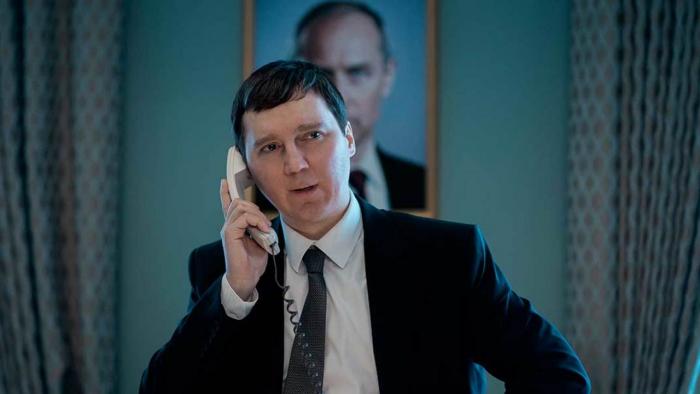
French director Olivier Assayas (Personal Shopper, The Clouds of Sils Maria) has adapted a bestselling novel that centers on Vadim Baranov (played by Paul Dano.) He is introduced to us by Rowland (Jeffrey Wright), an also-fictional researcher, invited to the semi-exiled spin doctor’s home so that he can hear his side of contentious history. Vadim was an idealistic artist with a great love of Yevgeny Zamyatin, the author of the pioneering dystopia We. As the USSR crumbled and was replaced by the grand and flashy promises of Russian capitalism, Vadim went from fiction to rewriting reality. Under the tutelage of Boris Berezovsky, one of many businessmen who grew fabulously wealthy in the ’90s, Vadim helps to pluck an obscure Diplomat from the shadows to become the next Prime Minister. They wanted to reinforce the new status quo. Former KGB agent Vladimir Putin had other ideas.
Vadim is inspired by a real person from Putin’s inner circle, a politician named Vladislav Surkov, who is frequently referred to as the “grey cardinal” of Russian politics. One imagines that it’s legally easier to create a more pliable fictional version of this figure to tell a story of political manipulation. The downside is that Vadim never stops feeling like a total non-entity in his own movie. Dano is a talented actor, but he can only do so much with a character who exists solely to spout exposition and always make the “right” decisions. Vadim is prodigious in his understanding of spin, from creating the ideal candidate to enforcing their increasingly fascistic whims. He never seems to make a slip-up or come to blows with any of his colleagues, yet he’s also oddly passive in his own cruelties. He’s just doing his job, but has no emotion or conflict about it. Such apathy could read as fascinating in its clinical approach to utmost destruction. Here, though, it’s just bland.
A lot of history is covered over two and a half hours. We see the decline of Boris Yeltsin in some Weekend at Bernie’s-esque puppetry, then the election of Putin in 2000. There’s his cold response to the Kursk submarine disaster, the Chechen wars and annexation of Crimea, and Putin’s growing hatred towards Urkaine. Most of this is explained in a didactic manner, like a beginner’s course on modern Russian history. The most intriguing stuff comes with the hints of macho fury that permeate Putin’s approach to politics. He’s a thug who thinks men should be men and the motherland needs a father to lead it. As his power grows, he attracts more muscled racist thugs to his inner circle. There’s a lot of ground to be mined here but the film just tells us what’s happening then moves on to the next event. The whole thing is, dare I say it, bloodless (but not literally: we get a couple of moments of archival footage that are shockingly graphic.)
Mercifully, we are spared a slew of dodgy Russian accents in favour of an Amadeus approach to geography. It benefits the performances. Sure, Jude Law as Putin still sounds like Jude Law, but he also sharply conveys the tough boy sulking and paranoia of a conservative power player who knows that brute strength works more effectively than boardroom back-slapping. The best performances come from Will Keen as Boris Berezovsky, the arrogant oligarch who thought he could be the puppetmaster, and a fast-talking Tom Sturridge as the proudly greedy banker Dimitri (based on Mikhail Khodorkovsky). They at least seem more lived-in than Vadim. He isn’t the only cipher in this tale. Alicia Vikander, who Assayas used to impeccable effect in the underseen HBO adaptation of Irma Vep, does her best with the underwritten token female role that never escapes the trap of being a sexist plot device. As Ksenia, she goes from idealistic artist to capitalist brat to head-shaking conscience of Vadim as he becomes evermore embroiled in Putin’s work. And, of course, there’s a brief love triangle.
The Wizard of the Kremlin struggles to make this extensively documented history seem plausible because it’s turned the entire narrative into a vehicle for cynical quips from a guy who doesn’t even exist. It’s all very watchable, especially for something of this length, but there’s no real insight in something this blandly presented. It’s confined by the demands of prestige when what it really needs is some pulpy fury or even a dose of kitsch. For a film seeking to tear open the dark secrets of a notorious dictator, this is an oddly dutiful film. If one wishes to be daring about this subject matter, one should be deeper in its interrogation of power. Alas, it feels like Assayas and company are just obeying orders.
The Wizard of the Kremlin had its North American premiere at the 2025 Toronto International Film Festival. It currently does not have a US release date.


