Old School. Biblically Independent.
By Mae Abdulbaki | Film | October 13, 2026
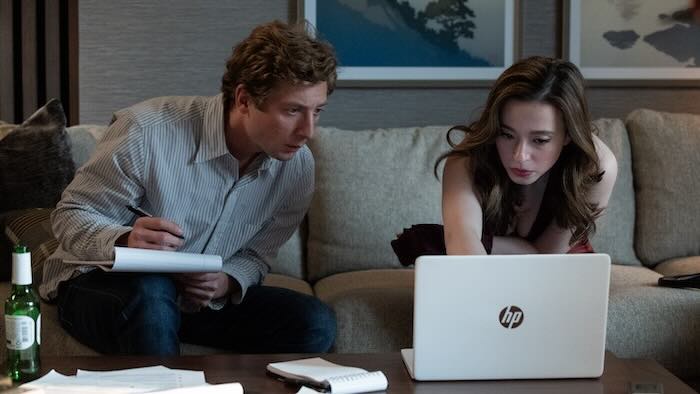
Writer-director Aaron Sorkin’s follow-up to the successful The Social Network is The Social Reckoning, a film about journalist Jeff Horwitz (Jeremy Allen White), who published a series of stories called The Facebook Files for The Wall Street Journal in 2021, and Facebook whistleblower Frances Haugen (Anora’s Mikey Madison). A miscast Jeremy Strong replaces Jesse Eisenberg as Mark Zuckerberg, who struggles through a Senate hearing prep session run by a crisis management specialist played by Wunmi Mosaku, while Portia Doubleday plays a radicalized woman whose viral video at the start of the film sets the stage for disturbing revelations that are still being felt to this day.
At the height of the pandemic, The Facebook Files were eye-opening for many. Not only did they reveal horrific details about the algorithms of Facebook and Instagram, which purposefully drove hate speech videos and inflammatory posts to the top of people’s feeds because it made them money, but it also showed how little Zuckerberg, and billionaires like him, cared about their role in it. The Facebook Files led to a proven correlation with increased violence and radicalization—on and offline.
If nothing else, The Social Reckoning understands the severity of the situation, even if it doesn’t actually dig more deeply into the implications it presents or ask any truly difficult and uncomfortable questions about the negative influence of Facebook, Instagram (now collectively under the Meta umbrella), and all the other social media we use. Despite its subject matter, the film plays it safe, too busy laying out the facts of the situation and pretending that it’s enough to shock us. It’s simultaneously disconcerting at times yet extremely tepid. When the latter overpowers everything else, it makes for a film that is mediocre at best and deeply restrained at worst.
The moments that are meant to add levity don’t work. The film is stuffed with so much exposition that it doesn’t leave much room for anything else. Frances and Jeff’s relationship is written with quippy dialogue, but there’s something off about it. It’s to the point that Madison and White sometimes feel like they’re in different movies, pushed to interact because that’s what’s required of them. And it is required of them. Frances is hesitant to give Jeff too much information, reiterating how much she loves her job—until she realizes that she can no longer defend it. In another writer’s hands, a more nuanced exploration of Frances’ belief in the good of Facebook as a way to connect people who are not so great in real-life social situations would have been more effective. Here, it’s more of a throwaway belief than a substantial one.
It’s far enough removed from The Social Network to stand on its own. In a social media-driven world, the details of The Facebook Files caused righteous outrage at the time, though the film becomes even more of a depressing watch when we sit with the fact that not a lot has been done about it and things have gotten worse in the years since.
At the end of the film, Zuckerberg, who’s finally made speechless by the January 6 attack on the US Capitol, decides to stop President Trump from posting on Facebook. It’s meant to be this big climactic moment, but it doesn’t have any real power behind it, especially considering it’s Zuckerberg speaking the words. When we know that Facebook got rid of its fact-checkers not long after that moment, The Social Reckoning loses some of its standing. Perhaps Sorkin should have waited a few more years to make the film, so that there was even more distance between what happened and now.
To be sure, the film is meant to anger, and it does, but it’s also wearisome. It’s also a lot more mellow than it should be. It’s lacking the same spectacle that made The Social Network a must-watch. As a director, David Fincher is far more skilled at pushing the envelope when it comes to drama. By comparison, The Social Reckoning comes off as being somewhat inert. Sorkin can write the hell out of a scene, and his dialogue can be quick and biting, but the way the story plays out is less invigorating than it should be considering what it’s about. Everything needed to be ramped up. What we’re left with is a film that is triggering but muted, and that’s not a particularly good combination.
The Social Reckoning is now playing in theaters.


