Old School. Biblically Independent.
By Jason Adams | Film | June 17, 2026
Loosely based on the true story of an unsolved murder that happened aboard a cargo ship that served the Inuit people of Northernmost Canada in 2012 (a boat that’s been considered haunted ever since), writer-director Rodrigue Jean’s takes that germ of an idea and from it delivers an atmospheric heartbreaker with Labrador: Autopsy of Silence. The film—which just took home three top prizes at this year’s Tribeca Film Festival for Best International Narrative, Cinematography, and for the quietly devastating performance from its leading man Christopher Angatookalook—spins strands of class and race and queerness through its deceptively simple whodunit tale, reverse-engineering a master-class on intersectionality while never speaking above a whisper. This is, to be more precise, a small marvel of a movie.
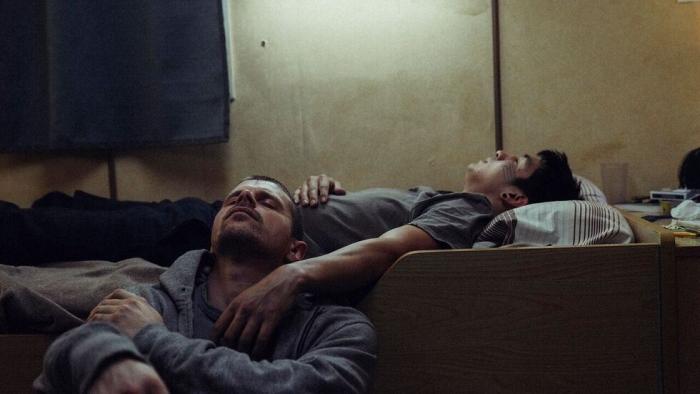
There were whispers that the real-world murder occurred because of a love-triangle gone awry, but as Labrador makes clear this is a cloistered-off world where people don’t spill one another’s secrets easily, and so its story must seek out its own elliptical structure. Fracturing the narrative into small waves of non-linear revelation, the main asset of Jean’s film is its patience. Nothing here is treated as melodrama or exploitation, even as its characters’ intertwined love-lives overlap in ways that do lead to a spray of blood and a lurid investigation that hinges on man-seed. Even the killing itself, once we get to see the truth of it, is over before you even realize what’s happened. And as with so many tales before it what we’re left with is one lover dying cradled in another lover’s arms.
Alupa Tulugak (Angatookalook) is a hard-working Inuk mechanic aboard a ship called the Adeawiktak—which it should be noted translates to “to bid him farewell” in the language of the indigenous Mi’kmaq tribe of Newfoundland—who’s pretty sure this will be his last tour before heading back home into the northern stretches of where he comes from. (Somebody should bring to his attention every cop movie ever made, where all the worst stuff happens on a retiree’s last week with their badge.) Without the film ever underlining his reasons why though it’s pretty clear from just the way Alupa’s name is thuddingly mispronounced every time a white character comes anywhere near it what’s feeding his exhaustion with life in the south.
All but one white character, that is—Alex (Alexandre Landry) is the ship’s cook and Alupa’s best friend. Or to paraphrase Michael Stuhlbarg’s character in Call Me By Your Name—“they had a beautiful friendship; perhaps more than a friendship.” Yes Alex and Alupa are lovers, which is clear in the film early on—on the other hand it’s the depths of their feelings for one another that becomes more of a revelation as Labrador progresses, since Alex is also seen having sex with the ship’s female first officer Michelle (Gabrielle Poulin B.). Basically the film starts us off wondering if Alex doesn’t just get around, and then it narrows in from there.
As an aside: it’s not necessary to your enjoyment of Labrador: Autopsy of Silence to know that Alex, also played by Landry, was the main character of Jean’s 2014 film Love in the Time of Civil War—I didn’t know this until after seeing Labrador myself. But looking at the character’s arc in light of that—Alex was an addict and a hustler working in Montreal in that earlier film—does fill in some details, and add some extra pathos to what becomes of him here.
Because one ordinary morning the ship’s assistant cook, a Sri Lankan named Shakir (Jassinth Thiagarajah) who’s also friends with Alex and Alupa, finds Alex dead on the floor of his cabin, bled out from a hole torn in his neck. What happened the night before—who was coming and going from one another’s cabins, who saw who doing so, and who has the power to be believed over the others—is the web that Jean’s movie spins out from there.
Labrador: Autopsy of Silence, extremely to its benefit, never feels like a “true-crime thriller” though. It has very little interest in slamming its palms on the buzzers of those tropes. The film seems to take its notes from the sea that surrounds its characters—half-frozen with still, small undulations as far as the eye can see. Alupa’s no noble suffering stereotype—although he does spend the majority of the film stunned into silence as he watches the still-grinding gears of colonialism push him slowly into their shredding mechanism, we see enough of him both before and after this tragedy that colors outside of those lines. Including his queerness itself.
And Angatookalook deserves every prize we can throw at him - a former circus performer and sports coach, this is (astonishingly) his very first acting role, and he holds the screen and the film’s center like only the best of newcomers before him. Quiet and watchful, aware of the suspicions he raises whenever moving through white spaces, Angatookalook makes every outrage palpable without ever raising his voice. His whisker-esque tattoos wobble treble-like, a cartological map of small inward smiles and emotional devastations and, on brief occasion, ecstasy. Alupa might be closed-off but Angatookalook brilliantly, crushingly, lets us see right inside of him every step of the way.
We do see Alex’s moment on the slab, but the autopsy of the title seems more aimed at Jean’s brutal but quiet excavation of the outside factors—the sinister forces of racist, homophobic culture itself—than it is in slicing up the man’s forlorn corpse. In matters of the spirit, for lack of a better word—once Alex is dead he nevertheless remains there beside Alupa, a spectral sole confidant, reminding them that one day they can head north, into the endless sea of white together. There, on a snowmobile bound for forever, we hear for the first time music, as outsiders often do. The way out is always, endlessly, senselessly through.
Labrador: Autopsy of Silence just world-premiered at the Tribeca Film Festival.


