Old School. Biblically Independent.
By Jason Adams | Film | June 19, 2026
If there’s one sub-genre of movies that feels legitimately dangerous to update into our modern moment it’s the Lolita Thrillers of the 1990s—think The Crush, the Poison Ivys, the actual Jeremy-Irons-starring Lolita. We hardly ever get old-fashioned Erotic Thrillers featuring grown adults these days! Much less ones where the protagonist (or antagonist) is a teenager. Age gap and consent discourse is a very awake bear in 2026—one that seemingly nobody wants to poke.
Enter stage right the fearless Act One from writer-director Sophia Takal, which just premiered at the Tribeca Film Festival and which does indeed feel legitimately dangerous. Much like its young heroine, Act One strides with great and unnerving self-confidence straight into its tale of power and exploitation and desire, all of it getting tangled up into confusing, hormone-fueled, and delicious little knots.
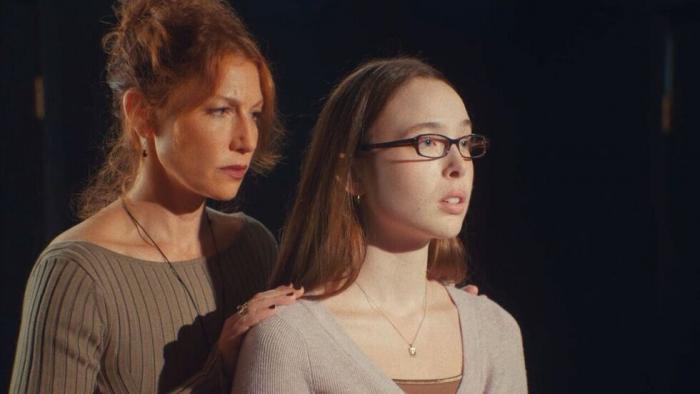
The film stars Ella Beatty (yes the daughter of exactly who you think and man can you see her mother in there) as 17-year-old Hannah, a wannabe serious actor who’s still trapped in dreary high school plays where the lead role always goes to the hottest girl in class, talent be damned. Feeling ignored and underappreciated, Hannah longs for bigger things—not stardom precisely, but genuine seriousness. In the way of many a teenager before her, Hannah takes herself very seriously. Deadly serious, you might say. But she definitely puts in the work, and believes in the process as the reward itself.
And the film never laughs at her for this because Takal, a former actor, believes this too. If you’re skittish about “pretentious” conversations about an actor’s “process” and “craft” this movie will definitely jam its hands down hard on those buttons. But Takal, without ever undermining Hannah as a character, does lace in plenty of self-aware humor (the scarves, they will be tossed dramatically over shoulders) to off-set it, alongside an acknowledgment that her protagonist is still a naive one despite all of her (excuse the pun) acting out. And so the film manages to skirt the line.
One of many such lines skirted. One day while wallowing in her latest rejection Hannah stumbles upon the website for Act One Studios, a weekly acting class held a couple of towns over that’s lorded over by preeminent scarf-tosser Melanie (played by the great Ari Graynor—speaking of underappreciated actors). Melanie’s claim to fame is having been the teacher for one of Broadway’s current big stars (Tavi Gevinson), a factoid she wields with laser-like precision at luring in prospective students. Is this making her sound like a spider with a web? Because it should be!
Hannah’s an easy mark, and immediately falls under Melanie’s spell. If you’ve seen Takal’s brilliant 2016 two-hander Always Shine (starring Mackenzie Davis and Caitlin FitzGerald as actress-frenemies) then you already know she’s got the goods to dreamily dissect fraught relationships between women—but where that earlier movie was all Persona-esque personality dissolves, Act One is less Bergman and more Woody Allen. Just with actual self-awareness.
Which is to say that the power imbalance is clearly way off, a fact that Melanie enthusiastically invites and luxuriates in. She’s tyrannical under the auspices of breaking down her actors’ defenses, all to supposedly better their art—but where does a demand for ego-lessness from her students turn into a trough to feed her all consuming one? Aye there’s the rub, and Takal is ruthless in breaking down and blurring the already blurred lines between artists. Hannah strives to lose herself, completely and totally in another character—Melanie is the woods and the wolves that such princesses must tread.
Although they share a similar focus on female competition and friendship, unlike Always Shine Act One is not a two-hander—the tussle between Hannah and Melanie is happening full out in front of a class-room full of people, some of them far more culpable in their guilt. Sweet-faced honeypot Henry (Nate Mann), a sexy 20-something actor who Melanie immediately partners with Hannah, being the most diabolically wielded.
Basically this is some textbook grooming stuff going down, which Takal refuses to shy away from showing to be both dark as hell while also kinda defiantly sexy at the same time, dare I say? Act One teeters on exploitation, yet it remains so locked into Hannah’s frame of mind and what she wants, or thinks she wants, that it allows itself the grace to wade into its confusion—this time in one’s life is a tumult of feelings that no teenager’s got a proper handle on no matter how self-determined they present, and Act One very much wants to take us to that place. We completely understand why Hannah does what she does, why she falls prey to Melanie’s spell and Henry’s hot ass, even as her confounded mother (a terrific Elizabeth Reaser) keeps throwing around the word “cult.”
And that’s what makes the daring Act One such a sticky and surprising experience. It sees what’s happening to Hannah while never robbing her of her autonomy (as Melanie aims to do), even as slippery and perplexing as Hannah’s choices might be at times. A film like The Diary of a Teenage Girl springs to mind (directed by Marielle Heller who’s also funny enough a part-time actress)—these are movies that allow these girls the space to wander into bad, harmful places without ever judging them for it. And if there’s one constant in society from today back to the 1990s and beyond (well well beyond), it’s surely the dangerous idea of not judging women.


