Old School. Biblically Independent.
By Jason Adams | Film | October 5, 2026
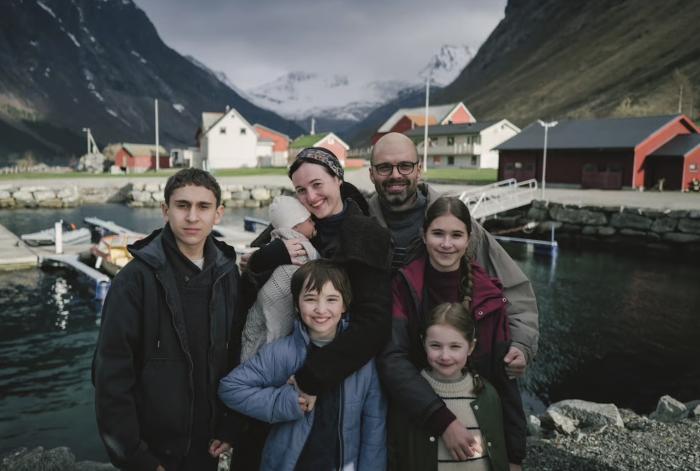
If you have ever wanted to have a Norwegian rug pulled out from under you in slow motion (and who among us has not wanted exactly that) then have I got the movie for you. Say hallo to Romanian master Cristian Mungiu’s Fjord, which reunites extremely likeable actors Sebastian Stan and Renate Reinsve (already so excellent together in incredibly different roles in A Different Man in 2024) to play a married couple, parents to five, who make the move from his home country of Romania to her home country of Norway only to find the different societal customs immediately tearing their seemingly loving family to shreds. Proving to be a somewhat controversial pick for the Palme d’Or this year, Fjord is to my eye anything but controversial, but rather another deeply resonant and humanist piece of art gifted to us from one of our greatest working directors.
Although Fjord clearly calls up comparisons to films like Force Majeure and Anatomy of a Fall, it’s never beholden to Ruben Östlund’s provocateur tendencies, nor does it find itself nailed to a single chilling question like the “Did she or did she not kill her husband?” conceit at the heart of Justine Triet’s killer thriller. It’s all far murkier with Mingiu, so that we’re not just questioning a single family and their neighbors but instead the depth and entirety of society itself. Class and race and religion and language and the backbone of “the family” are all microscoped in Mingiu’s vision, calling into question we the viewer’s shorthand assumptions right alongside the characters’ themselves. This family might not end up being who we think they are when we meet them, but after all the longer and the harder you look at something the more likely it is to dissolve before your eyes.
Anyway Stan and Reinsve each turn in more exquisite work as Mihai and Lisbet Gheorghiu, who we first meet (with all five of those kids of theirs) upon their arrival in a small fishing village along the water down below those proud Norwegian peaks of the film’s title. Indeed at the school where Mihai gets an administrative job there’s an almost daily rumble of avalanche that spills down from on high mountaintops, sending alongside its snow an easy dosage of doom-laden metaphor whenever deemed applicable—hey it’s right there in the title. It’s gotta mean something.
The Gheorghius have come to town because Lisbet has family nearby to help out with, again, all of those five kids—a necessity when there are, you know, five of them. (Five! Five kids!) Lisbet does some nursing on the side (mainly washing bodies in the morgue)—having her own mother there to watch her newborn infant while she does this seems especially crucial. But out of the kids only the oldest two register as characters-Elia (Vanessa Ceban) and Emmanuel (Jonathan Ciprian Breazu) are teenagers attached at the hip. They could be twins, or they could just be semi-inseperable-it’s hard to tell because the entire Gheorghiu clan is such a self-contained unit, despite their friendliness, that their bonds come to seem suspicious to the outsiders in town.
Which is, of course, the point. The Gheorghius turns out are deeply religious people, although across Fjord’s first act this mainly manifests as kindness and generosity—it takes much more work to not like Stan & Reinsve as performers than it does to immediately identify and be charmed by them, and so we do. And it’s only later, once we feel so deeply for them, than Mingiu begins that slow rug-pulling mentioned up top—because what seemed like sweet naivete and quiet decency begins to sour into a willful religious isolationism.
Or does it? Who’s the paranoid one? When Elia and Emmanuel’s teachers start seeing bruises on them and overhear the teens making jokes about their parents beatings, the liberal Scandinavian political apparatus swings into swift motion, literally removing the five children from their parents within what seems to be a matter of just a couple of weeks of their move, if even that. The family’s consistent if not particularly aggressive Pentecostal proselytizing had already been immediately greeted with Norwegian side-eyes. You add to that the fumbling of translation, as not everyone is fluent to one another, but also the purposeful coarsening of bureaucratic terms and phrases—see how the understandable parental instinct to swat a child’s hand away from a stove can become a savage brutalization with such ease. You might not even notice it until it’s too late; until your pulling your insides back up from behind you.
Still just when Fjord’s got you furious at the ways a socialist government can, in its own invasive ways, overstep the bounds of its well-meaning, Mingiu never lets Fjord be so simple-the Gheorghius’ religiosity starts to seem more toxic the longer we spend with it. And once Mihai grows so (rightly) frustrated at the system that he (wrongly) calls in conservative creeps from his homeland to take to the streets screaming about family values and religious freedom, our loyalties really start to get tested. Suddenly Lisbet’s head-scarves take on a fundamentalist edge whereas they just seemed like pretty scarves a step before.
And don’t get me started on the extremely passionate bond that develops between Elia and the troubled neighbor girl—you can hear it in Mihai ‘s voice when it comes up in a chilling aside, and staring down the barrel of those eventual repercussions becomes the thread that unravels almost all of our sympathies for him and his Father Knows Best brand of paternalist terrorism. Having been a queer kid raised in the exact same religion as this family it’s easy for this writer to understand even just the emotional violence on hand, but Mingiu thankfully finds time for both the forest and the trees.
And that’s what makes Fjord such a riveting conundrum, one that per usual sees Mingiu evading narrow defintions. It’s most akin to Asghar Farhadi’s A Separation really, where the guilt lands on everybody in bits, on the entire system in chunks, on individual choices snowballing into great blanching drifts, obliterating our perceptions, space-time flipped all upside down. There just is no good choice. That’s the eternal truth of it. And Mingiu offers us a flinch in its recognition. Hold it as long as you can stand it before the storm wipes us all out.
Fjord is screening at the New York Film Festival. It’s opening in U.S. theaters on October 9th.


