
Old School. Biblically Independent.
By Tori Preston | Film | June 8, 2026
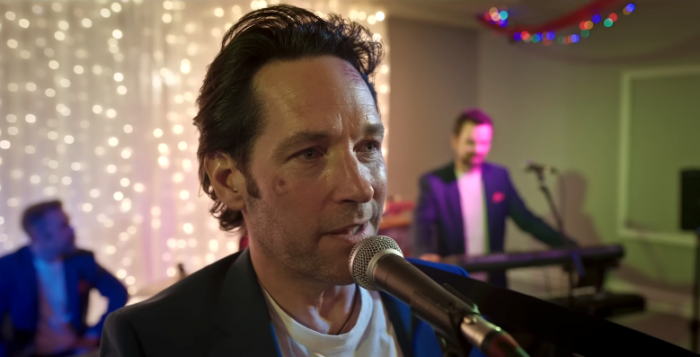
Most movies about music are about creative expression. Success too, on some scale, but mostly about the work, the collaboration, and the audience connection. They’re movies about art, where the industry around that art is either glossed over or treated as an obstacle. Director John Carney knows his way around those kinds of movies, after Once and Sing Street, but Power Ballad is something a little different. It’s a movie about the business of art. Writing a song takes talent; releasing a song takes managers and producers and solid marketing. And when something is a hit, when there’s real money on the line, then it’s also about royalties.
Don’t get me wrong, Power Ballad is still a proper art movie, full of feelings and creative expression, only it filters its message about artistic integrity through the lens of songwriting credit. Who had a hand in making a song, and who stands to benefit from its success. Rick Power (Paul Rudd), is an American ex-pat musician making ends meet in Ireland by fronting a successful wedding band. Danny Wilson (Nick Jonas) is a famous former boy band member who is trying to reinvent himself as a solo artist. When Danny joins Rick onstage to perform at his friend’s wedding, the two discover they are unlikely kindred spirits. Rick, who saw modest success when he was younger before he fell in love while on tour and decided to settle with his new wife and child outside of Dublin, still dreams of playing before thousands at Madison Square Garden. And Danny wants to do that again, on his own merit. The pair spends the rest of the evening holed up in Danny’s hotel room, swapping stories and riffing on their respective works in progress, only to part ways again the next day.
Then, six months later, Rick hears one of his unfinished songs - “How To Write A Song (Without You)” - playing over the PA at the mall. Danny finished Rick’s song and released it as his first solo single, and it’s a huge hit. Only Rick isn’t credited as the co-writer, and he can’t find any demo in his files to prove it was his song in the first place.
What could have been a straightforward story of intellectual property theft finds nuance in the characters themselves. Rick isn’t a clout chaser, and he’s not even really interested in the money (though both would be life-changing for him). He just wants Danny to acknowledge his contribution, because nobody in his life believes him. And Danny didn’t mean any harm, at least not at first. His own songs weren’t impressing his record label, and when his girlfriend overheard him noodling on the piano to Rick’s old song, she was moved to tears - and he realized it had the potential to be the hit he needed. He did do the work, writing the bridge Rick could never quite crack, so he’s less of a thief and more of a coward who missed every chance to come clean about the song’s collaborative origin. Neither man is greedy, necessarily - they’re just two artists navigating their own pride, more than anything.
Rudd and Jonas are predictably well cast, even as Rudd carries the majority of the film on his shoulders. Slightly dissatisfied middle-aged dude who is still kinda cool has become Rudd’s performance pocket, but I’m not mad at it. Their chemistry together, however, is the most surprising part. Good enough to make you wish they could sort their problems out and find fame together, Danny as the frontman and Rick as the songwriter, or at least have more scenes together, but it’s just not that kind of movie.
Instead, Rick spirals into obsession while Danny is eaten by guilt. Tonally, Power Ballad isn’t quite the comedy some might expect, but it also doesn’t lean as far into the madness as I might have hoped. There’s a version of this that could have gone full-on weird, like Rudd’s other recent effort, Friendship, but the film is ultimately too kind to wallow in that sort of discomfort (for the characters or the audience). And maybe that’s why I find myself frustratingly lukewarm about Power Ballad, even as I admire the performances and its unique spin on its music tale. It’s just so kind, so generous toward both characters as artists that it can’t let them be messy, like… artists. All that nuance around Rick and Danny’s motivations to keep them both sympathetic, and I’m over here thinking, “Gee, a little greed would also be relatable.” We’ve all seen feel-good movies about honesty and integrity; I wish Power Ballad had fully embraced the chance to be a feel-good movie about getting the credit and payday you deserve.


