
Old School. Biblically Independent.
By Melanie Fischer | Film | March 13, 2026
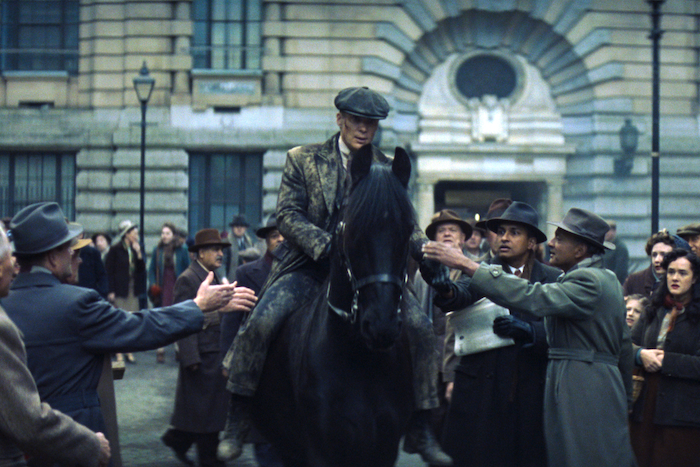
There’s a strange tension at the heart of Peaky Blinders: The Immortal Man, the film “spinoff” — let’s be honest here, belated finale — to the interwar Birmingham-set gangster crime-drama series that ran for six seasons. On one hand, there’s a sense of inevitably, a feeling of it was always going to end this way. And on the other, an awful ache of what could have been, a feeling of it wasn’t supposed to happen like this.
For five seasons, Peaky Blinders felt like a show with an unusually singular vision. The brainchild of Steven Knight, the highly stylized crime drama could certainly at times feel as over-the-top as its ever-escalating roster of Big Bads (rival gangsters and Russians and Nazis, oh my!). But it was easy to forgive these faults when the series seemed to still know what it was at its core — a family drama centered around the complicated push-pull between ambitious second son Thomas Shelby (Cillian Murphy) and his equally shrewd aunt Polly Gray (Helen McCrory), who ran the “family business” while Tommy was off fighting WWI and refuses to hand over the reigns to the Peaky Blinders and sit back quietly just because the boys are back.
Then between seasons five and six came the COVID-19 pandemic and more devastatingly the passing of Helen McCrory. Finally released in 2022 after multiple delays, Peaky Blinders’ sixth and final season is a portrait of grief in ways that feel sometimes intentional but more so a byproduct of terrible circumstances. It’s always been a dark show in many regards; full of violence and death and a commendably steady commitment to depicting the lifelong scars, both physical and psychological, suffered by the survivors of trench warfare. But the final season was bleak in a way it had never been before, reeling and off-kilter from Polly’s absence, and ending on a note that could kindly be called “ambiguous,” and less kindly but no less accurately labeled “unresolved.” Even just with regards to timing, saying goodbye to the Shelby in 1934 felt wrong, when from the very start the series seemed destined to end with WWII.
And now, four years after the final episode aired, The Immortal Man finally brings the war to the home front, and Tommy’s story to the finish line. The film reintroduces us to Tommy in late 1940, a haunted shell of his former self, living in the ruins of a once great house, with only lackey Johnny Doggs (Packy Lee) and his ghosts for company — most notably those of his daughter, Ruby, and elder brother, Arthur, who has succumbed to his substance abuse and mental health struggles since we last saw him. The Peaky Blinders are now being run by Tommy’s eldest yet most recently discovered son, the irascible Duke (Barry Keoghan, replacing Conrad Khan), who Tommy has acknowledged as his heir but otherwise abandoned, much like everything else in his life. “In the bleak midwinter” has long been to the Shelbys what “Winter is coming” is to the Starks, but never before has it felt so relevant.
It does not help that most of the supporting characters left standing are those that Steven Knight has never particularly known what to do with, like Ada (Sophie Rundle), Tommy’s only surviving sibling, who presumably spends her days doing something beyond trying and failing to convince her brother to return to the world, although we never get a clue as to what; or Charlie, Tommy’s son from his first marriage, who is conveniently off fighting the war and has presumably no real relationship with his father any more.
It’s the absences only mentioned in passing, or unaddressed entirely, that feel like the real elephant in the room. Where Peaky Blinders had a tendency to feel overstuffed, The Immortal Man struggles to fill all the empty space left behind by the characters who came before, and Polly most of all. It doesn’t help that Steven Knight mostly tries to fill these gaps with new characters who feel like cheap facsimiles.
Case in point is Kaulo (Rebecca Ferguson, who still can’t maintain the same accent for more than a sentence yet remains likable somehow), a character who might be the worst thing Steven Knight has ever written. Considering he’s also responsible for Serenity, that’s saying something (no, not that one, the tuna named Justice one). At once the film’s Polly stand-in and Tommy’s “love interest” — although he’s not really capable of love nor interest at this point — Kaulo is not just the identical twin sister of Duke’s dead mother, she’s also clairvoyant. Peaky Blinders has always loved a mysterious, morally ambiguous woman-shaped call to action, and never before has a character been more obviously a plot device. She’s arguably a necessary evil, considering Tommy is hardly the most forthcoming of men and there’s no one left close enough to him to pry him open, but inventing a character who conveniently knows all his thoughts and feelings (because ESP) is such a shamelessly blunt-force approach one almost has to admire it.
Despite having a lot of ground to cover, in terms of pacing The Immortal Man can feel, especially in the first half, like an episode of television stretched to nearly two hours. Director Tom Harper, who helmed half the first season of Peaky Blinders, clearly knows the style and swagger of the series intimately well, but there’s only so much energy one can bring to fundamentally inert scenes of a misanthrope brooding in self-imposed isolation. Even when the misanthrope in question is played by Cillian Murphy, demonstrating his unmatched talent for emoting internal torment.
It takes an unfortunately long time to get there, but when the escalating danger posed by Nazi conspirator Beckett (Tim Roth), attempting to court Duke into participating in a counterfeit currency scheme that would tank the British economy, finally drags Tommy out of retirement, The Immortal Man really comes to life. In a handful of scenes it even recaptures, in fleeting glimpses, the magic that made Peaky Blinders so special at its best. Most of these moments feature great needle drops, of course, and while Nick Cave’s “Red Right Hand” makes an obligatory and effectively nostalgia-inducing appearance, it’s Fontaines D.C. that are perhaps not-so-surprisingly the musical MVPs here (multiple band members contribute original material for the film, but it’s ultimately the use of songs from their catalog that stands out most). This franchise has had its ups and downs, but one thing that can be said is its taste in music has never faltered.
The Immortal Man is far from perfect. It does not achieve what the 2019 Deadwood movie did in bringing an almost miraculous sense of closure to a series that ended with the jagged edge of a sudden cancellation thirteen years prior, a point of comparison too obvious not to acknowledge. But there is closure here nonetheless. As someone who was along for the whole ride in real time — nearly half my life — that counts for something.
The Immortal Man is now playing in theaters, and will be released on Netflix March 20.


