
Old School. Biblically Independent.
By Jason Adams | Film | June 11, 2026
Documentarian Jeffrey Schwartz is perhaps ludicrously over-qualified to have made the new doc Mineshaft: The Cruising Murders, premiering this week at this year’s Tribeca Film Festival. Diving the viewer into both the horrific real-life murder that inspired William Friedkin’s controversial 1980 thriller Cruising as well as the story of the film itself’s extremely fraught making, reception, and aftermath, Mineshaft—one of Schwartz’s best and most essential films to date—straddles the director’s life-long fascinations with balletic aim.
On the one hand Schwartz is the queer archivist who’s given us a series of exuberant feature-length docs about queer icons like I Am Divine (about John Waters’ dogshit-eating drag muse), Tab Hunter Confidential (about the closeted movie star who one time made out with John Waters’ dogshit-eating drag muse), and Wrangler: Anatomy of an Icon (about the bisexual porn star Jack Wrangler who may or may not have made out with Divine and/or Tab Hunter but who knows? Let’s just start that rumor here anyway.)
And then on the other hand Schwartz has been producing physical-media documentaries about the making of movies for even longer. Looking through his filmography you’ll see a revelatory list of 20 to 30-minute-long DVD extras with titles “Lions and Monkeys and Pods… Oh My!: The Special Effects of ‘Jumanji’” and “Body Count: The Deaths of ‘The Final Destination’”. Ever watch a doc beamed from the lurid set of a Paul Verhoeven movie? Jeffrey Schwartz is probably the dude who brought it to you.
So bridging as it does an extremely important moment in queer history with a truly wild and perhaps even reckless bout of filmmaking excess, Mineshaft: The Cruising Murders might just be the movie that Jeffrey Schwartz was born to make. It sure feels that vital, revelatory, and alive, while watching it.
Because even if it was originally a commercial and critical flop, William Friedkin’s Cruising itself was and remains one of the most important movies in queer history. After all Friedkin was only a few years removed from The Exorcist when he decided to make itm, while his star, the decidedly A-list Al Pacino, was just as fresh off his Godfather run. Some third-rate low-budget affair this was not.
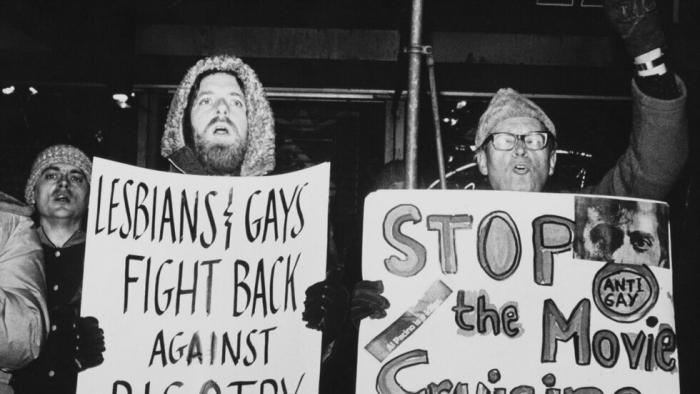
Add on that it’s the summer of 1979 and we’re fist-deep in the thick of hot sweaty and happily hedonistic Queer Liberation. And here came these two straight guys (one of whom had already offended a lot of queer people with the at-the-time regressive-seeming The Boys in the Band) marching into the real-life bars of Greenwich Village, all to shine a not particularly positive light on the gay leather underground scene in a post-Stonewall pre-AIDS NYC. Combustible? You can say that again. Combustible!
But for all of the controversy that’s long lingered with regards to Cruising and the regressive stereotypes that it also views the gay community through, one especially stark fact seems to’ve been lost amid all of the “good versus bad representation” Film Studies banter—Cruising was in fact based on a true story. On the night of September 14th 1977 a man named Addison Verrill, a journalist and film critic, had his head bashed in and his body slashed to pieces by a trick he’d picked up. In fact Verrill was just one of many gay men who’d been discovered murdered that summer—the Village Voice columnist Arthur Bell had begun piecing together stories of torsos and jockstraps being fished out of the Hudson, all to a collective shrug from the NYPD.
That said Mineshaft: The Cruising Murders is not really a “True Crime documentary” as we’ve come to know the term via the thousands of queasy-making hours that streaming services are currently drowning in. It’s not interested in fetishizing the horror of Verrill’s murder, or wallowing in the pain of the loved ones he left behind. But it is defiantly interested in making sure that those people get to speak, to be heard, and to paint a portrait of the man as a complete human being out from under the shadow of the fetishized thriller that William Friedkin turned Verrill’s final moments into.
And beyond that Schwartz uses his decades of bonafides in digging up what went into the making of a movie to wade through Cruising’s complicated and extremely messy cinematic birth. How Friedkin was inspired to tell this story because he had known Addison Verrill’s murderer, a radiology assistant named Paul Bateson who appears as an extra in The Exorcist. And how in turn the burgeoning queer activist movement used the “evil gay” story that they saw embedded in Cruising as a flash-point to up their momentum at a key moment in time. Would we have been so collective when AIDS came otherwise? Who can say.
Mineshaft is thorough, moving, and against-all-odds a sexy and funny portrait of a time and a place and the quite-happy-perverts who were there, bashing back at those who’d box them in. It’s transportative and it’s deeply emotional at times, inviting us into the darkest corners and showing us why decades of people have remained fascinated by crawling into those old crevasses ourselves. And it manages all of that in ways that Friedkin’s Cruising, for all of its fetishistic pleasures—and yes I’ll admit I’m a fan; such is the privilege of my distance from that moment in time—never begins to scratch the surface of. Schwartz, giving voice to every person from the pool-hall extras being fed cocaine on set to Verrill’s still-grieving sister, somehow grants justice and grace to them. As such as exists in a world where Pride must still remain a Riot.


