Old School. Biblically Independent.
By Jason Adams | Film | February 13, 2026
To say that Promising Young Woman and Saltburn writer-director Emerald Fennell courts controversy would be like saying the Muppets court felt. I would say she simply writes big, seems drawn to dark and stormy melodrama that she plays as prickly farce—I’d also say this is what makes her work interesting and entertaining to watch, but she seems to make some critics want to claw their own skin off. So be it—I imagine they have the same issues with Luchino Visconti, the decadent gay Italian nobleman who directed over-ripe class satires in the middle of the last century. Personally I find nothing more tasty than watching a queen eat their own. Let them eat cake, all those made from dessert.
Anyway, that sort of privileged self-loathing is perfectly suited for Emily Brontë’s generational tale of foot-stamping narcissism disguised as moor-swept romance, so what more appropriate director today could make a great film out of Wuthering Heights? None, I’d wager. Even the profoundly talented Andrea Arnold, as lovely as her 2011 version is in its texture-of-mud sort of way, misdiagnosed the nastiness embedded in the black coal heart of those beautiful feuding monsters Cathy and Heathcliff, whose self-sabotaged doom seems to rot the very stone around them.
Not so Fennell, whose wild and deliciously vicious “Wuthering Heights” (the pretension of those quotation marks already spawning their own assembly line of snoozing derision) is here this Valentine’s Day to rattle our tender parts with bone-shivering venom dressed up in Tom Petty music-video drag. This is a movie that knows the best love stories are all blood-lettings in minute (but sexy!) detail, and delivers just that. A deluge of melodrama, its bodice soaked through thick and mean, this movie leaves a heap of gorgeous corpses in its wake—ours included. I wouldn’t have it any other way.
As with most big-screen cinematic tellings, this “Wuthering Heights” smartly concerns itself with only the front half of Brontë’s novel, before all of the similarly-named characters start making a muck of it. Young Cathy Earnshaw (Charlotte Mellington) is a shrieking, pouting whirlwind of red-cheeked pubescence, making life hell for her quiet live-in companion, Nelly (Vy Nguyen), and her abusive, drunkard creep of a dad (Martin Clunes).
The girl very much needs a focus (aka target) for her outsized passions, cuz nose-in-a-book Nelly ain’t cutting it. And so after one of her father’s intoxications leads to him bringing a mute and impoverished raggamuffin named Heathcliff (Adolescence wunderkind Owen Cooper) home, she finds her reason for being. Heathcliff becomes Cathy’s immediate “pet” and project, and the two become inseparable. (Much to Nelly’s tossed-off irritation.)
And even if these early passages are sped through like two excited children scampering about the cliffs of Yorkshire, Cooper and Mellington manage to leave on the film a big emotional mark—watching the something sweet they find together turn to poison once the actors age up and their passions turn to lust gives this “Wuthering Heights” real stakes and drama and heartbreak in its own long overripe run. Oh that we all could remain wee babes and not curdle into impossibly sexy monsters. And yet we all must!
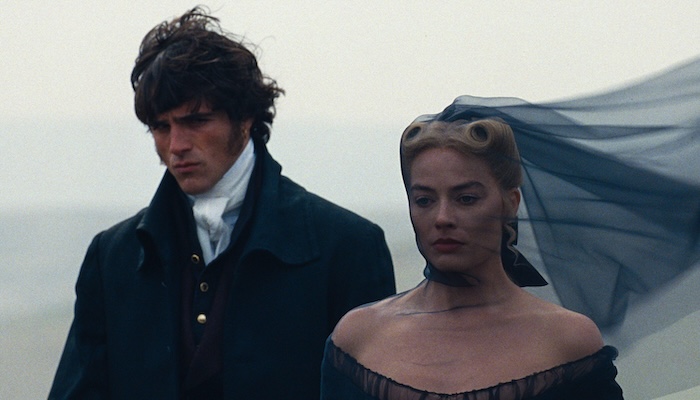
And so on the other side of a montage, Cathy’s suddenly Margot Robbie and Heathcliff’s gained seven or so feet (and those are just the width of his shoulders) in the shape of Jacob Elordi. And with this switcheroo, so too does the vibe shift, as the recurring image of sweat trickling down taut flesh first appears. (And make no mistake it will appear again, and again, sometimes even as the walls themselves pulse with perverse Videodrome feels.)
Yes the pseudo-friendship between these two misaligned and maladjusted creatures is going through its own growing pains—pains that will make their bones ache the same way that puberty’s done, and with just as much beautiful destruction. Cathy’s toy is tired of being played with, at least in this casual manner; they both realize only as he mounts her in order to shield her from a servant’s sex-games that these are not childish bodies that they’re working with any longer.
As for Cathy, she’s unsure what she wants as always, until some choices beyond her choosing are suddenly thrust upon her. After all a girl’s gotta eat, especially when her drunkard father’s gambled away everything and her dress is knee-high with pig guts. Panic leads to stupidity, leads to cruelty and coldness, and on until everybody’s somebody’s story’s villain, love naught but viscera trampled beneath leather boots.
Fennell threads this siege of mistakes together with impossible smoothness, one nasty decision as inescapable and dangerously gorgeous as the next—as the texture of costumes turns stiff and plastic, so go hearts, as manufactured as Valentine’s tins. This world is never quite reality, the way that it’s presented—it’s always more mythic than that. But the fakery explodes into sinister découpage with every steed’s stride toward a bigger betrayal—Victorian hair-art and Chihuly-esque mantel-places teeter us off a cliff’s edge of aesthetic madness. An inner-space of emotional tumult turned decorative and fog-choked claustrophobic. One will and should think of the yellow wallpaper more than once.
Anyway, Elordi and Robbie make for the best Heathcliff and Cathy we’ve yet seen on-screen—free to mix the grandeur of Old Hollywood gorgeousity with the anything-goes decadence of our terrible modern moment, these two impossibly beautiful people dig their delicate hands deep into meanness. Elordi especially, fresh from the full-bodied lessons he learned crafting a very different Romantic beast for Guillermo Del Toro, shows a willingness to plunge the depths of Heathcliff’s sickened machinations—his Heathcliff becomes a hard smack on the ass, a yank of the hair, a hate locked into mutually-decided-upon sado-masochistic immolation.
Which is to say that it’s all exactly as beautifully ruinous as it should be. Fennell’s said she set out to make the version of Wuthering Heights that she felt and remembered feeling as a teenager reading the book, but divorced from page-and-number specificities. And her “Wuthering Heights” is the ecstatic truth of it. Bigger, bolder, red flesh in a hand-shaped welt over the heart, in sickness and in death, til in cinema, exquisite cinema, we part. Swoon, sickos, swoon.


