
Old School. Biblically Independent.
By Jason Adams | Film | August 28, 2026
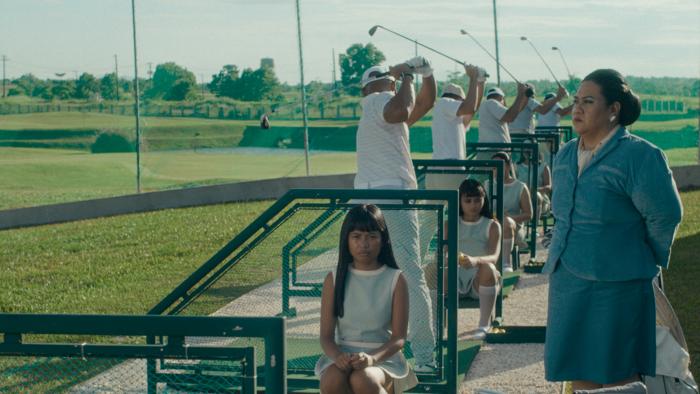
All we see or seem is but a dream within a dream, or so it feels inside the surreal and shadow-less world of Rafael Manuel’s Sundance-premiere Filipiñana, a beguiling class satire set at a mega-ritzy Filipino country club. Insistent on only revealing a glint of fangs from under its glossy stock-advertisement surface, they’re there all the same, shaking at the bushes at the edge of the frame and taking chunks from us when we dare to glance aside. Anyway the movie, the director’s first feature (based off his own 2020 short), deserves to shoot Manuel straight into the big leagues—its formal and visual brilliance slices us into well-deserved ribbons, without ever straining a muscle to get it done. Casual class evisceration.
Set across the blazing hot span of a single day on some endless-seeming stretches of golfing greens where the wealthy wander to and fro, swatting at the air, Filipiñana is the story of several characters whose paths criss-cross across it. But the main character we follow past and through the rest is Isabel (Jorrybell Agoto), a teenager freshly hired to the gig of “tee girl”; basically but not quite a caddy, if you will. And it’s Isabel’s passage from naif to veil-fallen class-warrior that Filipiñana brilliantly charts.
A hierarchy of colors separate the classes on the course (reminiscent of the red and green and brown costumes of the women in The Handmaid’s Tale no less)—the guests and golfers are of course done up in their crisp and spotless whites. There are deep pinks, like wounds or grapefruit, on the middle-classed servants. But Isabel’s bottom rung of the hierarchy wears a light sea-green that has them blend in with the surroundings, as that’s their job. To not be seen.
Early on, while aiding the mainly Chinese businessmen with their swings by swiftly and silently replacing golf balls in front of them whenever necessary, a near miss from a lousy player forces Isabel to ask one of her co-workers what’s to be done if she’s struck in the face, by ball or by club. Her co-worker smiles and tells her hey, it’s not so bad, the golfer will feel sorry and give you an extra tip.
And every little over-heard snatch of conversation we hear across the span of Filipiñana seems intent on underlining that harsh and horrible reality. Every character, from the strange and unreachable Dr. Palanca (Teroy Guzman) who owns the club on down to Clara (Carmen Castellanos), an American-born Filipino woman who’s being relentlessly harassed by her uncle to move to the country, is there to reinforce the rigid structures that Manuel’s film is staring down. A serfdom exposed to bright, terrible sunlight, its baked-in immoralities attempting to skitter like scared cockroaches as we watch with our magnifying glass eyes.
That’s how Manuel and his marvelous cinematographer Xenia Patricia (Zodiac Killer Project) film it anyway. With a remove, a distance, that forces us to lean in. Names like Haneke and Tati will rightly be thrown about, but I kept thinking of the mad Swedish genius Roy Andresson, whose impeccably crafted and unmoving frames—in masterpieces like A Pigeon Sat on a Branch Reflecting on Existence and About Endlessness—seem to be interrupted by the action instead of the other way around. As if this landscape painting before us has always existed and will always exist, but human inanity and violence will sometimes stumble through it. Eventually nature will take hold.
Isabel, smartly skeptical of her position in this place from the start, keeps wandering out onto the greens to the shade of a mango tree, cooling herself and eating fruit that’s fallen to the ground. It’s there where she meets Clara, and the two chat amicably; it’s clear that Clara, an outsider to the country, sees straight through the way this country marginalizes its women and indigenous people, and doesn’t want to have any part of it. One of the other tee-girls is left mouth agape when Clara tells her the golfers carry their own bags in America—not entirely true, of course, but it’s nice of Clara to plant this small seed of revolution anyway.
Little oddities and revolutionary off-ramps like that keep making this sweltering day, where all the characters move as if stuck in molasses, tremble with premonition despite its slowness—there’s a little girl in a red dress lost and wandering the greens, occasionally spotted running into some bushes; there is a group of monks in orange robes standing in a circle and chanting around a flag, blessing a hole, as well. And Isabel accepts a new side-quest a little too enthusiastically—Dr. Palanca, who she’s had her eye on all morning, has left behind one of his clubs. Won’t she return it to him? First day and she grabs at the chance to go off-book—why is this newbie so fixated on that top-of-the-pyramid man anyway?
Best let Filipiñana, marvelous Filipiñana, answer (or half answer, that is nudge lightly) its questions in due time. Manuel lulls you into a trance in this artificial place, a simulacrum of the old world’s order, only to chip away at it little by little as a thundering consciousness seeps down and out toward the scattered masses. There’s a hint of Ruben Östlund, specifically Triangle of Sadness, to be had here too, but Manuel is far more restrained toward his punchlines. He seems above all else giddy to have this play-set plunked down before him, and to poke and punch holes straight through the very substance of this gleaming, false surface. And that feeling becomes highly infectious in his hands. Viva Filipiñana’s revolución!
Filipiñana is currently in limited release.


