
Old School. Biblically Independent.
By Sara Clements | Film | April 3, 2023
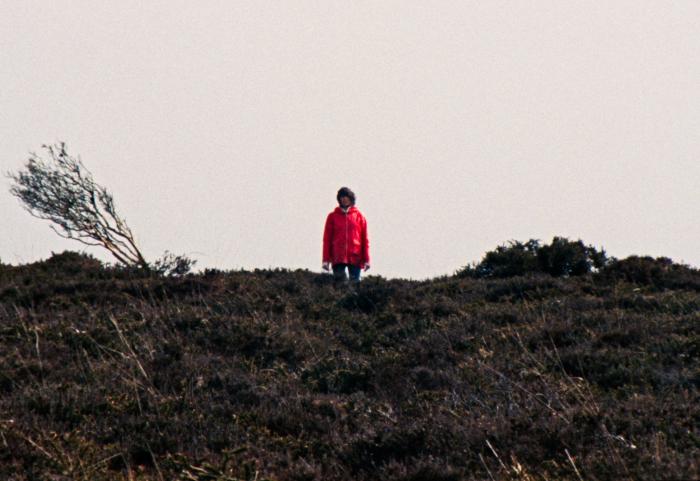
Enys Men is one of those films that feels like a recent discovery. Not a film made in our century, but one pulled out of a dust-covered box that sat among others in a storage unit for five decades. Mark Jenkin crates a surrealist picture that’s a feast for the senses as it follows a woman, simply known as “The Volunteer” (Mary Woodvine), who resides on an uninhabited island off the Cornish coast. It has a folklore spirit as it meditates on everything from humans’ relationship to the environment, life, love, and death. It’s enigmatic and unsettling, challenging the viewer to embrace a cinematic experience outside the ones that are filtering the current landscape.
Set in 1973, a woman in a bright red coat sits around a dull array of earth tones. On an island otherwise covered by moss and dead shrubbery, the only other bright things are a few rare wildflowers blossoming. The woman’s job as a wildlife volunteer is to take temperature readings of the earth from where these flowers are growing. In Jeanne Dielman-esque fashion, the film focuses on the woman’s routine: She checks her flowers, drops a rock in a well, and passes an ancient stone monolith before heading into her ivy-covered cottage. She fires up the generator, brews tea, and marks down the day’s observations. She finds entertainment in listening to music over her transistor radio and reading Edward Goldsmith’s ecological book, “A Blueprint for Survival.”
She leads a solitary existence. Many would find peace in such aloneness, but what does that do to the psyche in the long term? Her firmly held routine is the only thing keeping her from falling into a Robert Eggers’ The Lighthouse cabin fever. One day, as she waits for the supply boat, she relays over the radio that she’s “nearly out of tea.” In British terms, that spells absolute disaster, and the film’s tone immediately gets more ominous. Her routine eventually shatters. And while her routine and behavioral changes may not evolve with the slow effectiveness of Chantal Akerman’s masterpiece, it still results in its own kind of horror. Hints of folklore and paganism abound as the woman begins to have spectral visions and hear voices. Is this turning into a ghost story or just a descent into madness?
The film is non-linear; the past, present and future collide dizzyingly. It may have no sense of time narratively, but it looks like it’s a film true to its period. The use of 16mm — that flicker of celluloid — gives it a vintage feel, while its formalist approach, focusing more on technical elements than plot, nods to Structural-Materialist filmmakers of the 1970s like Michael Snow. It has an experimental backbone, one that results in some of the best sound work and images produced for the screen so far this year. The sensorial sound design captures both the early tranquillity of the piece and later eeriness, but all sounds from radio static to crashing waves are pronounced. It’s one of the ways the film creates a symbiotic relationship between the woman (or humanity) and nature. The camerawork accomplishes this as well by fixing its lens throughout on various parts of the woman’s body and likening it to shots of plants or stones. And while we follow her same routine, the shots never remain the same. Focus is put on every angle, preventing any dullness.
Enys Men leaves the viewer with a lot of questions, especially in terms of what is real and what is not. It hands us a full deck of cards for us to draw our own conclusions. The audience carves out the island’s history, as well as the history of the woman who we are following. Every element of the film has some level of ambiguity. This and the minimal dialogue may not be for everyone. It can also end up feeling a bit anti-climatic, as despite how trippy it gets, it never goes totally bonkers. However, it’s commendable how authentically 1970s the film is. Not only visually, but in its embodiment of the experimental essence of the era. Like Akerman and many other filmmakers of the time, Jenkin presents a structural work that encourages patience from its viewer to move away from the normal narrative structure and immerse themselves in the abstract. In our current cinematic landscape, it’s also commendable that studios still see value in that kind of storytelling.


