
Old School. Biblically Independent.
By Jason Adams | Film | July 14, 2023
A seaside town, the sort of serene place where people go to write their great novel and stare at the calm water while they do it, is the setting for Transit and Undine director Christian Petzold’s gloriously unsettling fable Afire—and if that title isn’t intimation enough that things aren’t as serene as you expect them to be, then just wait until you see the flames relentlessly nipping at the edge of the forest. We seem to live in a world on the edge of catastrophe now, and this is a movie that captures the feeling we’re one wind-change away from annihilation; that every little choice we make is almost unbearably fateful. (Watching it one day after the skies turned red in NYC was let’s say An Experience.) Call it Éric Rohmer’s Apocalypse.
The unease settles in quickly, as good friends Felix (Langston Uibel from the Netflix series Unorthodox) and Leon’s (Thomas Schubert) car breaks down in the middle of nowhere, a dozen kilometers from their destination, Felix’s father’s summer house nestled in the forest just a short walk down to the dunes of the Baltic Sea. They’re headed there, in theory, to do some work—Felix has a speculative photography project due while Leon, an endless bundle of nerves, is finishing up a story he’s written before his agent Helmut (Matthias Brandt) comes to read it. In practice, well, it doesn’t exactly turn out that way.
But first they need to get there. Felix says he knows a short-cut through the woods, and so he and Leon, neither of them dressed for a hike and the both of them looking like the most stereotypical of city slickers as they attempt to do it, plunge into the trees, loaded down with their luggage. And sure enough and soon enough Felix is unsure of where they are. He runs off ahead. Leon sits on a log, watching it get darker, and darker. Bizarre animal noises grunt and snuff nearby. Very nearby.
The boys do eventually make it to where they’re going, but that old-school fairytale feeling clings to them like a thick fog—when they do arrive at their cottage there’s already somebody there, sleeping in this little piggy’s bed, eating that little piggy’s porridge. Felix calls his mother and it seems there’s been a schedule mishap; a friend of a friend, a young woman named Nadja (Paula Beer, a Petzold regular by now), is also staying at the house. The boys will have to share a room—already Leon is incensed.
It takes a long time for their paths to cross with Nadja—they mostly see the things she’s strewn about, not knowing she has company. Or they lie awake listening to her having sex with who knows in the other room at night. The tension of when she will realize there are two adult men also staying in her vacation home becomes its own sort of live wire—we suspect a large reaction to such a thing! Add on the fact that the radio is being somewhat hysterical about local wildfires and the skies are full of rescue helicopters overhead and sea-side serenity is the last thing on anybody’s mind.
Or at least on Leon’s. Felix has more of a laid-back laissez-faire approach; he hasn’t figured out his photography project yet and is receptive to slow inspiration, happy to fix a leak in the roof and see what comes as he stares at the water. Leon on the other hand is a big old bundle of nerves, and he can’t seem to stop taking everything—the helicopters overhead, the broken down car, this strange woman flitting by the window as he sips his morning coffee—as a personal attack. An impediment to doing his very very important work.
Eventually, they do meet Nadja and the world doesn’t end, at least not yet. And they also become friendly with the handsome lifeguard Devid (Enno Trebs) with whom they heard her having her nocturnal activities. Well Felix becomes friendly, anyway. Leon keeps eyeing everyone with resentment, especially as the ease with which they go about things begins to needle at him for its own sake. Why can’t he relax, he seems to ask himself? But that only makes it worse. And Petzold morphs that into the real tension at play here—Leon, so cyclically trapped in his bullsh**, just can’t calm down and enjoy the moment. And the sight of everyone else swimming, sunning, flirting and having fun, only exacerbates the ache in his belly.
And if you’ve ever found yourself the black cloud unable to do anything but rain on everybody else’s parade—an instinct that I will admit has come woefully naturally to me ever since I was the kid who refused to take his coat off at family gatherings, lest they become confused and imagine I wanted to be there—all of Leon’s sh**ty behavior will land like a ton of bricks on your head like it did for me. Leon is clogged like a drain and every small slight— dirty dish, a stolen kiss —only stops him up worse. I trust we’ve all been in that unforgiving place, and it ain’t fun, and it’s only crueler the more you become aware of it.
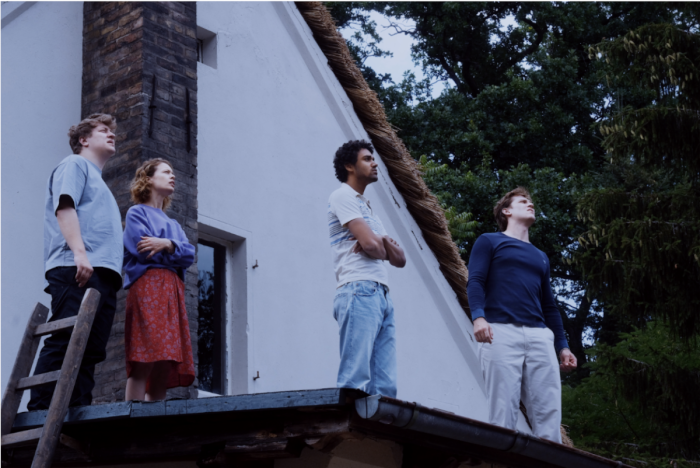
And Leon’s world, ringed with fire, answers in kind. His agent will arrive and immediately hit it off with everybody while also deeply side-eyeing Leon’s work, and then every night they will all stand on the roof of the cottage and watch the sky grow redder. The sounds of those animals in the forest will grow bigger and start to turn into screams. Ash will begin to fall like snow over everything. And Leon will only grow harder, angrier, until there’s nothing for this holiday left but hellfire itself.
Afire is a disaster movie writ through emotional blockage; Leon’s selfishness is a cork in a crack in the earth, causing lava-bomb calamity to pop out on all sides. The way Petzold entwines human frailties and faults with the environmental; the disconnect between this gorgeous setting and the tumult blackening its edges—it’s all so subtly profound that it doesn’t hit you until you can stand askance, from the other side, and see what a lavish achievement it is. One taken in small merciless steps. This is a great film, unforgettable, seared into my skin.


