
Old School. Biblically Independent.
By Jason Adams | Film | February 5, 2026
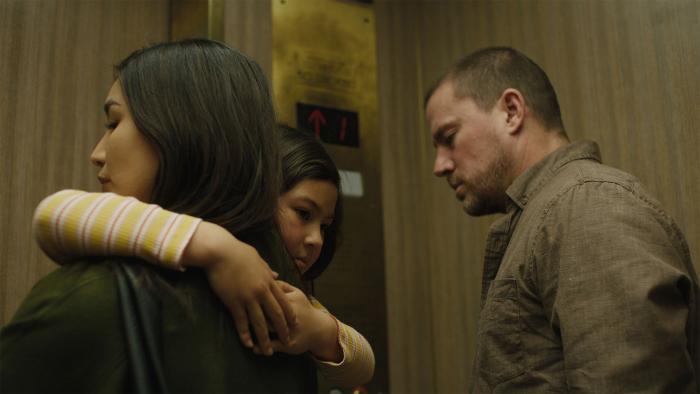
Josephine is only writer-director Beth de Araújo’s second feature (following 2022’s Soft & Quiet, a daring and divisive balancing-act about suburban white-supremacist moms), and yet it was the big winner at this year’s Sundance where it nabbed the prizes for U.S. Dramatic Feature as well as the respective Audience Award. Starring Channing Tatum and Gemma Chan as the parents of Jo (Mason Reeves), an eight-year-old girl who witnesses an act of sexual violence and naturally has issues processing what she’s seen, it’s not hard to see why critics and audiences were both stirred—Josephine has all the trappings of a serious Sundance darling. (Especially in a year where the fest menu was almost all misery-tinged—the broadest comedies of the 2026 crop were about school shootings and 9/11!)
And yet Josephine feels like a clumsy step backwards for its filmmaker to me—despite its at times viscerally upsetting subject matter, this is ultimately nothing more than a decently performed but dated after-school special; a lot of cornball draped in robes way too big for its britches. A daring filmmaker who last had soccer moms baking All-American Apple Pies with swastikas carved into them feels here to’ve been sanded down for a blander mass consumption. So allow me to weep a little.
Which isn’t to say that the subject matter of Josephine isn’t inherently risky business. While out on an early morning run with her fitness-obsessed dad Damien (Tatum), Jo playfully runs ahead temporarily losing her father, and from behind a tree witnesses a woman being beaten and raped outside of an isolated park bathroom. All of what Josephine sees we see alongside her, and it’s brutal and horrific. Both because we’re subjected to watching it ourselves and because we’re simultaneously watching an eight-year-old wall themselves off in confusion in real time, without much idea of what’s happening besides that the woman is clearly in pain.
Damien comes upon the scene at its very end and chases off after the rapist, leaving his daughter there with a strange woman crying in the dirt; then when the cops arrive he again leaves his daughter with one of them so he can lead some of the others off after the man. And they do catch him, and the woman identifies him, and for a hot minute Damien and Jo’s mom Claire (Chan) seem to think that maybe they can just not have the conversation that they definitely need to have. That maybe they can let Jo’s young and malleable mind wallpaper over this horror.
Of course, that’s not the case, both because Jo starts displaying behavioral issues and because it slowly becomes apparent that Jo is going to have to testify in court as the only eyewitness to the crime. Damien, a good man and father with some smothering white knight tendencies, is gung-ho that the man must pay and that it’s his daughter’s job to do what she can; meanwhile Claire, a good woman and mother who understands the world more realistically, knows that justice is rarely served. (It remains unspoken but heavily implied that she is herself a survivor of assault.)
There are interesting threads here that promisingly threaten to pull Josephine out of its standard parenting/courtroom drama lanes, like how Jo’s trauma becomes manifested by her being haunted everywhere by a specter of the rapist (Phillip Ettinger). He’s always at her side, her invisible play-mate and nightmare, and as Jo grows more troubled her lashing out grows increasingly dangerous. (Yes you will see an eight-year-old girl creepily handling a knife.) And perhaps it’s my inclination toward metaphor in storytelling, but this stuff was always far more involving than any of the film’s endless parental back-and-forths which never veer out from their preordained stereotypical places. Tatum and Chan do fine enough work, but there’s not an unexpected note given to them to play. (The less said about the dance montage the better.)
Meanwhile, it’s a huge ask of an adult actor to ask them to play this emotionally shut-off and make that riveting cinema, and so asking it of a child actor seems especially unfair. Whether Reeves was asked to play Jo as a near total cipher or whether that’s just the limits of what the filmmakers could get, we’re forced into the position of projecting everything onto the character while receiving very little in return—let’s just say this is not one of the rare and wondrous Adolescence situations. This movie remains very much on the outside of Jo, quizzically staring in.
And perhaps as a field guide for parents asking themselves these difficult questions in the face of an unknowable child before them there’s helpful fruit to be plucked out from that frustration. The route that Josephine takes to its unbearably sappy last scene was just way too straightforward and uninspired from where I stand. Handling thorny subjects with kid’s gloves should still leave some kind of a mark behind.


