Old School. Biblically Independent.
By Jason Adams | Film | October 20, 2026
What did Saint Sebastian do to deserve this? Seventeen centuries ago he was just a lowly nobody Christian boy who wanted to stay that way. But then the Romans had to go and shoot him full of arrows (fun aside: he survived that only to be clubbed to death a little later) and the next thing you know he’s inspiring centuries worth of homoerotic art just for being a pretty, suffering twink. Suddenly Oscar Wilde’s using his name and Derek Jarman’s making a nudist romp about him, and every gay artist is all up in his business. The latest culprit being Los Javis (aka the Spanish filmmakers and former couple Javier Ambrossi and Javier Calvo) with their Cannes-winning film La Bola Negra, which in its vapid maximalism never met a single queer cliche it couldn’t strip for parts. This is a movie that will be deemed Very Important because it gloms itself onto a lot of very important subjects and then throws everything everywhere all at once at them, but don’t be fooled—this marble statue deflates like a pool floater when any arrows strike it.
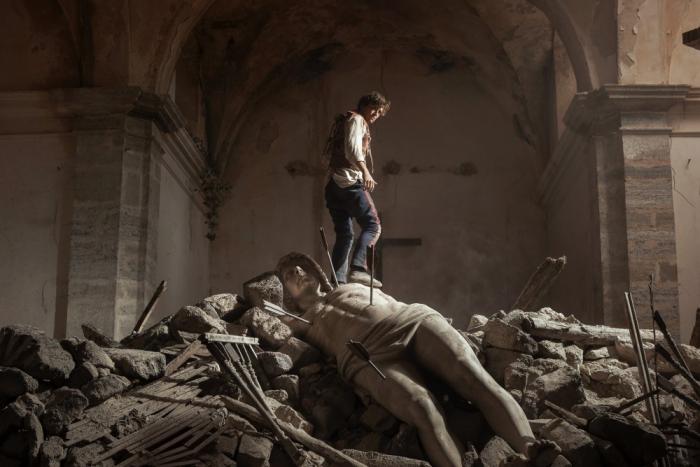
The film opens in 1937 during the Spanish Civil War as a large-eyelashed young thing named (you guessed it) Sebastián (played by the singer Guitarricadelafuente) is poorly playing the trumpet in the village square to welcome the planes of the triumphant Italians to town. He beckons his mother over just in time for the Italians to “accidentally” open fire on all of the people gathered there—Sebastián only manages to barely escape with his life by clambering up the rubble of the town’s toppled Saint Sebastián sculpture (I guess that’s why he got his name), using the poor lad’s unquenchable arrows to gain his purchase. And much like that image La Bola Negra will from there continue to pull itself up by the centuries of queer work that came before it, kind of shuffling it all together into a stew so over-salted you become suspicious of what all that salt is being used to cover up.
Kind of The Hours with more buggering (or so it wishes), La Bola Negra tells three intertwined stories, all of them edited together into a furious maelstrom of “intent.” There’s the aforementioned trumpeter Sebastián, who finds himself pulled into the war where he falls for the beautiful blank slate of an injured former-soccer-star named Rafael (Miguel Bernardeau). Sebastián finds himself tasked by his superiors with spying upon Rafeal to get information they think he has out of him. but all Sebastián can seem to spy on with any real determination is Rafael taking a bath. (Which, well, understandable. But god they’re an uninteresting pair.)
Then there’s a story set five years earlier just as the war’s heating up, where a rich lad named Carlos (Milo Quifes) swans about the city getting drunk and being beautifully dissolute. He’s got a pretty anarchist best friend who shamelessly flirts with him, but Carlos won’t be satisfied until he’s voted into the company of the members of a rarefied casino (this seems to be equivalent to a country club today, or perhaps even, given its political leanings, the Christmas Adventurers from One Battle After Another). And this is where the film’s title comes from—the club members cast their secret vote via white balls for yes and black balls (la biola negra) for no. And Carlos keeps drowning in the black ones all because they know he, you know, parts his hair in the middle. (And yes that’s a genuine innuendo of queerness that this film delightfully resurrects.)
The film’s title also happens to come from a lost play by the legendary gay Spanish poet Federico García Lorca, famously assassinated in 1936—only a few pages of that work remain, but not in this film! In the third section of La Bola Negra’s story the rest of the play is finally uncovered in 2017 when a young man named Alberto (Carlos González) gets a phone call (in between his Grindr notifications) telling him that his grandfather has died and left him a mysterious envelope. Alberto never knew said grandfather, and when he asks his drug-addicted whirling dervish of a mother (played by Almodovar icon Lola Dueñas) about it she freaks out. So Carlos heads off on his own to tear open said mystery and unravel the past, and soon enough it will be plain to all how these stories figure in.
In the interim there will be lots of Spanish soldiers running naked in the surf; there will be Glenn Close speaking the word “la homosexualidad” in a thudding American accent; there will be Penelope Cruz temporarily stealing the movie by closing the gap between Mae West & Marlene Dietrich as a sin-loving chanteuse who’s tasked with entertaining the troops—and make no mistake, everything just listed is not nothing, to be sure! La Bola Negra is a gorgeously filmed movie bursting its trousers with visual swagger, with a barn-burner of a score from Raül Fernandez Miró all ladled over ithat. A whole lotta sturm and drang has been assembled in its fruitless pursuit of substance.
But it’s also a film that ends well, finally plowing its way to its rather obvious point in its closing minutes, after almost three hours of wandering around aimlessly, all as Miró’s gorgeous music crescendoes and the words of the poet Lorca are finally deployed to full effect. A movie that ends strong will often convince its audience they were flying that entire time, even if it was more like being dragged by an unwieldy mule over intermittent peaks. La Biola Negra accumulates a whole lot of other people’s stuff and then smashes it together a lot, and of course some meaning will manage to poke out from that mess. But mostly it’s just a big pile.


