Old School. Biblically Independent.
By Jason Adams | Film | August 2, 2026
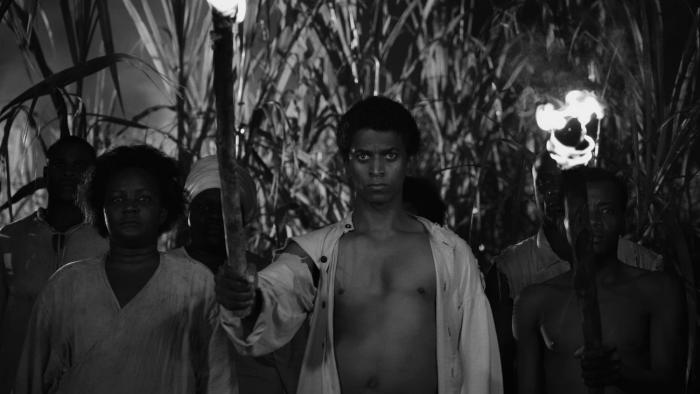
Even for stupid people who say they hate it when horror movies “get political” (as if they haven’t always been so, and intrinsically) it still seems undeniable that George A. Romero’s 1968 masterpiece Night of the Living Dead was a parable about the racial unrest of its moment, landing as it did smack-dab in the midst of Civil Rights Era America. When [spoiler alert for a nearly 60-year-old story] our black hero Ben (Duane Jones) is gunned down in the film’s closing moments by a rural white mob and Romero dissolves the film into a nightmare of grainy imagery showing his body being hooked and dragged and burned with the rest of the monsters, it’s unsubtle enough (one would hope) that even the rubiest red of rubes can’t deny the obvious reading.
Romero always pushed back at this being entirely his intention—he maintained (with a hint of a knowing smirk that nevertheless undercut such insistences) that Jones was simply the best leading man that he had on hand. Nevertheless Romero’s lauded “bravery” at sneaking a race message into what might’ve otherwise been just a forgettable horror picture has solidified into a totemic thing—a pillar of how we think about Modern Horror.
So it’s with no small vibe-shift that director Maya Annik Bedward’s brilliant and vital new documentary Black Zombie side-eyes all of that with a half-tossed-off comment dropped in its midsection. With just the eensiest switcheroo in perspective—a “Hey here’s a thought: let’s listen to what a black person has to say about this movie!”—you suddenly realize that what seems “brave” to white viewers wielding our White Savior Complexes willy-nilly was probably a devastating downer to the black people watching the same film.
Black Zombie doesn’t belabor this since it’s not exactly Breaking News (even the whitest of us has surely briefly considered this for a moment), and it also doesn’t disavow the obvious importance of Romero’s masterpiece. But the film does give that feeling some long-denied space to really breathe, to make its case. And inside a film practically bursting its seams with the fresh air of a fresh perspective that’s, dare one say, refreshing. As a queer person who’s been watching noble and/or evil gays die in the last reel for decades, it’s a feeling that certainly resonates over here.
Tracing the zombie genre back to its Haitian roots and the white colonizer mind-set that reshaped and continues to reshape a black religion and its cultural narrative, Black Zombie is another essential documentary in a steady stream of them to drop over the past decade—ranging from ones hyper-specific like Lynch/Oz to ones immense a la Bryan Fuller’s long-form series Queer For Fear, these cinema-focused docs have made any of us who spent tens of thousands of dollars on Film Studies degrees helplessly picture flames licking at all of that pointless debt we buried ourselves in; and we maybe beg for some sweet sweet un-death ourselves. (Wake me up in time for brainssssss.)
Anyway Bedward structures her arguments with great and vivid force, dissolving chronology when necessary to make a point or alternately to dip in a little levity whenever things have maybe gotten too academic. (It helps to have the fantastic thinker and writer Tananarive Due on hand as a talking head, as she’s always a sign of true quality; if you haven’t watched the doc Horror Noire yet that’s pretty much now a requisite companion piece to this one, so give yourself the gift of a double-feature the minute you can.) Mostly the film begins at the beginning though, with American “occultist and explorer” W.B. Seabrook’s 1929 book The Magic Island. This mega-successful novel detailed Seabrook’s travels through Haiti where he learned the supposed ways of the Vodou priests, and with this he became the person who introduced the idea of the “zombie” to the U.S. for the first time. (And yes the evolution of what a “zombie” is, changing from a brainwashed person to a braindead flesh-eating monster, is another integral throughline in Annik’s doc.)
Nevermind that Seabrook’s circus-barker accounts of Haitians using magic spells to hypnotize people into a trance-like obedience were as farcically mixed-up as they were purposefully embellished for his book sales—within three years movie star Bela Lugosi was starring in White Zombie. Vaguely based on the book, this 1932 horror hit saw the previous year’s Dracula playing a crazed plantation owner in Haiti who turns another man’s beautiful blonde fiancee into his own mindless sex-slave through his wielding of the ol’ local religion. And off we went.
Obviously the racialized roots of “the zombie” were there and thick-as-heck already—Lugosi’s a man perverted by his immersion in a perverse culture says that film; in the parlance of the time he went “native” and so only sickness and madness could follow. What Bedward’s movie does so well is tie these ideas to the very real Haitian Revolution of the late 18th century, where the enslaved people of the island fought back against the French and actually won, driving their enslavers from the island and winning their independence. One of the few successful slave rebellions in history that turned into the actual founding of a free state, off-island Haiti immediately turned into a sumbol of something that terrified the outside powers that be.
And so, Bedward argues with spectacular precision, the powers that be set about turning Haiti into something that would scare anybody in turn. Vodou became (specifically) White America’s boogeyman—scary dark-skinned people beating drums in the woods, turning beautiful blondes into their mindless servants. Run, crackers, run. But it’s not like there were a bunch of white guys sitting around a brown-panelled board-room making all of this happen—White Culture was more than happy to loose its subconscious on things it didn’t understand and, instead of trying to, feed its fears with the seemingly undepleteable firewood that is Xenophobia.
And this was what the zombie remained in popular culture until Romero came along and flipped the script on them, rewriting the monster into a reanimated corpse riding a hankering for living people parts. That the Living Dead lands like an Atom Bomb at the exact moment in time where Black Americans had begun demanding their equal rights en masse hardly seems inconsequential, given this history. And Black Zombie brilliantly makes its case from there too, tying the ever-hurrying hordes of fiends breaking into our homes, crossing over the borders, straight to more modern fears about immigrant invaders. (A moment in the film that cross-cuts zombie hordes from entertainment like World War Z and The Walking Dead with news-footage framing undocumented people at our borders as an equal kind of terror is mighty telling.)
That Bedward manages to do all of this while simultaneously working to humanize real live religious Haitians is really quite something. She gives several local religious figures as much talking-head time in the film as she does the movie-nerds and academics (and, somewhat awesomely, Slash from Guns N’ Roses)—we watch them practise their Vodou like any old schmoe off the street, buying herbs at the local corner mart. And there’s nothing even a tenth as scary as Catholicism up in here. And thankfully the locals, who give voice to their well-earned distrust of an outsider coming in and promising to tell their story with fairness this time, no really, had nothing to fear. Bedward, with her brilliant and unmissable documentary, finally does them right. Oh that we can follow in the film’s footsteps.
Black Zombie just screened at the Fantasia Film Festival in Montreal. It will hit U.S. theaters on September 11th.


