Old School. Biblically Independent.
By Jason Adams | Film | October 8, 2026
This past week a gang of renegade white-supremacists who fancy themselves an art collective installed a fifty-foot-tall bronze statue of Prometheus, his gift of flame hoisted unto the heavens, just a few miles down the road from Starbase, the Texan town where Elon Musk and all of his nonsense is based. This was apparently done sans irony—they really meant what they sculpted. (In so far as they mean to get rich off such stunting, no doubt.) So that’s the reality we’re living in the year 2026. And we can only wish the best of luck to all of the actual artists out there attempting to grapple with how much stranger than fiction it is here, in what passes for the real world these days.
But bless them, the real artists are still trying. Landing in cinemas this very week there’s both Alex Gibney’s four-hour Musk documentary and Aaron Sorkin’s pseudo-Social-Network follow-up The Social Reckoning, which details a more recent chapter in Facebook’s decades-long reign of terror. Having seen neither of those I can’t speak to their quality, but I have very little doubt in my mind that either of them will approach the sick-makingly hilarious success of Luca Guadangino’s Artificial, which just premiered at the New York Film Festival (no thanks to Amazon, who tried to bury it). Artificial spills the guts of tech-creep Sam Altman’s OpenAI (now, no doubt coincidentally, co-funded by Amazon) across the floor like a spray of slippery Stooge-ian banana peels. Walking a tightrope between horror and comedy so razor-sharp it’ll split you from toe to tip just for the fun in it, Artificial is a bright and brilliant farce of necrotic adolescence—one that feels terrifyingly honest and true because it embraces the ugly noogie absurdity of right now. Once the CEOs stopped wearing shoes we should’ve known it was all over.
Yura Borisov, who found himself a sudden Oscar nominee two years ago for his lovely and understated work in Best Picture winner Anora—note that I didn’t say he came out of nowhere because I’d already fallen for him thanks to 2022’s Compartment Number Six—in Artificial plays OpenAI co-founder Ilya Sutskever. We meet Ilya at all of 17-years-old, already balding as he stumbles into the University of Toronto office of “The Godfather of A.I.” Geoffrey Hinton (Mark Rylance). (Keeping an eye on Sutskever’s balding is the best way to keep track of time passing across Artificial, although there are helpful intertitles as well.) With hardly any hello Sutskever immediately begins rubbing the calculations off Hinton’s chalkboard to showcase hiw own and Hinton, prone to rattling off poetry and literature quotations like a one man Wikipedia, is not terribly impressed—you get the feeling he gets ten such antisocial weirdos storming into his office every day.
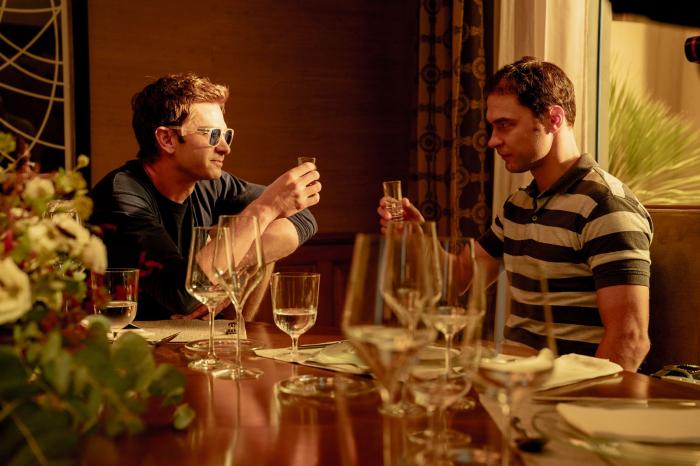
But Hinton’s eyebrows do waggle, in that very particularly Rylance-ian way, and Sutskever and Hinton’s paths cross and re-cross enough that soon they’re working together at Google on the dream of Artificial General Intelligence. (That’s the one where the Terminators kill us.) Hinton insists that it’s decades off but Sutskever, stars in his eyes, sees the beautiful possibilities of tomorrow. Like tomorrow tomorrow. And his brilliant but boundless idealism is like blood in the water of Silicon Valley—very quickly the sharks are sniffing about. The ones keen to repurpose Ilya’s vision of a shining city on a hill into a walled-off palace where they rule over all us measly NPCs. The Matrix is the documentary of their dreams for sociopathic chuds like Elon Musk (Ike Barinholtz) and Altman (Andrew Garfield—serpentine, hilarious and horrific in equal measure). And unfortunately all the money (like literally all of it) is flowing in their direction.
If this sounds dark then you’ve probably opened the blinds within the past five years and had those blinding bright rays of the future obliterate your own eyeballs. But the dark genius of Guadagnino’s Artificial is just how much it suits itself up in the baggy cargo shorts and hoodies of an Aughts-era teen-comedy—squint hard enough and this is just Superbad. Just with a more literal take on that title. Because things are indeed super bad! And absolutely nobody is McLovin it. Oh to just be Clueless again.
The abyssal sink is slow for Ilya though, who is the absolute last person to notice he’s hitched his caboose to power-mad sociopaths. He’s so busy with his head buried in his laptop he doesn’t notice the ways in which Altman, eyes sparkling with Faustian ink, is bit by incremental bit manipulating everyone into a cult of exactly one. Around campfires and keggers Altman gets the entire company to chant “Feel the AGI!” in orgiastic wonderment, but it’s clear he considers himself the only singularity that matters. There is no work-life boundary in this place—devotion’s all-in, mind spirit and the sleek sterile body of an iPad in each of your hands, gently bumping.
Anyway leave it to Luca, Dionysian Luca, to make a movie about stunted boy-men all balled up inside their own skull-cavities still feel so fleshy and human. Altman being gay is the only hint of sexuality on hand but even that always feels like snuggling; when gorgeous tech genius Mira Murati (Monica Barbaro) shows up it’s to school-yard titters and bashful blushes. And yet the dorky bacchanals on hilarious display here still thrum with a clueless sweaty homosociality—Guadagnino unearths the humanity even here among the machine-men, horrible and tragic in repressed neck-grabs and the noise of green juice slurping. Altman’s twunk-studded bunker and slo-mo tighty-whities parties abound. Garfield’s Altman is a knot of elfin depravity—what squelched out of Pandora’s box and slipped into a band tee. These beasts have been handed the godhead with no damned clue what to do with it. A.I., created in their image—the devil save us all. Well at least we got this brilliant and funny movie before we’re swallowed up into the acid bath of algorithm.


