
Old School. Biblically Independent.
By Kayleigh Donaldson | Film | September 21, 2026
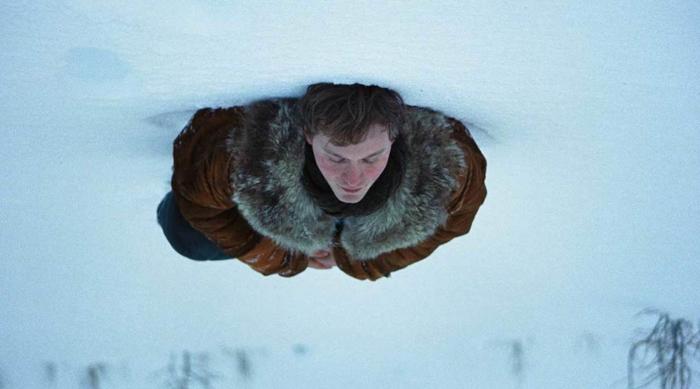
In the mountains of Oregon, Winter is coming. Mike (Fred Hechinger) lives a quiet life in the wilds. His brother Tommy (Kit Connor) is preparing to serve in the Korean War. His father Lester (Ebon Moss-Bachrach) relishes his simple existence away from the city, but for his mother Louise (Caitriona Balfe), things are less appealing. As the first wave of snow hits the region, Louise goes missing. With a harsh winter ahead, Mike will have to deal with the fallout, and decide what his own future holds.
Andrew Haigh has never made a bad film. The English director has spent the past 15 years delving into quietly enigmatic narratives about loneliness and its consequences and cures. Weekend deftly depicted a brief yet impactful romance between two men. In 45 Years, the deep-hidden secrets of a long-married couple emerged and left a once rock solid relationship in tatters. All of Us Strangers, which made me bawl like a baby, revealed the ways that shame and isolation leave generational scars. With A Long Winter, adapted from a short story by Colm Toibin, Haigh is in familiar territory, but his light touch and un-flashy approach to thorny topics makes this a subtly stirring watch.
Everyone in this family is alone. Louise drinks to stave off her depression, but intoxication only exacerbates her bitterness. Tommy has chosen war over home life. Lester, very much a man of his time, can barely express a relatable emotion when his wife disappears into the unknown. For Mikey, finding out the unseen depths of his parents, ones seemingly everyone but him were aware of, is seismic, and only serves to make him feel more isolated from the wrld. It seems hard not to be lonely in this vast space of untouched snowfall and towering fir trees. Via André Turpin’s cinematography, the landscapes seem monochromatic, which is sharply contrasted with the claustrophobic indoors of Mike’s home, a wooden hut lit by the amber glow of gaslight. It’s all like a Victorian ghost story, a liminal space overwhelmed by a season of drastic change.
Haigh’s work often focuses on gay men and their intersections with community or lack thereof. For Mikey, his burgeoning queerness is something of an afterthought in his own life, a secondary priority after everything else unfolding. He has dreams about Jimmy (D’Pharaoh Woon-A-Tai from Reservation Dogs), a mixed-race local who later comes to work in his house as the domestic help-slash-replacement wife. Mike’s longing is subtle, even by Haigh’s standards, a brief respite in the face of such emptiness. But it’s gender that the director is most fascinated by in A Long Winter, not sexuality. The toxic gender binary makes fools of us all and only serves to stifle community and relationships.
Lester, played by Ebon Moss-Bachrach with a keen balance of arrogance and regret, is a one-time New Yorker who clings to dreams of a humble life away from modern trappings, but the reality is that his attempts at self-sufficiency have left his family in a constant state of precarity. It only grows worse once Louise runs away and Lester tries to avoid confronting his own uselessness. The masculine dream is almost entirely dependent on the labour of women, rendering these macho dudes into mere infants in constant need of mother’s milk. Rather than, you know, cook his own dinner, he forces Mikey to be “the girl”, then shoves it all onto Jimmy, the only non-white person he knows.
Even the loneliest and most broken person has to keep moving forward. Survival mode is tough for everyone, from the locals who scrape by after the closure of the mines to the vultures who await the first melt of spring so that they can feast. Keeping calm and carrying on is something Haigh is familiar with, and his work is intimately detailed in revealing the emotional cost of this faux-tranquillity. It’s a slow-burn and unpretentious tale that quietly reveals the tragedy of a life lived in limbo, although, in typical Haigh fashion, it keeps the audience at arm’s length. There’s a distance to A Long Winter that may leave some feeling shut out. Its focus on the stifling nature of repression comes a tad too close to emotional opacity, and for a film set in the open wilds of Colorado, it has a real sense of airlessness to these feelings. The characters can barely breathe, so we can’t either.
While A Long Winter doesn’t reach the heights of Haigh’s best work—and he did set the bar incredibly high for himself—it’s a welcome addition to his filmography of loneliness and a reminder of how much he can do with seemingly so little. A restrained movie about restraint, it’s a gentle but lived-in portrayal of the importance of opening up and rejecting tradition.
A Long Winter had its Canadian premiere at the 2026 Toronto International Film Festival. It currently does not have a release date.


