Old School. Biblically Independent.
By Melanie Fischer | Film | June 3, 2026
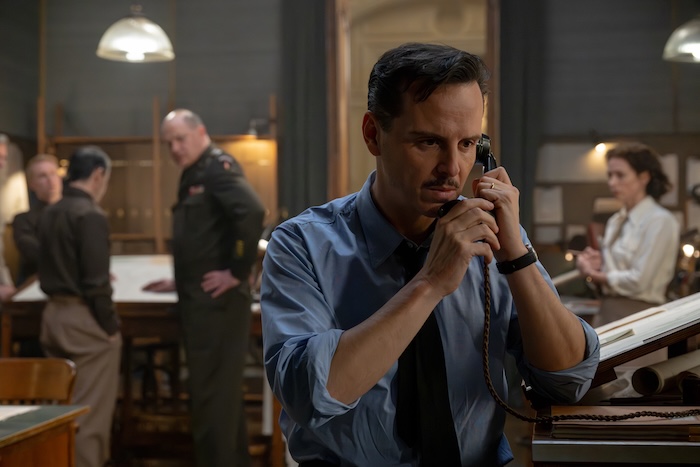
Considering Hollywood pumps out WWII movies with a regularity that suggests the sky might fall if it did not, it’s quite an accomplishment to find an angle that feels truly new, particularly when it comes to an event such as D-Day. Yet that is precisely what Pressure manages to do with the story of James Stagg (Andrew Scott), the Scottish meteorologist tasked with forecasting the weather in the nail biting days leading up to the Allied invasion of Normandy. Stagg forecasts terrible storms for the morning of the planned invasion—catastrophic news unto itself, but the more immediate issue is that his forecast contradicts earlier predictions provided by his American counterpart, Irving Krick (Chris Messina).
Stagg’s forecast is the result of meticulous calculations made using the most comprehensive and up-to-date data set available. Krick’s method relies on digging through old weather maps dating back years, even decades, to find similar weather conditions, from which he extrapolates his predictions. In other words, if today’s weather looks a lot like it did on June 2nd five years ago, Krick anticipates that the weather on June 6th will also greatly resemble what it did on June 6th five years ago. It’s an enticingly simple strategy—easy to grasp conceptually, with a lot more pictures and fewer complex equations than Stagg’s way of doing things.
Stagg is sharp, both in terms of his intellect and his rather cutting disposition. He falls into a familiar undersocialized genius archetype—the first to spot a calculation error and the last to get a joke, booksmart to a fault yet unable to read a room (or can’t be bothered to try)—but Scott brings him to life with the depth and emotional vulnerability he consistently brings to characters who could easily fall flat in different hands. Krick is a much smoother operator than Stagg and Messina does an excellent job of walking the line between charmingly charismatic and downright smarmy; full of confident smiles and breezy reassurances backed by anecdotes of his many past, often star-studded triumphs (MGM brought him in to forecast the weather during the production of Gone With the Wind, and he’s absolutely told everyone he’s ever met since). He’s not a fraud, but more enamored by the perks of rubbing shoulders with the rich and powerful than the actual work itself that brought him there, willfully ignorant to the potentially disastrous consequences of the assumptions upon which his beloved shortcuts are built. There’s something compellingly timely to the central tension here, even as it feels painfully foreign to see a scenario where a complicated, unlikable truth has any chance whatsoever against a well-packaged vat of snake oil.
In this showdown of style vs. substance, it’s up to none other than US General Dwight D. Eisenhower (Brendan Fraser) to determine who wins. Fraser plays a considerate, distinctly brittle version of the future President, haunted by the specter of Exercise Tiger, the training exercise intended as a D-Day rehearsal that, due to a perfect storm of strategic miscalculations and communication failures, resulted in the death of over 700 American troops.
The shadow of Oppenheimer looms large over Pressure. Not in a bad way; this is a film that happily thrives in the shade. Considering it’s adapted from the play of the same name by David Haig (adapting his own material in collaboration with director Anthony Maras), which predates Oppenheimer by nearly a decade, it’s certainly not a knockoff. But much like the Christopher Nolan helmed behemoth, Pressure is a crossover between a WWII drama and one of the few perennial stalwarts of Hollywood that dates back even further, the persecuted genius biopic. (Or as I like to call it, the horseshoe crab of movies.) But if you saw Oppenheimer and loved it, or liked it but wished it was 80 minutes shorter, this movie was made for viewers like you. Yes, at first glance it might seem like a stretch to compare the weather to an atomic bomb, but anyone who has ever planned a major event outdoors (not to mention the largest seaborne invasion in history) respects and fears its potential to be obliteratingly catastrophic.
The big news at the box office right now is Hollywood’s sudden realization that giving a million dollars or so to a twenty-something with fresh ideas and a built-in fanbase exported from Youtube might be more effective at attracting young audiences than spending exponentially more on franchises older than they are. (Better late than never, I suppose, but seriously, how much do these executives get paid?) But a healthy film industry, like any ecosystem, has diversity, and Pressure is a great example that even in a new world order there’s still room at the table for a classic story well-told.
Pressure is currently playing in theaters.


