
Old School. Biblically Independent.
By Kayleigh Donaldson | Film | December 11, 2025
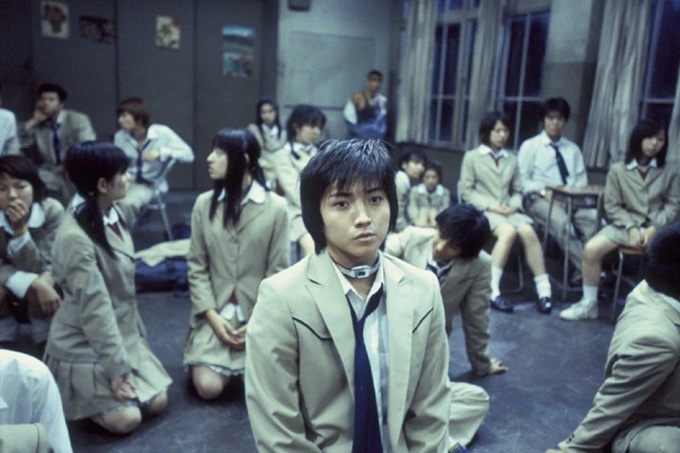
Quentin Tarantino has been putting his foot in his mouth a lot lately, eh? Well, actually, all those quotes that had the internet forming The Official Paul Dano Defence Squad came from one longform podcast interview with Bret Easton Ellis, but who had time to listen to that? One of the other most-shared quotes from his ramble was about one of his favourite films of the 21st century: Battle Royale. After listing it as one of the best movies of the era so far, he ranted about how The Hunger Games, the still-running dystopian franchise based on a beloved YA series, had clearly ripped off Battle Royale.
Tarantino wasn’t the first to make this claim, nor will he be the last. Only recently, The Guardian chief film critic Peter Bradshaw echoed the claim. It’s become a popular way to deride the work of Suzanne Collins, which evolved into one of the true pop culture touchstones of its generation. These are the books that introduced the entire concept of dystopian fiction to a whole demographic, and the trend it kicked off helped to replace the paranormal romance trend of YA for a good few years.
Collins has faced this criticism from the beginning of The Hunger Games’s literary life. She told The New York Times in 2011 that she’d ‘never heard of that book until [her] book was turned in.’ For her, the biggest inspiration to her tale of a fascist government forcing kids to battle to the death was her then-ongoing fascination with reality TV. She describes an incident where she was channel hopping and jumped between footage of a reality competition and footage of the Iraq war. The combination unsettled her but sparked her brain to imagine a world in which the gladiatorial arenas of old were a propaganda tool of subjugation combined with entertainment. There are certainly similarities with Battle Royale, but the two works are starkly different where it matters.
Battle Royale was also based on a book, by the Japanese author and journalist Koushun Takami. It was an instant success and controversy, as were the film and manga adapted from it. Unsurprisingly, the idea of a group of teenagers being forced to kill one another was seen as too shocking for audiences, but it was that same hook that got readers interested in the first place. It’s such a simple set-up: In an alternate Japan ruled by a fascist totalitarian government, 50 randomly selected classes of high school students are kidnapped, dropped onto an island, and forced to kill one another until one remains. The kids are told that this is part of a military programme to provide research into battle skills, but it’s actually part of a propaganda campaign to keep Japan’s citizens in their place.
The 2000 movie, directed by Kinji Fukasaku, best known for his yakuza films, was a huge hit in Japan but also faced worldwide bans and refusals of distribution from several major countries. The film was viewed by many Westerners as part of the ‘New Asia Extreme’ genre, movies from Japan, Korea, and China that embraced hardcore violence and disturbing content that would never make it past the MPAA in Hollywood )see Oldboy, I Saw the Devil, and basically every Takashi Miike movie of this era.) For many years, Americans could only see it at film festivals, and the movie only gained further notoriety as school shootings like the Columbine massacre entered the headlines. Some critics saw Battle Royale as needlessly gratuitous. Others embraced it as a prescient satire of fascism and reality TV. Quentin Tarantino was one of its most vocal supporters.
Battle Royale is great and it truly holds up. It’s merciless in its contrast of terrifying violence towards children and the rictus grins of the adults enforcing it. The book and movie are also uniquely Japanese in their themes. Both take place in a world where Japan’s imperialist army won the Second World War and enforced a military-controlled regime. Takami was inspired by his own youth in 1960s Japan, when university protests led to violent measures by the police, as decreed by the government of the time. This is a story about a disenfranchised and maligned younger generation being scapegoated by the elders who were supposed to pave the way to a brighter future. It’s not unlike the manga of Akira in that regard.
The concept of a battle royale has been around for centuries, originating with sports like bare-knuckle boxing. Several fighters enter, one walks out victorious. It’s a big part of modern wrestling too. As a pop culture entity, you can find this idea everywhere, from Call of Duty to Squid Game to Stephen King’s The Running Man and The Long Walk, the latter of which was an inspiration for Takami. Hell, we could find the roots of this concept way back in the era of gladiators if we wanted to. The gamification of war and fighting is, sadly, an old idea, one that has remained nefarious for centuries.
The Hunger Games didn’t create the idea of fascism using entertainment to control and appease the harried masses, but its version of this concept resonated for a reason. It put the young people front and center in a grotesque carnival where the rich dress in ludicrous fashions and have proudly sacrificed empathy in favour of their own comforts. Collins created an aesthetic that mocked the elite who have never been in on the joke. She also made her series, to put it bluntly, an absolute bummer. The ‘happy ending’ is bittersweet and ravaged with trauma for its heroes. The promise of a more optimistic future is never guaranteed.
I think Collins has continued to delve into her creation through prequels because she’s keenly aware of how fascism takes root and wants to convey that to her readers. It’s certainly never stopped being relevant, and Collins has always been savvy in how she treats her YA audience with empathy and a total lack of condescension. Many of the dystopian YA books that followed in her footsteps relied too heavily on a gimmicky set-up and wrapped things up neatly with a happy-ever-after. Collins has never taken the easy way out, but she believes there is a way out. Even her bleakest works have that hint of hope. Some might view it as too cock-eyed to create a world where one person can inspire a revolution, but Collins makes it believable.
I get it. Tarantino remains passionate about a film he’s been a cheerleader for well before it was cool to do so. We’ve found ourselves turning towards pop culture of the past to find a path into our uncertain future, and right now, more people are familiar with The Hunger Games than Battle Royale. But there’s room for both, and the former would still exist without the latter. It’s not as though we’re short of current-day inspiration for such stories anyway.


