Old School. Biblically Independent.
By Jason Adams | Film | March 19, 2024
“It’s lonely being a cannibal; tough making friends.”
It’s been generally accepted that the year that was 1999 was one of the greatest years that the movies have ever seen. That year gave us (deep breath) Fight Club, The Blair Witch Project, All About My Mother, The Talented Mr Ripley, Election, The Virgin Suicides, Being John Malkovich, Go, Toy Story 2, The Matrix, Eyes Wide Shut, The Sixth Sense, Sleepy Hollow, Three Kings, Magnolia… I could literally keep going for another two paragraphs. An entire book was released on just this very subject; Pajiba even published a list of movies to get drunk to from it!
But one particular movie has always stood out from that fêted pack for me. A messy production with a director ditched at the last minute, and a major belly-flop at the box office when it was released (failing to even earn back its paltry 12 million dollar budget), Antonia Bird’s Ravenous has spent the past 25 years—25 years as of today, as it plummeted off the cliff of its release on March 19th, 1999—gathering up cult status. But I’m here to demand better for it. Ravenous is a bloody masterpiece that stands, incisors and cuspids proudly bared, alongside any of those other 1999 movies. And it deserves its proper due, dammit.
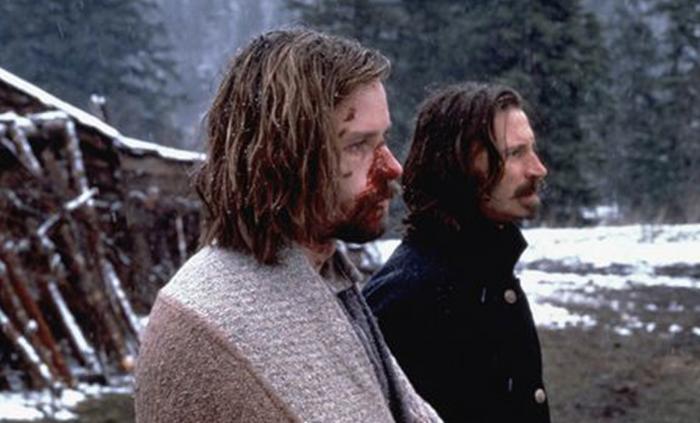
Guy Pearce (at his most grungily beautiful) stars as the cowardly Second Lieutenant John Boyd, who somehow fools everybody into thinking him a hero during the Mexican-American War of the 1840s. Everybody except for his direct supervisor, that is, who sends him off to a remote post in the Sierra Nevadas as punishment. Riddled with guilt over his actions, Boyd finds a chance for redemption when his camp—which is populated by a veritable who’s-who of character actors including Jeremy Davies, Jeffrey Jones, Stephen Spinella, Neal McDonough, and David Arquette—gets invaded by a maniacal stranger (played with relish by Trainspotting’s Robert Carlyle) who’s nursing an insatiable hunger for human.
And before you can even place your napkin in your lap bloody good stews will have been brought to a bubble, the fierce banjo score by Damon Albarn and Michael Nyman will have shrieked your nerves to tattered shreds, and the bodies will have hit the proverbial floor one by one by mouthwatering one.
Mashing together the infamous story of the Donner Party with that of the notorious “Colorado Cannibal” Alferd Packer (who presented himself to a small group of travelers as a guide only to show up on the other side of the Rockies with them all tucked neatly inside his belly), Ravenous was perhaps a lot for its moment. It’s perhaps a lot for any moment! Although looking back at it now through Must See T.V.’s recent Cannibalism Craze—Yellowjackets, Dahmer, and The Last of Us, oh my!—it feels more prescient and ahead-of-its-time than anything else.
But in 1999 there wasn’t anything else like it happening. Horror movies were in the thick of the post-Scream Teen Slasher Cycle; comedies were of the Farrelly Brothers sort. And period films were mostly artful and stuffy Oscar bait a la The Cider House Rules. Yet here roared a period horror-comedy, thick with nasty queerness and fiery political satire, beating them all at their game while never really entrenching itself in any of those paths completely. It was everything, and therefore perhaps too much. At the time.
Only one year later would Ravenous find what I consider to be its perfect double-feature mate in Mary Harron’s also ahead-of-its-time American Psycho—two brilliant women directing hilariously scathing black-comedies about masculine entitlement that sneaked right past their targets only to chew them right up their backside? How did we ever have it so good?
We almost didn’t. Macedonian director Milcho Manchevski directed the first three weeks of Ravenous’ shoot in Slovakia, but he butted heads one too many times with Fox producer Laura Ziskin and she fired him. The studio then hired Home Alone III director Raja Gosnell, but the cast hated him and staged a mutiny. Only when Carlyle suggested Bird—who he’d worked with a few years earlier on the moving gay catholicism drama Priest—did things finally fall into place.
It’s impossible to say what the film would have ended up had it stayed in any of those men’s hands, and Bird herself was vocal about the situation being less than ideal—in an interview with the Independent at the time she said the studio did wrong by Manchevski, and that they went on to add sans her consent a bunch of superfluous nonsense like explanatory narration to her own cut of the film. But she had to “go in and be Mum” and soothe it all over, and while she did if she just happened to import some of her socialist, anti-colonialist, vegetarian beliefs onto the project, well then so be it!
She even joked in that same interview that Ravenous was really about Hollywood, calling Los Angeles “the most cannibalistic society I’ve ever spent time in.” It is after all a movie about a bunch of misfits getting gobbled up in the terrible netherworld before the golden hills of California, where voracious monsters lay in wait like trap spiders on the path to the American Dream. (And I’m not really sure where the joke that the two Native American characters are named “George and Martha” fits into this, but I desperately feel the need to include that information anyway, so there that is.)
Still the film, much like its partner-in-scorn American Psycho, feels to me more thoroughly concerned with Men, and with Men’s stupid insatiable hunger for Power no matter the cost. Robert Carlyle’s character practically licks his lips on the term “Manifest Destiny”—okay, no “practically” about it. He licks his lips and he eats it right up. “Eat or die” he literally screams, not long after licking the tasty wound in pretty young thing Jeremy Davies’ side.
And like American Psycho too, the homoeroticism of this film runs rampant. Pearce and Carlyle are mirror images of one another, each attempting to get the other “coursing through your veins” first. The film ends with them locked crotch to crotch inside a bear trap, promising that whoever dies first will be the one whose tasty flesh saves the other. And has ever there been a more potent summation of Capitalism’s savagery dropped onto the screen? “Waste not, want not,” quoth the perfectly delicious Ben Franklin.


