
Old School. Biblically Independent.
By Melanie Fischer | Film | October 14, 2025
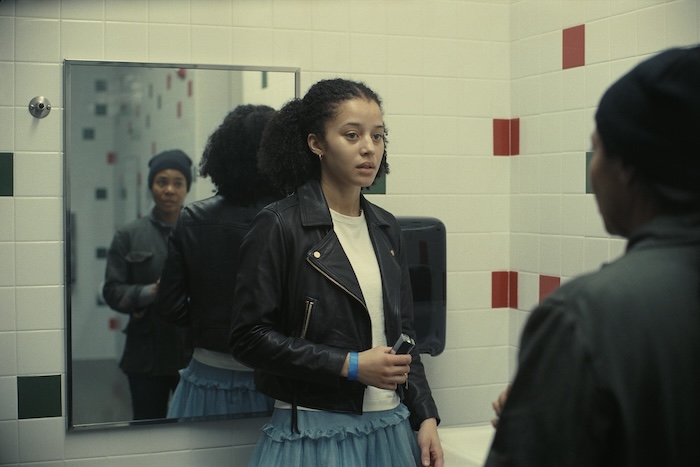
Perhaps more so than any other Paul Thomas Anderson film to date, One Battle After Another feels presciently timely in its universe-next-door depiction of an irreconcilably polarized America as a heavily surveilled hellscape where state-sanctioned violence runs rampant. While it is basically impossible to intentionally make a movie to meet a moment — cultural moments pass too quickly, and making a movie simply takes too long — sometimes fate or chance or whatever you’d like to call it steps in, and everything aligns.
To get one thing out of the way early — this piece is not a commentary on the film’s politics, nor any of the numerous takes, insightful or decidedly otherwise, that have been shared since its release. Those are deep and turbulent waters, and I do not feel like fighting for my life today. The intention of this article is to speak to an element of the film that has so far been largely absent from the prolific discourse, and why it’s worth adding to the conversation.
One Battle After Another is an oddly personal film for me in the sense that I personally identify with Willa (Chase Infiniti) far more than what I’m used to seeing, particularly in a movie as big as this one. Quite like Willa (third act reveals notwithstanding), I’m a mixed-race woman who owes my existence to radical politics. My grandparents were an interracial couple who met through community organizing in the 1950s — the time before most schoolbooks start their Civil Rights narratives, despite the efforts and sacrifices so many remarkable people made at the time, probably in part because many stories of activism from that era are dark and messy in a way that’s very difficult to clean up or rewrite. In actual practice, much of what they fought for came down to workers’ rights and school desegregation efforts. As far as various government agencies were concerned, this made them dangerous political radicals.
Because of my family ties, I realized from a young age that the version of history I learned in school could often differ quite significantly from what I learned at home. It’s been interesting to watch more bits and pieces of “at home” history, and corresponding worldviews, trickling into more mainstream entertainment, particularly over the past several years. Films like Judas and the Black Messiah — a movie that I had mixed feelings about on the whole, but will always remember as one of the first times I saw a movie depicting the Black Panthers in a way that resembled what I learned from my family (education-focused, pioneered free breakfast programs for kids) than my textbooks (scary militants with guns).
Like all truly great films, One Battle After Another operates on many levels. It’s the kind of movie that can be enjoyed brain off as a piece of high-octane entertainment, with a cast of memorably kooky characters, excellent comedic timing, and plenty of great action sequences, but also has great depth and nuance for those seeking food for thought. The film isn’t set in the past, but does an excellent job in drawing from our history to build a world that feels richly authentic and resonant. But in all of the political discourse the film has inspired so far, one of the elements that I found most striking, as someone with significant personal ties to the subject matter, has been largely absent from the conversation: the character Deandra, portrayed by the always excellent Regina Hall.
When it comes to revolutionary groups and depicting them on screen — whether it be an invented group like the French 75, or a dramatization of real movements past or present — Deandra embodies the kind of person who is the true backbone of such movements but typically gets relegated to a footnote, if they get any mention at all. The people who ultimately end up contributing the most to a cause are almost never the loudest voices in the room. Movements need spokespeople, it’s true, but when it comes to dramatic depictions of such organizations, what typically happens is that people like Deandra get written out, their work ascribed to the more prominent faces and bigger personalities within a movement. It’s not some grand conspiracy; it’s just narratively convenient. To tell a compelling story, you typically want characters who are very active and also have a lot of agency. It’s often simplest to dramatically streamline things by attributing actions to decision-makers that would, in reality, have been delegated to others. It’s akin to how one of the biggest creative liberties taken even in a very detail-oriented medical drama like The Pitt is in how much of what it shows doctors doing that would in reality be handled by nurses.
It is easy to overlook Deandra amongst the ensemble of larger-than-life personalities, but that’s a feature, not a bug. It rings true to the nature of her character and the people she represents. She’s at once perhaps the closest the film gets to having a real deus ex machina moment (how does she find Willa so quickly?) and a critical source of gravitas, the anchor that keeps the French 75 movement, and arguably the entire film, from tipping over into something farcical.
In the end, Deandra is the character who does the most for the cause, who never loses sight of the mission, who always shows up — and suffers an awful fate for it, captured and headed to jail with no Sensei Sergio (Benicio del Toro) to rescue her. To cut deeper, it’s a fate she likely would have avoided if Bob (Leonardo DiCaprio) had not shown up so late. She’s always there when others need her, but has no one there for her when she eventually is the one in need — a bleak conclusion that resonates in its unvarnished honesty.
One Battle After Another is now playing in theaters.


