Old School. Biblically Independent.
By Kayleigh Donaldson | Film | January 16, 2026
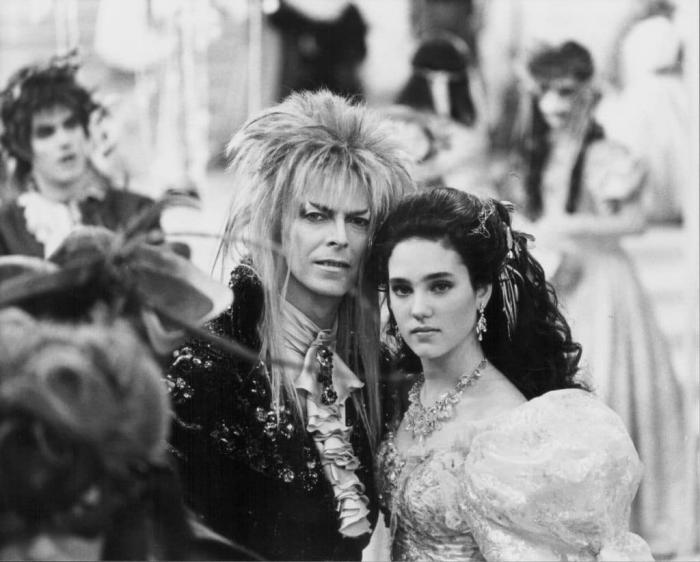
You remind me of the babe… Story time. I first saw Labyrinth, Jim Henson’s fantastical tale of a young woman’s journey through the realm of the Goblin King, when I was about nine years old. My grandmother eagerly showed it to all of her grandkids, so I, as someone who was already obsessed with film, was primed to love it. And, of course, I did. I’d never seen anything like it: this baroque and hyper-detailed blend of live-action and puppetry that was scary, funny, curious, and alluring in a way I didn’t quite understand at the time. And there was David Bowie, a fascinating looking gentleman who somehow made the most ridiculous hair and tights combination look dignified. Who was this man and how could I get the opportunity to dance with him while I wore the world’s greatest ballgown?
I’m now 35 and I still treasure Labyrinth. I rewatch it regularly and am eager to introduce it to my nieces and nephews. So much about it leaves me as giddy as that first-ever viewing did - the trickery of the labyrinth’s layout, Sir Didymus on his mighty steed, the little blue worm of impeccable politeness, the Escher maze, and Bowie’s last promise to Sarah. It’s also a film that has, in many ways, only gotten better with age, both its and my own. Labyrinth is a very different film to teenage me, just as it’s another beast to adult me, and therein lies the core of its enduring appeal.
For those of you lucky enough to still be awaiting your first viewing of Labyrinth, here are some key details. Directed by Henson and with a screenplay by Terry Jones (and script doctoring by Elaine May), the film follows Sarah, played by a young Jennifer Connolly, a flighty adolescent who loves imaginary worlds more than the real one. Irritated at having to babysit her crying baby brother Toby, she accidentally wishes for the Goblin King to take him away. To get him back, she has 13 hours to traverse a tricksy labyrinth, as well as the machinations of Jareth, the bored monarch of the maze who also happens to be David f*cking Bowie.
On the craft level, Labyrinth is unbeatable. Befitting Henson’s loving attention to detail and his commitment to the creative potential of puppetry, every scene is full of lavish world-building, from the largest trolls to the smallest worm. Fantasy illustrator Brian Froud acted as conceptual designer on this and Henson’s other high fantasy film, The Dark Crystal, helping to birth the Victorian and Edwardian-era art style with Pre-Raphaelite shades and myriad mythologies. The use of physical effects whenever possible only adds to the richness of the aesthetic. It feels like you could reach into the screen at any given moment and touch everything. Every corner seems populated with a whole other narrative we could follow for hours if Sarah took a different turn. While it wears its many influences proudly on its billowy sleeve, Labyrinth is thoroughly its own world.
If it was just a gorgeous looking original ’80s fantasy movie then the chances are that Labyrinth would still have become a cult hit, not unlike contemporary works such as Ridley Scott’s Legend, Terry Gilliam’s Time Bandits, or its Henson sibling The Dark Crystal. But what makes it stand out decades later, what keeps generations of fans so deeply attached to it, is Sarah’s story. This is the tale of a heroine stuck in the liminal space between childhood and adulthood, a young woman who is both terrified of growing up and drawn to its allure. When I watched the film as a teen, Sarah’s plight hit me like a ton of bricks. I suddenly got it in a way I hadn’t as a prepubescent nerd with ballgown envy.
Stories of feminine adolescence and desire are rarely produced for the mainstream and even rarely done well. Pop culture tends to default to treating teen girls’ maturation as titillation for gross old men or a taboo that should be locked away until it’s time for marriage and babies. Frankly, it’s easy to do it poorly and end up with something super creepy. Labyrinth should be uneasy in that aspect. It is a movie featuring 15-year-old Jennifer Connelly in a romantic waltz with the undeniably adult David Bowie as one of his most ’80s ballads plays (and it’s a banger - the critics were wrong, this soundtrack is iconic.) Yet it works, because the film threads a very fine needle of curiosity and understanding.
The surprisingly great novelisation of Labyrinth, which you can buy on ebook, fills in some hints in the narrative about Sarah’s absent mother and the man she ran off with. It further reveals Sarah’s catch-22 situation, one we all find ourselves in at that age: growing up can’t come quickly enough but why the hell does it have to be so damn adult? Why do we suddenly need to become braver, to find solutions to our own problems, and move forward alone? The journey is treacherous with hardships untold. And in the end, when Sarah gets to reclaim her baby brother, she rejects Jareth’s enticing offer. It’s the hero’s journey of yore with the weight of womanhood piled atop, and by the climax, it is worth it. You just have to jump.
Sarah may start to pack away her childish things in the final scene but she doesn’t abandon the magic. It’s there when she needs it. Who doesn’t relate to that, to the ways we hope to find comfort in our nostalgia without cloistering ourselves in it? I write this as I prepare to head off to a 40th anniversary screening of Labyrinth, eager to revisit the world I know so well. I wonder what it looks like now that I’m, gasp, in my mid-30s.


