Old School. Biblically Independent.
By Kayleigh Donaldson | Film | October 13, 2026
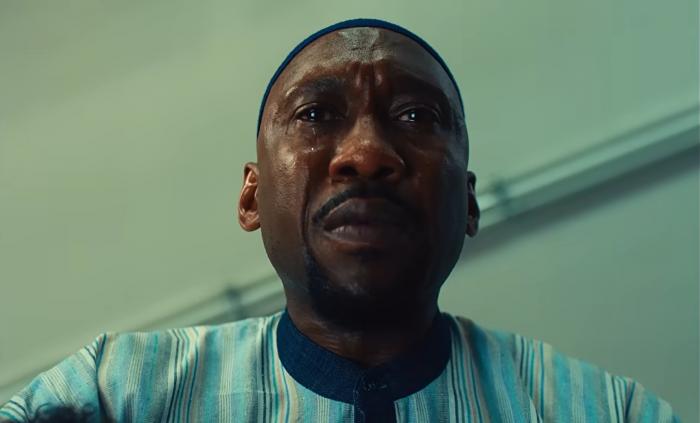
It is unfortunate that we will never get to see Mahershala Ali play Blade. After winning his second Oscar, Ali was eagerly recruited by Marvel Studios and he made it clear who he wanted to play. But several years of pre-production hell and a revolving door of directors, writers, and actors eventually culminated in the project being shelved indefinitely. Ali had spent all that time in shape and prepared for shooting, all but pausing his career to ensure he was ready when Marvel called “action.” Now, Ali is done with Blade and even Kevin Feige has admitted he screwed up by letting things fall apart. Instead, we got Ali in another action role, one that is far better suited to his skills and one that offers a modern spin on a classic thriller trope.
Your Mother Your Mother Your Mother stars Ali as Latif, a hitman in Houston who kills with a machete due to his strict moral code. Outside of his work, he is a devout Muslim who is struggling to keep his head above water after the death of his wife. He must look after his three children, including a baby daughter, while dealing with a new threat in the form of a machine gun-toting hard-right mega-pastor with an anti-porn crusade and a vendetta against Latif’s boss.
A lot of the marketing for the movie, which is written and directed by Bassam Tariq (one of the many directors attached to Blade during its period of endless limbo), makes it seem like a John Wick-style cavalcade of slick vengeance. While the fight scenes are intense and imbued with an aesthetic flair that wouldn’t seem out of place in Keanu’s world (particularly one scene in a former strip club turned neon church), the overall film is a more pensive affair. Your Mother Your Mother Your Mother has more in common with samurai movies like Yojimbo than your traditional bullets-and-bodies affair. It’s the ideal platform for Ali, an actor who hasn’t always been well served by the roles he’s gotten.
Ali is a commanding presence. He’s tall, extremely handsome, and radiates an easygoing charisma that is still buoyed with gravitas. There’s something utterly unflappable about him. The ground could shake and he’d be unbothered. In Moonlight, for which he won his first Oscar, he brought that heft to the role of Juan, a drug dealer who bonds with young Chiron. Juan’s job requires a degree of intensity, a protective barrier that keeps his enemies at a distance, but with only a minor shift, he suddenly radiates parental warmth. He’s fiercely protective of Chiron, and that makes him even more dangerous to mess with. Latif has a similar quality, the hard-earned ferocity of a father who carries the weight of the world on his shoulders.
It’s Latif’s parental duties where the lion’s share of the drama rests. After his wife’s death, he is burdened with grief but unable to pause and take it in. His eldest daughter, Fatiha, wants to carve out an identity for herself but is forced into a substitute parent role for her siblings. The baby, Aziza, needs to feed but can’t hold down formula and supplies of her mother’s milk are running low. More tension is wrung from Latif’s increasingly panicked search for breast milk to feed his daughter than the lunatics with AR-15s. He has a strong community to rely on but roadblock after roadblock is flung in his way. His superhuman abilities as a killer are pointless in the face of bureaucracy and biology.
Latif claims to have a code, a familiar feature in many an assassin movie. He bears a strong resemblance to Forest Whittaker’s character in Ghost Dog: The Way of the Samurai, a mafia hitman who adheres to the ancient code of the Samurai. Said director Jim Jarmusch about the character, “I don’t think he even views what he does as a violent act; it is just an extension of something he must do to maintain the order by which he lives.” But ultimately, with both Ghost Dog and Latif, it’s the same set of shoddy justifications every on-screen killer uses. There may be some kind of personal dignity in using knives over guns, and sometimes the targets are “bad people”, but in the end, you’re still just a murderer for hire. And his faith is earnest. There’s never any moment of doubt over his commitment to Islam (this is a wonderful but depressingly rare piece of pop culture that doesn’t demonize American Muslim life.) Latif is attempting to live two lives as one, to imbue the morality he dearly cultivates into the abhorrent crimes he commits.
He doesn’t do what he does in the name of his religion, unlike Hwan Yoon, the charismatic preacher who repeatedly invokes Christ’s name while acting like a dictator. Complete with a gold grill and tacky airbrushed cowboy shirt, Hwan Yoon is played by John Cho with the repulsive allure of a hard-right rabblerouser. Like Latif, he is a true believer whose skills at ultra-violence are as earnest as his prayers. Unlike Latif, Hwan Yoon sees zero contradiction in firing guns and kidnapping people while reciting doctrine. To him, religion is a life or death scenario, a game of winners and losers. He’s no scamming pastor cloaking himself in faith for the money; this man is 100% earnest about God, which makes him a terrifying force, with or without the guns. Yet he and Latif, across barriers of belief, are united in a common bond of bloodshed. Ultimately, how much does the reasoning matter in why you kill people?
Your Mother Your Mother Your Mother is a film ripe with contradictions, but it’s also one of the most acutely observed faith-based films I’ve ever seen. That term usually elicits memories of Kirk Cameron or smarmy proselytising where religion is an unchallenged glory to knock down the “woke” with. Works like God’s Not Dead are not interested in examining how to life a life of belief. They just want to pat themselves on the back for doing the bare minimum and justify their decidedly un-Christian politics. Here, Ali and Tariq are truly intrigued by Latif’s dilemma, and what it means to be a man of faith, of fatherhood, and of death. What is his true duty in life? How noble is your sacrifice for your family if it’s built on something unforgivable?
It feels all too rare to see a film like this, one that is both a startling piece of genre filmmaking and a tender, utterly committed examination of religion as a lived experience. That’s what makes Latif stand out amid the crowded field of on-screen men who kill. Trying to be good, whether or not you’re religious, is a daily struggle we’ve all tried to navigate, and you know what they say about the road to Hell.


