Old School. Biblically Independent.
By Kayleigh Donaldson | Film | May 5, 2026
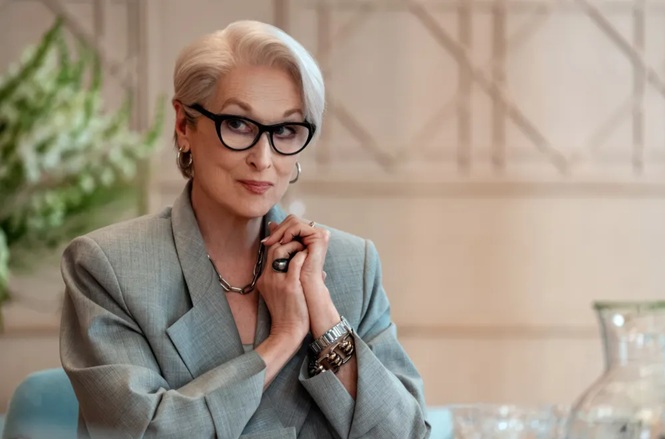
Despite fears of legacy sequel fatigue, The Devil Wears Prada has earned a slew of surprisingly positive reviews and the box office receipts to match. Millennials of a certain disposition were eager for more of this world of high fashion, albeit with the new twist of navigating a declining journalistic space dominated by tech bro bullies and the clickbait economy. It’s a reminder of what made the first film work. The Devil Wears Prada is one of the sharpest comedies of the 2000s. Derided by many at the time as a mere “chick flick”, the sly study of workplace toxicity and the push-pull allure of the elite was buoyed by a keen eye for detail, an endless array of quotable zingers, and an excellent cast. At its heart was The Greatest Actress of Her Generation. At first, many saw the movie as a chance for her to half-ass it and make an easy payday. But The Devil Wears Prada ended up being the catalyst that turned a celebrated performer into an icon.
By 2006, Meryl Streep was long established as a monument in American cinema. She had won two Oscars from 13 nominations and worked with directors as varied as Michael Cimino, Mike Nichols, Robert Zemeckis, Clint Eastwood, and Spike Jonze. In 2004, Streep was awarded the AFI Life Achievement Award. It would be fair to say she was already a legend. But I wouldn’t necessarily say she was beloved by the masses. Streep was known as a technically proficient actress, a master of accents who played strong but troubled women who defied easy categorisation. She could play it all, and she would often bring more to the table than what was in the script. With Kramer Vs. Kramer, which won her the first of three Oscars, she insisted that the script be rewritten to avoid making her character, a woman who leaves her husband and young child, a lazy villain. She also wrote her own dialogue in a key scene where she testified in court for the right to have sole custody of her son. It’s a stunning moment, so lived in and raw, that it’s startling to think it had to be created by its actress and not the men writing and directing the film.
It was Sophie’s Choice in 1982 that took her to the next level. Playing a survivor of the Second World War who was forced to choose which of her two children would die at the hands of the Nazis, she gave what many considered to be one of the greatest performances in cinematic history. It has it all: Meryl doing an excellent Polish-American accent, moments of romantic swoon, a drastic physical transformation, and, of course, that choice. It won her Oscar number two and cemented her reputation as a unique talent. But one could also argue that it boxed her into an image as a very serious person who only did the most serious of movies. Streep characters often suffered greatly, and audiences felt dragged down by the portentous nature of it all. When she branched out with comedies, the box office numbers were disappointing. She never really lost the critics and she kept racking up a healthy glut of awards, but she struggled as a commercial force (a matter not helped by the fact that she was entering her 40s and Hollywood has no idea how to handle that.) Things picked up in the 2000s, thanks to an array of quirkier projects, like Adaptation and Angels in America, but it was Miranda Priestly that really changed the game.
The Devil Wears Prada by Lauren Weisberger was a huge deal in 2003. It attracted a lot of attention because the author had worked as a personal assistant to Anna Wintour and the pre-release publicity leaned into the implication that the novel was a thinly-veiled memoir. It certainly doesn’t paint a rosy picture of life at a major fashion magazine, working under a tyrannical boss who treats subordinates as punching bags for psychological torture. The Miranda of the book is not deftly drawn, to put it lightly. It’s mean-spirited at times, more pantomime than drama, and for all of the juicy gossip it inspired, you don’t get a sense of her as a person. That works fine for a fizzy beach read, but you need more for a film. You need Meryl.
Streep’s Miranda is quiet, never raising her voice but devastating her employees with a raise of the eyebrow. Her aloofness is not entirely an act but also evidently armour against a brutal world she’s helped to shape. She doesn’t need to overwork a quip or add too much mustard to a line delivery. It will sing through her imperious tone, as it does in the iconic cerulean monologue. It’s fascinating to know that Streep was initially not considered for the role because the producers didn’t think she could be funny (did they miss Death Becomes Her?) Streep can get hammy, especially in her later years, but she’s practically minimalist in The Devil Wears Prada, and I think that’s what helped to win audiences over. She didn’t need to try too much to make this woman real.
Miranda’s a b*tch, of course, but as Tina Fey famously said, b*tches get stuff done, and you never doubt Miranda’s power. It’s admirable as much as it is repulsive. While we do get glimpses of the real person behind the devil, like her troubled relationship with her husband, this Miranda is still a tough nut to crack. Where the novel goes for pat villainy, Streep’s performance is aristocratic, graceful, but steely-eyed. She will not relinquish her power, even if it means hurting those she cares about. It’s an excellent portrayal of an oft-maligned archetype: the career woman.
Streep earned another Oscar nomination for her performance, and she earned it (which I can’t say for all of her noms - ahem, Florence Foster Jenkins.) Moreover, it added a new sheen of appeal to her image, one that mainstream audiences embraced. This new Meryl was funny, stylish, in on the joke, and endlessly quotable. She seemed far warmer than the Meryls of prestige dramas who stumbled into agony with an array of accents. And it made her a more bankable star. Look at Mamma Mia!, another Meryl movie that punctured that old self-serious image and had women cheering her on with delight. Now, she was big with female audiences, including those of “a certain age” who were largely ignored by the entertainment business. As Meryl became fun, she grew into a kind of pop culture figurehead for that demographic. Women don’t stop being interesting after 40 and her career became a testament to that.
With The Devil Wears Prada 2, we have Streep back in couture, but also at a different point in her career. She’s now a 21-time Oscar nominee, a four-time Emmy winner, and a Kennedy Center honouree. She’s doing some top-notch work on TV in Only Murders in the Building and is preparing to play Joni Mitchell in a biopic from Cameron Crowe. Personally, I wish we could see more work from her in the Miranda Priestly mould: not necessarily comedic but restrained, controlled, playing around with people’s expectations. That role helped her to prove that she wasn’t one to rest on her laurels or succumb to snobbery, and I think we could use more of that, and not just from Meryl.


