
Old School. Biblically Independent.
By Jason Adams | Film | August 7, 2026
Do you like a dippin’ sauce? Barbeque? Honey Mustard? Whatever the in-house spicy special flavor of the week might be? This question might seem frivolous—it might also seem strange, coming as it does at the start of a movie review—but it’s profoundly important in the context of your probable enjoyment of Teenage Death and Sex at Camp Miasma, the to-this-critic immensely pleasurable new slasher-comedy from filmmaker Jane Schoenbrun that wink-wink nudge-nudges at those two genre labels so hard that they—poof!—simply cease to exist. Dippin’ us straight into something strange, new, and totally friggin’ delicious.
The third and best of filmmaker’s movies to date—following We’re All Going to the World’s Fair and I Saw the T.V. Glow (and beyond all of their many talents Jane is very very good at coming up with memorable movie titles)—Teenage Death and Sex at Camp Miasma marks a huge swing from a director who was working with micro-micro-budgets only five years previous. Starring real-life living-legend Gillian Anderson alongside her baby ginger bisexual icon mirror-version Hacks star Hannah Einbinder, and made with a budget of around $10 million, lucky-for-us that big swing 100% pays off—it’s a damn homerun, actually.
Einbinder plays Kris Williams, a young queer filmmaker whose first film—an interrogation of Alfred Hitchcock’s Psycho told from the point of view of the shower curtain (and if that joke lands for you, just you wait)—won her massive critical acclaim and not a small amoutn of indie buzz. So now comes Kris’s turn in the H’wood gauntlet, trying to mold all that small-potatoes heat into something bigger-potatoes. And when the major studio behind a now-defunct and deeply Friday-the-13th-coded slasher franchise from the ’80s called Camp Miasma comes calling re: the reboot, Kris can’t help but attach her jaws tight. The series was foundational for her and her all-consuming love of horror films—not even an actor in the franchise (and we get to meet a couple) could come anywhere near Kris’ encyclopedic nerdery on the subject. It’s a perfect fit!
Nevertheless Kris finds herself when we find her in a bit of a rut as she approaches the reboot—not because she doesn’t have any ideas but because she has too many. Too many theories, too many graduate degree dissertations, all of them duking it out frantically inside her head. Why, if you cracked her open Carol J. Clover might just come spilling out. The fact that the Miasma franchise was based in transphobic tropes—its killer who goes by the name of Little Death (played by T.V. Glow star Jack Haven) was getting revenge on the ignorant and hateful campers who were disgusted by their gender malleability—only draws Kris deeper under its ambivalent spell.
And so, despite the protestations of her cartoonishly disconnected agent (Sarah Sherman), Kris hops into a rental car and drives off into the deep and snowy matte-painted mountains where one Billy Presley (Anderson), the one-time Final Girl of the very first Miasma picture, now lives. Turns out that Billy—and speaking of Carol J. Clover, do note the gender-neutral names of both of our leads—bought and lives on the grounds of the very same sleepaway camp where several of the Miasma films were once filmed, including her own. Isolated, mostly off the grid, this place seems so remote you can practically hear a groundskeeper intoning, “No one will hear you if you scream… in the dark… in the night.” Or more appropriately a “Crazy Ralph”-type screaming, “It’s got a Death Curse!!!” (To which we say hey there, great character actor Patrick Fischler!)
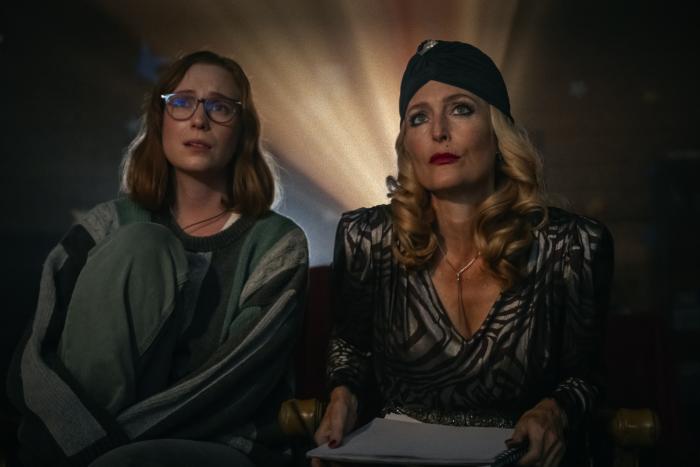
Kris’ polycule partner Mari (Jasmin Savoy Brown) also warns her that Billy sounds like a real Norma-Desmond-ish loon and Kris should maybe be careful. For her part Billy seems to be both hyper-aware of this reputation, whilst also being more than glad to lean into it—hell she even wears a glittering turban at one point, as she flitters her manicured fingers in the light of a film projector. She’s ready for her close-up too, Mx. DeMille. Only this one will come with way more blood, thank you very much.
Calling Billy larger than life doesn’t even capture half her picture, and Kris is immediately bewildered slash smitten. As are we all! Anderson, perhaps never funnier or sexier than she is here, delivers her lines via a loose Dolly Parton-esque drawl (just the way she pronounces “chick-kin” is worth the price of admission alone) with an aura of off-kilter amusement. All of which slips, here and there, just here and there and everywhere, into weirdness. Anyway Billy’s lived alone for a long time and she knows how to entertain herself, be it by gummy candy or marijuana or the places the twain shall meet.
A lot of Billy’s joy now shall come through a playful prodding of Kris, whose immediate insecurities flood into the campgrounds like a tidal wave of Millennial angst. Billy’s provocations aren’t a one-woman circle-jerk of self-satisfaction, though—she might be remembered, and even then only by a few, for playing a role in a crusty old horror flick, but she’s whip-smart and something like a genuine artist. Her paintings, featuring the recurring motif of squares inside squares—a motif that carries all over Schoenbrun’s mise-en-scene, from the shape of Little Death’s air-vent helmet to Kris’s Zoom calls where a “Queer Assistant” (played by Castration Movie filmmaker Louise Weard, no less) sits silently in the corner—are hypnotic. With Billy’s insights into the human condition even more so.
So it goes for Schoenbrun too, whose film is hypnotic, hysterically funny, and surreally unforgettable. This goes doubly-so for the film-within-a-film portions, where the original Camp Miasma is given brain-bending life that from one angle makes absolutely no sense, and then from another all of the sense in the world. The needle-drop that lands on Little Death’s mid-film slaughter is so far left-field it circles the earth to be Right again; and the gorgeousness of Schoenbrun’s deliriously-choreographed oner that captures said same rampage the same. No slasher movie ever looked like this! And yet here they all are, every single one, split open like one of Hannibal Lecter’s elaborate art-projects; beauty by evisceration. To simply call Miamsa “meta” really doesn’t do what Schoenbrun’s working at justice—much like Litte Death’s inexplicable mask this movie is squares embedded in squares embedded in squares; patterns that seem closed-off but which nevertheless beckon us vertiginously toward their telescoping middle. We’re Alice’s Rabbit tumbling down the hole of its own digging. The remakes of the remakes of the remakes have become so divorced from humanity and truth that they’re dissociative now—so the only way out really is through.
It would require a dozen dissertations to even begin to crack the code of what the wondrously assured Camp Miasma is exploring—more like exploding—but much like Kris’ attempt to over-intellectualize what Billy says was really just “flesh and fluids”, it seems more important in this forum to just say that Teenage Sex and Death at Camp Miasma is (and this is a word this critic never likes to summon this early in a film’s lifespan) a genuine masterpiece. It’s totally next level for Schoenbrun, who’s gotten better with each cinematic spin but who leaps right off the cliff and magically delivers a movie that will be remembered and respected for generations with this one.
Simply put Camp Miasma is, in the old and new school definitions of the word, iconic. Immediately, indisputably. Watch it with a rapt audience attuned to its frequency and in between the bouts of hysterical laughter you’ll hear a pin drop, so enthralled by its completely unique explication of what comes down to, as the woman in the turban rightly spoke, flesh and fluids all over again. It’s amazing what a cinematic culinary movie magician can muster from the old familiar sauces—brand new flavor explosions bursting up everywhere!


