Old School. Biblically Independent.
By Kayleigh Donaldson | Film | September 14, 2026
In 1989, while playing Hamlet, Daniel Day-Lewis walked off-stage in the middle of a performance at the National Theatre in London. He refused to return, having reportedly seen his father’s ghost, and hasn’t been on the stage since. Director Richard Eyre was left scrambling to find a replacement. He chose Ian Charleson, the Scottish actor and beloved theatrical figure who was best known to the world for his work in Chariots of Fire. What he, and only a handful of others, had to conceal was that Charleson had been diagnosed with AIDS, and he was declining fast. But the show must go on.
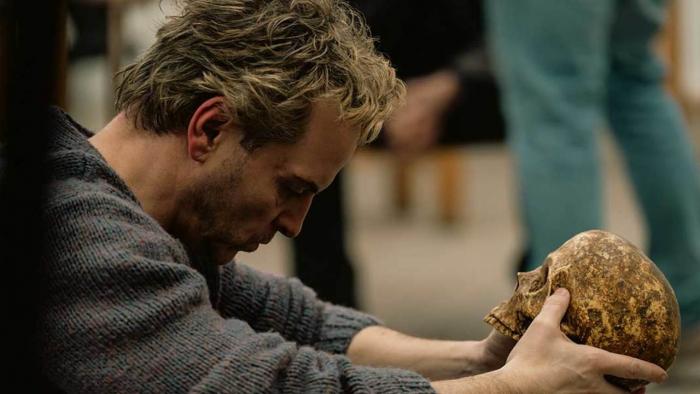
Charleson’s triumph in Hamlet is one of the most legendary moments in British theatrical history, still talked about in reverent tones by people like Ian McKellen, who considered it one of the greatest performances he’s ever seen. Director Simon Stone has chosen this moment at the end of Charleson’s life as the focus of Elsinore, with another acclaimed performer of the Prince of Denmark picking up the mantle, Andrew Scott. It’s no mean feat, to play a beloved actor playing one of the most famous roles in all of theatre. If only the film was as up to the task as Scott himself.
By the end of the ’80s, Charleson had proven his mettle on the stage but his dreams of Hollywood success were waning. He had moved on to shlock like Dario Argento’s Opera (briefly mentioned but sadly not shown here) and was auditioning for unsatisfying genre fare with scripts that didn’t make a ton of sense. Ever the professional, he got on with the job, smiling stiffly whenever someone hummed the Chariots of Fire music in his presence. But he wanted Hamlet, as every actor does. “It’s the greatest part you’ll ever have,” he says, and on the grandest stage in London. After he convinces Eyre (Johnny Flynn) that he has the strength to do the show, and prepare for it with only three and a half weeks of rehearsals, he flings himself into the process. The battle is between his mind and his body. As his health declines, he races between work and care, receiving treatment from Margaret Johnson (Olivia Colman in full Colman mode), the first dedicated HIV doctor in London’s Royal Free Hospital.
Playing Hamlet requires an actor to look death in the face for eight shows a week. It’s one of literature’s most profound and iconic portrayals of grief and the madness it incites. Even the heartiest and most well-adjusted performers find themselves overwhelmed with the task. Charleson was literally dying to play Hamlet, choosing the might of art over health until it became impossible to do so. But he wasn’t alone. He was but one of many gay men in his community who this plague engulfed, and together, they retained the force of their community, them against the world. Elsinore is at its most tender in these moments, with Ian and his friends, acquaintances, and strangers bound together by sickness clinging together to keep their heads above water. The legendary Sisters of Perpetual Indulgence hand out condoms and offer advice in dogging parks. His best friend Patsy (Billie Piper) helps with food, medicine, and gossip. But there is also conflict.
The legendary director Derek Jarman (David Dawson), who gave Charleson his first film role in Jubilee, is a frenemy of sorts. The openly gay director and activist made fiercely queer works in the midst of Thatcherism and was open about his HIV status from the get-go. Ian became the “establishment” once he chose film fame over being out, but Ian was also a working-class kid who didn’t have Jarman’s class comforts. Their squabbles and solidarity could have made for a fascinating film in their own right, showing the intersections of art, queerness, and AIDS to the backdrop of a broken system. Frankly, it probably would have told Charleson’s story better than Elsinore, which falls into middlebrow safeness all too soon.
Andrew Scott is so damn good as Charleson, nailing his Edinburgh accent and the witty charm of a man whose stubbornness dragged him to the finish line, that you cannot help but be infuriated by how little Elsinore seems to trust him. His performance does not need the shortcuts that the director and screenwriter Stephen Beresford give him. Why does this film have so many damn montages? We get no real sense of the work of rehearsal or the endurance of Charleson’s all-too-brief run in Hamlet because those scenes are chopped up into an endless series of montages! It’s made all the worse by a samey piano-and-strings score that acts as the “cry now” beacon but is also mixed so loudly that I couldn’t hear the dialogue at certain times. These are all pretty well-worn tools of the biopic, a genre that cannot help but give in to its most middle-of-the-road desires. But we usually see these devices employed in stories taking place over decades. This is one of mere weeks. It’s as though the director worried we wouldn’t feel appropriately sympathetic towards a beloved actor playing an icon who dies tragically.
Honestly, by the end of Elsinore, I was actually rather pissed off. This is a story I cared about deeply, helmed by an actor who could not be more perfect for the party, and yet he was cruelly underserved by a film that revealed itself to be puny in scope and timid in its intentions. Elsinore is cut to ribbons and dominated by trite dialogue that feels like a 1st year discussion of Shakespeare’s themes. Worse of all, it’s safe, flinching in the face of the radical truths at the heart of Charleson’s story. There’s a moment where Jarman says, “Nature is queer”, but the film feels terrified of that fact. This is the film about Charleson that would have been made in the ’90s for a bunch of Oscar voters who are still too afraid to say the word AIDS. In 2026, it’s unforgivably cheap. Andrew Scott rises above it, but surely the late great Ian Charleson deserved something as fiery as his spirit?
Elsinore had its Canadian premiere at the 2026 Toronto International Film Festival. It is scheduled for a limited theatrical release in North America.


