
Old School. Biblically Independent.
By Kayleigh Donaldson | Film Festivals | September 17, 2026
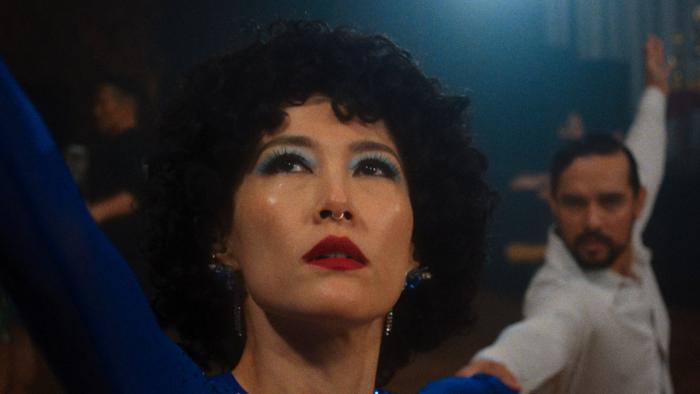
Haru (Rinko Kikuchi) has a beautiful little life with her husband Luis (Alejandro Edda.) They have the perfect house, they dote on one another, and they move together in sync on the dancefloor. But when Luis unexpectedly dies in the middle of a competition, her passions for dance and life are smothered. Grief overwhelms Haru, turning her into a shut-in who ignores her friends’ attempts to help. Perhaps dance can help lift her spirits once more, especially with the arrival of a hunky new dance instructor from Spain, Fedir (Alberto Guerra.)
I do love a good ballroom dance movie. Strictly Ballroom and The Tango Lesson are all-time favourites of mine. There’s something so magnetic about the combination of chemistry and skill, the ways that two people can work in tandem to force their bodies into a display of sporting genius, and do it backwards and in high heels. Spend enough time spinning on the floor, the glare of sequins blinding your view, and you’ll probably send yourself into another realm. For the eponymous Ha-Chan of director Josef Kubota Wladyka’s comedy, it’s a way to escape her emotions, or to give into them. Even before Luis dies, she imagines them floating into space, propelled by their bliss. After his passing, her grief takes the form of a giant black bird, albeit one who looks like a plushie and has the unnerving aura of the Burger King mascot.
The moment he sets her eyes on Fedir, she is sent into a fantasy world. The plot summary makes Ha-Chan, Shake your Booty seem as though it will be an inspiring tale of a second chance at love that culminates in a glorious return to competing, not unlike Baz Luhrmann’s take on this set-up. Instead, we get a weirder, but no less crowd-pleasing tale of letting go of the past through art, friendship, and casual hook-ups.
Grief is the driving force of the tale. Haru is stuck in the limbo of widowhood and her loneliness is exacerbated when Luis’s father insists on returning his son’s body to Mexico for burial. He had wanted to be cremated in a traditional Japanese ceremony, and without it, Haru believes his soul will never find peace. Her friends mean well but are clearly rushing her to get back in the driver’s seat after less than a year of mourning. Rinko Kikuchi, perhaps best known outside of Japan for Pacific Rim, is wonderfully expressive, finding the balance between the extremes of Haru’s emotions and keeping her grounded even as she makes her jaunts into the surreal. While the film is light on its feet, it’s Kikuchi who carries the weight of its themes.
Fedir seems like he could provide Haru with a new happy-ever-after, but he’s already married. No worries, because it’s an open marriage, and so is Haru’s, technically. This is a rare film that treats the notion of a non-monogamous person fairly, not using them as a joke or scolding them as conniving. Fedir’s marriage works, and his openness is honest. It’s Ha-Chan’s own limitations of what a relationship can be that hinder things. But she is willing to experiment, and her dreams are certainly raunchier than her action. There’s a delightful moment where she lets out her inner shipper with the two men she lusts for. It’s a horny movie but a sweet one too, guileless but not stupid.
Haru’s romantic fantasies are a blend of nostalgic cinema, amateur theatre, and magic show. She imagines Fedir gallantly fighting off a group of men who disrespect her, culminating in a grand dance number. One scene involving a local production of a famous movie musical is done with surprising accuracy to the original but with Japanese lyrics. That cultural exchange is key to the film. Haru is Japanese but is married to a Mexican man. She dances the rumba and Latin ballroom. With her bouncy curls and endless walls of vinyl, she lives like the coolest woman of 1974 (seriously, I haven’t coveted a house in cinema this much since the mansion in Knives Out.) The matter-of-fact presentation of this kind of diversity shouldn’t feel like a big deal and yet it does.
I was surprised to see that Wladyka has largely worked in dramas before this film. His TV credits include The Terror and Narcos, and his 2021 film Catch the Fair One was a brutal thriller about the sex trafficking of Native American women. In Ha-Chan, he brings a light touch to his portrayals of grief and sex, and the musical moments maintain a scrappy, do-it-yourself quality that heightens Haru’s familiarity. And the end result is something so charming and distinctive that you’ll have to resist the temptation to dance if your seats. Or not resist. I didn’t. Look, they were playing “Stay With Me”, I had to!
Ha-Chan, Shake Your Booty! had its Canadian premiere at the 2026 Toronto International Film Festival. It will be theatrically released in the United States on September 25, 2026.


