Old School. Biblically Independent.
By Kayleigh Donaldson | Celebrity | June 20, 2025
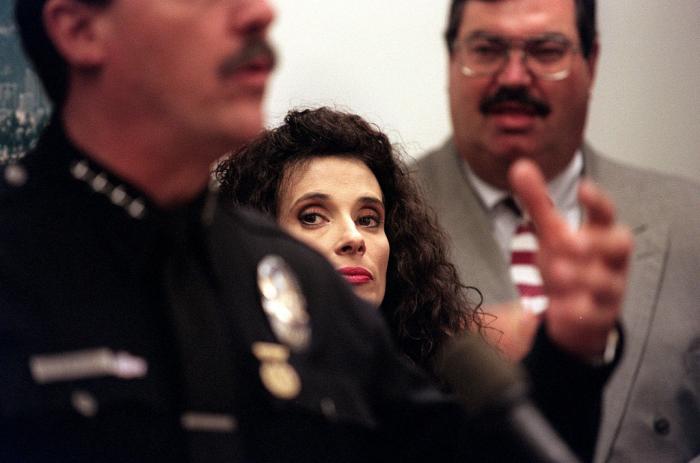
In 1982, Theresa Saldana was best known for her roles in I Wanna Hold Your Hand and Raging Bull. She was a rising star who had worked with Martin Scorsese and Brian De Palma, but was several years away from what would become her best-known role, as the wife of Michael Chiklis in the ABC sitcom The Commish. She was, by no definition of the term, a major star. But she suffered the fate that every celebrity fears, and her experiences would change perceptions of stalking worldwide.
Arthur Richard Jackson was a drifter from Aberdeen, Scotland, who had a history of mental health issues. He spent some time in an institution before obtaining permanent U.S. residency in 1955, seemingly through lying about his history of mental illness. According to his INS file (via the L.A. Times), Jackson served in the U.S. Army for about a year before being granted a disability discharge. In 1961, after the Secret Service detained him for making threats against John F. Kennedy, he was deported to the UK for lying on the application for his immigrant visa. Somehow, he was able to re-enter the USA in 1966, before being deported six months later for overstaying on that visa. He entered the country illegally for a third time on New Year's Day, 1982. By then, he was already deep in the throes of obsession with Saldana.
He hired a private investigator who obtained the unlisted phone number of Saldana's mother. He used this to call her and request Theresa's address, posing as an assistant to Martin Scorsese and claiming that the director had a new role for her. Theresa's mother didn't see anything wrong in this. At the time, the safety of actors from stalkers and such wasn't seen as a pressing issue. And anyway, she knew Scorsese, and it didn't seem unusual for him to want to reach out to her daughter regarding a last-minute job. Saldana later explained things to Larry King:
SALDANA: As soon as I got the call from my mom, my manager, Selma Rubin, called a moment later to tell me that she had been getting some odd calls. It appeared to be the same person. I called the police, but at that time, they didn't have themselves on the alert for things like this. They thought it was just nothing. They thought it was a fan.KING: Did this person then begin to stalk you?
SALDANA: Well, what we didn't know at the time is that he had been stalking me for 18 months. I didn't know anything about it. And, in fact, for the week after I found out he had my address, I was very cautious and careful. But nothing happened.
Jackson went to Saldana's home in West Hollywood on March 15, 1982. As she got out of her car, Jackson approached her and asked, "Excuse me. Are you Theresa Saldana?" She replied, "Yes." He then pulled out a hunting knife and began stabbing her. His attack was so violent that he punctured her lung. There were several onlookers while this occurred, but it didn't stop until Jeff Fenn, a deliveryman, rushed from the second floor of his building and stopped Jackson. Saldana was hospitalized with 10 stab wounds and required 26 pints of blood. According to PEOPLE, "[Jackson] stabbed and slashed her so hard, and so often, that the knife bent [...] most of the blood had drained from her body and her heart had stopped."
Jackson was arrested quickly and pleaded not guilty during his trial. Convicted of attempted murder and inflicting great bodily injury, he was sentenced to 12 years in prison, the maximum possible sentence at that time for this charge. Saldana was understandably dismayed that it wasn't longer, especially since Jackson was released only seven years later due to "good behaviour." This came despite the fact that prison officials considered him to be very dangerous and that he had repeatedly vowed to kill Saldana once released. He even claimed to have murdered two people during a bank heist in London 20 years prior. In 1988, Jackson sent a letter to Jonathan Felt, then a producer for Geraldo Rivera's show, outlining his plan to "assassinate" Saldana. He repeated these plans to Ellen Greehan, an L.A.-based stringer for the Scottish Daily Record, as well as his fantasies about friendships with Gregory Peck and Charlton Heston.
Saldana told PEOPLE:
"[The authorities] say, 'We wish there was something we could do, and we know this is a very bad situation.' And it's not as if they don't care. It's that there's nothing in the system to address this very, very real situation. I've asked everyone--the district attorney, prosecutors, judges, lawyers. There are absolutely no plans to protect me. Period. Period. Period. And there will be none. None at all."
She ended up taking things into her own hands. Only two years after the attack, she starred in a made-for-TV movie about it, Victims for Victims: The Theresa Saldana Story. This required her to re-enact the stabbing. The movie also detailed her struggles with depression and PTSD afterward, and her financial troubles following a long period out of work during her recovery.
She founded a victims' advocacy group and lobbied for the 1990 anti-stalking law and the 1994 Driver's Privacy Protection Act. The latter law was especially notable because of how it applied to another infamous stalker case, that of actress Rebecca Schaeffer.
Schaeffer was a rising star, with one of the leading roles in the sitcom My Sister Sam. She began landing roles in movies and was expected to move on to bigger things. In 1989, Robert John Bardo, a disturbed fan, travelled from Arizona to Los Angeles and knocked on her door. He shot her in the chest. She died 30 minutes later.
Bardo admitted to being inspired by Jackson and the methods he used to track down Saldana. He was able to acquire Schaeffer's address through a private investigator who found her records through California's Department of Motor Vehicles records. It was a shockingly easy process. It wasn't until after Schaeffer's murder that California took major steps to rectify this. Many of the state's strictest anti-stalking legislation was introduced because of Schaeffer, but also Saldana's campaigning. The protections don't eliminate the various ways celebrity stalkers can torment their victims, but the system has drastically changed in the decades since Saldana was attacked. The LAPD now has a specialised unit dedicated to keeping celebrities safe from stalkers.
Jackson eventually returned to prison after making further threats against Saldana. He was extradited to the UK in 1996 to be tried for robbery and murder, but was found not guilty by diminished responsibility. He was committed to a psychiatric facility for the rest of his life. He died in 2004 of heart failure.
Theresa Saldana died in 2016 at the age of 61 from pneumonia. In 1989, she told PEOPLE that she hoped going public with her ordeal would help others, because even she, a celebrity, had to fight to get attention for her case. "All these years, I've never met anyone who has been able to say, 'Here's a way that this can be helped, some piece of law.' The problem is someone wants to kill me. There is someone who says he is going to carry out a murder and they're letting him out. What does that mean for the rest of your life?"
Saldana's case drew attention to the troubling bind of stalker cases: both the lack of true legal protection for victims and the total dismissal of mental health treatment for the accused. In the ensuing decades since her attack, many celebrities have struggled to contend with stalkers and felt let down by the authorities during it.
In 2016, when Lily Allen went public with her years-long ordeal of being stalked, she told The Observer that the police were deeply unhelpful. At first, they wouldn't even let her see a photo of the man who had been harassing her and sending her letters. When the man in question broke into her house, cops told Allen the intruder was probably someone who had stumbled into the wrong flat after too much to drink. They even admitted to destroying evidence. Following her interview, Allen received a letter from the Metropolitan Police that she described as "victim shaming and victim blaming" because it suggested that her comments would dissuade other victims from reporting their own crimes.
It took far too long for anti-stalking legislation to become law and many campaigners are still fighting tooth and nail to make it happen in their countries. The seriousness of it is seldom understood until someone is physically hurt or killed, and it being seen as a crime largely experienced by women (and often by romantic partners) makes it easier for good old-fashioned misogyny to further dismiss its severity. With celebrities, it's seen as "another occupational hazard to put up with", like tabloid tattle or talk-show appearances. Online harassment and the accessibility of private information via the internet, coupled with the increase of conspiracies and hate speech in these spaces, have greatly exacerbated the problem. Writing this piece, I couldn't help but think about any number of creepy celebrity conspiracies I've covered over the years on this site, and how, every single time, I received at least one response to the tune of, "It's not that serious."
Theresa Saldana heard the same thing, even after she almost died at the hands of her stalker. How often does someone have to suffer before it is that serious?


