Old School. Biblically Independent.
By Kayleigh Donaldson | Celebrity | March 12, 2026
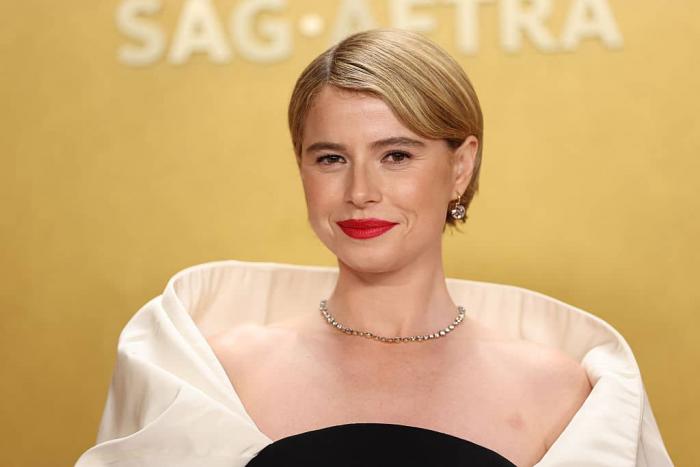
There are very few categories at this year’s Oscars where the winner is locked in place. Best Actress is one exception. For months, it seems as though Jessie Buckley has been set in stone as the winner for her stirring performance in Chloe Zhao’s Hamnet. In the historical drama based on a novel by Maggie O’Farrell, Buckley plays Agnes Shakespeare, the wife of playwright William and the mother of his children. She lives on the outskirts of country life, embracing nature to the point where some have derided her as a witch. Through her relationship with the natural world and her relationship with Will, she tries to navigate her future as a wife and parent in the face of judgment and eventually the ultimate pain.
It’s a startlingly good performance in a film that made me, and many other critics, sob hysterically. Buckley’s work in it has been celebrated and she has been a charming and gracious winner over the past several weeks as her trophy cabinet fills up with every major Best Actress precursor award. She is not the kind of actress, nor is this the kind of performance, that would usually have people eager to call her an awards season villain. This is a season without a team of adversaries or inexplicable nominees in the way of more deserving winners. So, what’s with the last-minute push to make Jessie Buckley the bad guy?
I think most of it is just a combination of boredom and online awards season fever. This happens every year, and in comparison to some discourses, Buckley is getting off lightly. Plenty of people also dislike Hamnet for solid reasons, even if I disagree with them, but the push to make it somehow equivalent to Crash and Buckley an Oscar-hungry shrew stealing Rose Byrne’s statuette from her hands is baffling. And as a Buckley fan who was there from the beginning, I shall not stand for it.
Buckley’s career is representative of what luck and talent can get you. At the tender age of 18, she broke through not with a film or stage role but as a contestant on a reality TV show. She was one of a group of women competing in I’d Do Anything, an American Idol-esque series produced by Andrew Lloyd Webber that was seeking to find an unknown woman to play Nancy in a West End revival of Oliver! Buckley made it all the way to the final but lost, even though she was Lloyd Webber’s favourite. In an interview with Vogue, she talked about how anxiety-inducing and surreal the experience of being on a show like I’d Do Anything was, wherein she was critiqued for not being ladylike enough in her movements by male choreographers and made to feel shame over her body. Said Buckley, “I really hope that a 15, 17, whatever-age woman never has to be brutalised quite like what happened on that show. But I didn’t recognise it fully at the time. I just felt it, which was difficult.”
After the show, Buckley went to RADA and managed to get some small parts on stage alongside some true megastars, like Jude Law and Kenneth Branagh. After a few turns in period dramas — a prerequisite for any actor working in Britain — Buckley made her film debut in the psychological drama Beast. Inspired by true events, the unnerving indie had Buckley play a troubled tour guide in Jersey whose romance with a dangerous man leads her down a rabbit hole of bitterness and revenge. Buckley is excellent in Beast, evolving from a timid black sheep of a respectable middle-class family to a figure of rage who soon revels in the violence that follows her. It’s the kind of debut performance that would have made headlines regardless of who played the role. But it was certainly unique to see the girl from the musical TV casting special do it. We typically expect these former contestants, even the ones who win it, to disappear once the hype dies down. Buckley just kept going.
And the roles got bigger. She does a truly impressive Glaswegian accent in the musical drama Wild Rose, which landed her first-ever BAFTA nomination. In Women Talking, she is the one who stubbornly fights for forgiveness for the men who abused their community, even though she knows it’s probably impossible. Back on stage, she took on the ultimate troubled diva of musical theatre, Sally Bowles, in a revival of Cabaret that won her an Olivier Award. And just to keep things interesting, she made an album with Bernard Butler of Suede that got them a nomination for the Mercury Prize. Add to that her first-ever Oscar nomination for The Lost Daughter and I’m not sure we have any other actor alive who pulled off Academy Award, Olivier, and Mercury nods in the same year. Buckley is a true triple threat.
I’m forever impressed by both Buckley’s range and her fearlessness. She tries every genre, goes big and small, seems as at home in historical pieces as she is with contemporary settings, and moves seamlessly from stage to screens big and small, and occasionally puts out an album when she feels like it. Many critics have deemed her work in Maggie Gyllenhaal’s The Bride! to be truly terrible, so over the top and knowingly artificial that it can only be deemed a failure. I disagree. Her doing too much is the point because women are expected to do too much! It’s a performance as theatrical as the world it inhabits, a frenetic multi-character, multi-accented blend of gangster’s moll, bawdy barmaid, and Harley Quinn that embodies the ways that women are forced to invent and reinvent themselves over and over. It’s broad and abrasive but also oddly relatable, albeit with more gun-toting and musical numbers than your typical day-to-day life. Buckley knew this was not the time to go under the top.
I’ll be happy when Buckley wins her Oscar on Sunday, and I hope that the post-awards season calm allows others to embrace her work in Hamnet with less industry know-how or perennially online cynicism hanging overhead. Hollywood has been desperate for another performer who can embody the classic movie-star type, and I think Buckley has a lot of that potential but with a hefty dose of modern realism and liberation. We finally have a singing, dancing, acting talent who does comedy, drama, horror, and historicals, and we shouldn’t take that for granted.


