
Old School. Biblically Independent.
By Kayleigh Donaldson | Celebrity | March 6, 2026
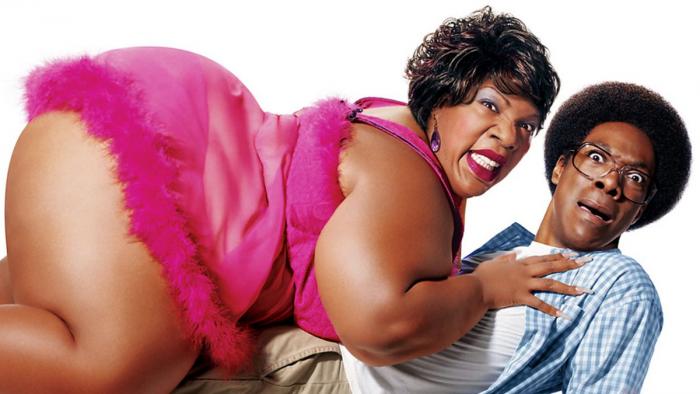
This week sees the release of The Bride!, Maggie Gyllenhaal’s reimagining of The Bride of Frankenstein that blends together classic Hollywood, musicals, heist flicks, and Hot Topic hauls. Reviews have been decidedly mixed, with some loving Gyllenhaal’s messy ambition while others think it’s just a mess. Leading the cast is Jessie Buckley, the current frontrunner to win the Best Actress Oscar for Hamnet. She’s won all the major precursors and feels like one of the only locks of the night in terms of the acting categories. This has, of course, made some people mad and eager to spin her as an awards season villain. Her reviews for The Bride! have also been mixed, with some calling her a charismatic leading lady while sceptics say it’s her worst-ever performance. It’s led to a surprising number of people eagerly surmising that this could be her Norbit.
For those of you not fluent in the language of terminally online film fans, Norbit is an Eddie Murphy movie where he plays two characters: A meek man who falls for a gorgeous woman with a heart of gold, and his fat and evil wife who is graceless, cruel, and all-round repulsive. Slathered under prosthetics and a fat-suit, Murphy plays into every stereotype of fat Black women you can imagine, plus some he may have invented. It’s a mess of a movie, one of the low points of his 2000s career decline. It’s also frequently cited as the reason that he lost the Best Supporting Actress Oscar for Dreamgirls. Murphy had been the season-long frontrunner for his performance as a one-time soul singer and lothario who becomes an easy listening sellout. Many theorized that it would be something of a career win, a pat on the back for over two decades in the business as a bona fide mega-star and one of the most important leading men of his generation.
But then the Oscar went to Alan Arkin for Little Miss Sunshine, shocking everyone. You can see Murphy hiding his disappointment in the clip of the announcement. Reports started surfacing claiming that voters were turned off by Norbit, which landed in theatres during the voting period. There’s this idea that a supposedly sure-fire Oscar victory can be stopped dead in its tracks by a poorly timed bad movie release. Voters can be devoted to a performance then suddenly decide it’s not worthy of their celebration because another performance wasn’t as good. It caused them to second-guess their choice, as though they were concerned that it would reflect poorly on them to implicitly endorse that flop. You can’t give Eddie Murphy his dues for a rare display of his dramatic and musical range because he also made a financially successful gross-out comedy that’s cut from the same cloth as his usual persona. If we reward him for Dreamgirls then we’d also be encouraging him to make more movies like Norbit, so the logic goes.
This created a new kind of Oscar lore: the last-minute flop that can cause just enough hesitation among voters for your competition to cross the finish line first. Indeed, the lore went further and began theorizing that any recent movie with less than favourable reviews could tip the balance. Yeah, sure, you have the performance of a lifetime in your nominated work, but we saw that one superhero movie where your accent was wonky and the green-screen was unreliable, so do you really deserve it?
I’ve never fully bought into this idea. Murphy’s loss was a shock, yes, but I don’t think the sole factor behind the Academy giving it to Alan Arkin was that they hated seeing Murphy in a fat-suit. The film industry is a fickle place dominated by people with poor taste and they probably had more money riding on a Norbit success than a Little Miss Sunshine one. There are hundreds of reasons not to vote for someone and just as many to tick their box. But it’s not as though the Oscars has ever been immune to good old-fashioned pettiness and favouritism. So, how much of an impact would something like Norbit have had on Murphy’s - or any actor’s - chances?
Eddie Murphy was one of the highest-paid men in Hollywood for a long time, and someone who helped to shape cinematic comedy. He was such a star that his stand-up specials were box office hits. This dude made ‘Party All the Time’ a success, despite having a singing voice thinner than two reeds. After years as the king of raunch, he reinvented himself as a family-friendly star and still made bank from it (and earned a shock BAFTA nomination for his voice work in Shrek), even if the reviews weren’t great. The musical Dreamgirls felt like a long overdue opportunity for Murphy to show his range. He’d been trying to make something more dramatic for years without success, so now it was time for the age-old trick of having a comedic actor go serious. It worked wonders, and critics were won over by his performance. It was, to put it bluntly, the anti-Norbit.
Murphy had made worse movies than Norbit and he would go on to do even worse ones after it, but this is the film that has come to represent his creative nadir. It’s crass, cruel, creatively uninteresting, and lazy in its stereotypes. The character of Rasputia, the malevolent fat woman played by Murphy, is depicted as such a ghastly amalgamation of misogynoir and fatphobia that you do wonder if Murphy just doesn’t like women. He s certainly committed in his performances, but all of the sweetness and savvy slapstick of The Nutty Professor is completely absent here. It is worth noting that not all critics hated Norbit. Richard Brody of The New Yorker praised it and put Murphy’s performance in his list of the best of the 21st century so far. It also received an Oscar nomination for its make-up. Yes, really.
Maybe Norbit wasn’t the killer, but I do wonder if the snobbery surrounding Murphy’s entire shtick was symbolised by that movie. Comedy has never done as well with the Academy as drama, which is why Murphy never got nominated for stuff like The Nutty Professor, even though he was given the Best Actor Award by the New York Film Critics Circle for that movie. His work was big, brash, and Black, and Murphy was happy to wield his power to get his own way and make a lot money doing so. Again, Norbit made a TON of money because, in 2007, Murphy was still a king. That was the version of Eddie the fans wanted, more so than the one in Dreamgirls.
The focus on whether or not Norbit killed Murphy’s Oscar chances overlooks what Alan Arkin may have done to secure Academy members’ votes instead. Alan Arkin was an industry stalwart who had been making films since the ’60s. He was a Broadway regular and frequent TV star who worked with everyone and had incredible range across styles and genres. With Little Miss Sunshine, he had a fun, scene-stealing gruff grandpa with a heart of gold role in an indie smash hit that had earned a ton of money. He’d never won an Oscar before, and the Academy loves to celebrate old guys who stick around. Frankly, I think the push to give it to the septuagenarian before he passed was a bigger motivation than sticking it to Eddie over a fatsuit.
I don’t think Oscar voters went on a mass anti-Norbit drive that year (and I don’t think even the worst reviews of The Bride! will hinder Buckley’s road to victory), but I do think many of them are fickle enough to be more focused on matters of legacy than merit. It’s one of the reasons the Academy has this reputation for being out of touch, even as it makes changes to improve its dusty image. They’re always calculating who is ‘worth’ the Oscar and using arbitrary and often deeply biased measures to decide that. It sucks that one of the most important leading men of his time and an icon of Black Hollywood had only been nominated once (justice for Dolemite is My Name), but don’t blame Norbit for that. Don’t let the Academy off the hook that easily.


