Old School. Biblically Independent.
By Kayleigh Donaldson | Books | August 31, 2026
This month, I also shared my thoughts on Life of M by Rachel Cusk and why her barely-veiled take on Natalie Portman isn't very good. It was a busy time for reading.
Divine Ruin by Margot Douaihy
Sister Holiday is ready to take her final vows and give her entire life over to Jesus. It's been a tough path to peace for the one-time punk, and being a tattooed lesbian in a habit at a Catholic high school in New Orleans isn't a walk in the park. Now, she's a part-time private investigator, and her latest case is hitting too close to home. A model student is dead, seemingly from an overdose of fentanyl. To uncover the seller, Holiday will have to return to her old ways and go undercover, lest more kids die.
I love this series. Margot Douaihy's tale of a highly unique detective feels like it should be cutesy or more in line with the cozy mysteries that have inspired many a Hallmark movie. Instead, she's gone for hard-bitten noir, making her nun PI a heir to Raymond Chandler over J.B. Fletcher. Holiday is a grab-bag of contradictions: a rebellious cynic who is devoted to God and her future vows; an anti-authoritarian lesbian who must adhere to the stifling confines of the Catholic Church; a meddling know-it-all with a habit of screwing things up. She could be insufferable, but Douaihy's deft pen has rendered her lived-in and magnetic, an irascible fighter who knows that breaking the rules and doing the right thing are not mutually exclusive. I'll read anything she chooses to write, but I selfishly hope we get many more of Sister Holiday's mysteries in the future.
Dungeon Crawler Carl/Carl's Doomsday Scenario by Matt Dinniman
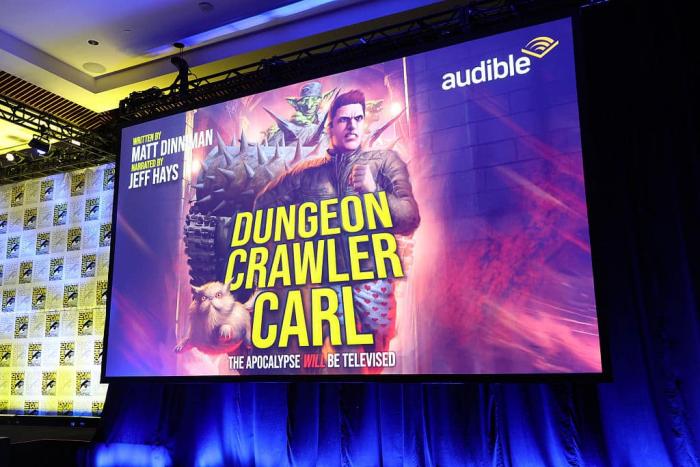
So hey, have you heard of this Dungeon Crawler Carl series? It seemed to come out of nowhere, right? Matt Dinniman went from self-publishing his RPG-inspired tale on Royal Road to becoming a multi-million bestseller and bona fide phenomenon, with a TV adaptation produced by Seth MacFarlane on the way. This time last year, it felt like these books were some well-guarded secret, and now, they are dominating my local bookshop and social media algorithms. So, as a plucky pop culture writer who needs to be somewhat part of the zeitgeist, I knew I had to jump on the bandwagon. Plus, a solid portion of Team Pajiba are huge fans of this series.
I read the first two books and... I liked it!
Carl is a perfectly normal coast guard veteran who's trying to move on from his messy break-up when Earth is destroyed and all but a few million humans are wiped from existence. Now, the planet has been turned into an 18-level dungeon crawl that is the setting for the hottest game show in the universe. Carl, accompanied by his ex's cat (who can now talk, because of course she can), must now compete for survival. Let the jackassery begin.
It's intriguing to me that Dungeon Crawler Carl has become as big as it has because this is some real nerd shit. This was written for people who know RPGs inside out and it does not hold the reader's hand with this barrage of nitpicky details. This genre, known as LitRPG (or Isekai if you're a manga nerd), is by design not for beginners. And yet this series is now beloved by the masses. I get it. Move past the word salad of levelling up and character classes and this is a propulsive story of fights, snark, and total lunacy. The llamas are high!
Carl's lack of discernible personality in the first two books is a problem (I've been told it gets better in later books) and you can tell that this was originally a serial that's been haphazardly structured into separate novels. The humour is juvenile but not without some well-earned laughs. There's a talking cat in a tiara and I can never hate that. And the stakes are real. For all of the snark, this is a story of overcoming fascism (and not trusting ICE agents.)
I've seen some sceptics claim the series is just wish fulfilment for guys, and I can't say I disagree with that. The genre heavily indulges in a certain kind of male power fantasy, and Carl is a blank canvas for readers to project themselves onto. But I also disagree with people who claim that this is like an RPG version of Ready Player One. That book is offensive in its smarm because the author acts as though knowing the most basic bitch pop culture references makes him special. Dinniman has clearly loaded these books with references I don't get but he's also focused on something grander than gazing at his own navel.
You'll either love these books or find them deeply irritating. I was certainly entertained enough that I'll probably check out the third book and beyond in the future. At the very least, I think this will make one hell of a TV show (Alan Ritchson for Carl?)
The Mushroom Tapes by Helen Garner, Chloe Hooper & Sarah Krasnostein
In 2023, an Australian woman named Erin Patterson murdered three of her in-laws and seriously injured a fourth by poisoning them with death cap mushrooms she had cooked into a beef Wellington. The ensuing trial, of which she was found guilty of all counts and sentenced to life in prison, became one of the most widely covered true crime cases in the nation's history. It inspired TV specials, books, podcasts, and way too many armchair investigations to count. Helen Garner, Chloe Hooper, and Sarah Krasnostein, three acclaimed and highly respected Australian writers, decided to get in on the fun with The Mushroom Tapes, a series of conversations centred on the trial, which they attended and discussed.
Garner, Hooper, and Krasnostein are all celebrated women in their own right. Garner is a legend of Australian letters. Hooper frequently writes about high-profile crimes, and Krasnostein wrote the excellent biography The Trauma Cleaner. They are not without insight in their analyses of the Patterson case. They know that the image of a female murderer is too enticing for some to ignore, and the current era of true crime fandom is one dominated largely by women like Patterson (who herself was in a Facebook group dedicated to a specific case.) All three women are savvy, sensitive, and aware of the minefield they're navigating with this trial. They frequently mention feeling as though they're part of a meat market, of a crowded field of content creators taking advantage of the case.
But acknowledgement doesn't balance out the fact that they are indeed doing just that, and that The Mushroom Tapes feels like a rush-job. It's just transcripts of their conversations with little extrapolation. Sometimes, we get a weird aside, like Garner noting something from her window, which could make the work feel more lived-in but only serves to highlight how padded out this already-short read is. One wonders if this could have benefitted from the trio having had more time to delve into the case, but then the book wouldn't have been flung onto shelves shortly after Patterson's conviction, thus undoing the entire point of the project. Perhaps this should have been a podcast.
V for Vendetta by Alan Moore
I was convinced I had already read V for Vendetta. Surely, I'd already bought it at some point in my youth when I was starting to get into comics and I'd already devoured Watchmen and From Hell? I'd seen the film so why wouldn't I have read this titan of the medium? Apparently, it had just slipped me by, and since we live in totally utopian and democratic times, why not finally read it to see what I was missing?
It's 1997. A totalitarian government rules over the shattered remains of England following the devastation of nuclear war and famine. A young woman named Evey Hammond solicits a man who turns out to be part of the fascist secret police. She is saved from brutality by V, a masked vigilante who then blows up the Houses of Parliament. And that's just the beginning of his plans to bring about total anarchy.
Alan Moore has always been an uncompromising writer, rejecting the Hollywoodization of his work and the dilution of his politics that accompanies it. He hated the film of V for Vendetta for what he saw as a timid attempt to tackle Bush-era neoconservatism through the lens of his far more explicit (and explicitly British) narrative. Certainly, a lot of the graphic novel has aged like fine wine, such the fascist leader's obsession with the government's computer system, which quickly becomes fetishistic. Moore has never had a problem with dense dialogue, filling the page more than the illustrations, although he's always a collaborator. His references are numerous and highly literary, with V being a veritable madman who is nonetheless eloquent and theatrical. He's a fancier terrorist than the thugs who rule the land, but a terrorist nonetheless.
Moore said he wanted the reader to make up their own mind, but he clearly has V-esque leanings (sadly, V does not worship a snake god.) This makes reading V for Vendetta a fascinating and often troubling experience. How often do you read stories that are this enthusiastically in favour of true anarchy by any means? It's no wonder the film chickened out on its most potent themes. Could you imagine the hoops that DC would have to jump through to adapt this in 2026? I'd like to see them try.


